
Best AI Engineering Courses in 2026
The right AI engineering course depends on whether you're starting from zero, adding LLM features to software you already ship, or trying to make a prototype hold up with real users.
In this guide, we've reviewed 10 of the best AI engineering courses in 2026, from full career paths and recognized certificates to free agent courses and focused training for evaluation and production. Each course is compared by cost, time commitment, format, tools taught, and best use case.
Table of Contents
- Top Picks by Goal
- Compare All 10 AI Engineering Courses
- How We Chose These Courses
- Best AI Engineering Career Paths for Going from Zero to Job-Ready
- Best AI Engineering Courses for LLM Foundations
- Best AI Engineering Courses for Building Agents
- Best AI Engineering Courses for Evaluation and Production
- When You Actually Need an AI Engineering Course
- What Should You Look for in an AI Engineering Course?
- When You Should Skip the Course
- Making Your AI Engineering Course Decision
- Frequently Asked Questions
Top Picks by Goal
Want the short version? Here is the best AI engineering course for each common goal:
- Best for career changers starting from zero: Dataquest AI Engineer in Python Path
- Best for Python developers adding LLM features: Dataquest AI Engineer in Python Path (skip the introductory Python courses)
- Best credentialed full program: IBM Generative AI Engineering Professional Certificate
- Best free agents course: Hugging Face AI Agents Course
- Best free production course: DataTalks.Club LLM Zoomcamp
- Best for evaluating an LLM product: AI Evals for Engineers & PMs (Maven)
For the full breakdown of all 10 courses across cost, format, tools taught, and what each one actually delivers, keep reading.
Compare All 10 AI Engineering Courses
The list of AI engineering courses below has been compared across cost, time, format, tools taught, and reader fit. Course specs were checked against public provider pages at the time of publication. Regional pricing may vary.
| Course | Track | Cost | Time | Format | Tools Taught | Best For |
|---|---|---|---|---|---|---|
| Dataquest AI Engineer in Python Path | Career Paths | $49/month; free enrollment available | 10 months at 5 hrs/week | Interactive browser | Python, LLM APIs, MCP, FastAPI, Docker, Hugging Face, PyTorch, ChromaDB, RAG, evaluation | Beginners who learn by doing, not watching |
| IBM Generative AI Engineering Professional Certificate | Career Paths | Coursera subscription; regional pricing may vary | 6 months at 6 hrs/week | Video + labs | Python, Flask, Gradio, PyTorch, Hugging Face, LangChain, RAG, LoRA | Career changers who want a recognized credential |
| Dataquest Generative AI Fundamentals in Python | LLM Foundations | $49/month; free enrollment available | 2 months at 5 hrs/week | Interactive browser | Python, OpenAI API, prompt engineering, Streamlit | Beginners who want the LLM layer first |
| Hugging Face LLM Course | LLM Foundations | Free | 12 chapters at ~6–8 hrs each | Text + notebooks | Transformers, Datasets, Tokenizers, Accelerate | Developers working with open-weight models |
| DataCamp Associate AI Engineer for Developers | LLM Foundations | Premium subscription, $336/year (or $35/month) | 29 hrs across 10 courses | Video + interactive exercises | OpenAI API, Hugging Face, LangChain, Pinecone, MCP | Developers who already know Python |
| DeepLearning.AI Agentic AI | Agents | Videos free; labs and certificate with Pro at $300/year (or $30/month) | About 10 hrs across 5 modules | Video + labs | Python, reflection, tool use, planning, multi-agent, MCP, evals | Developers who want durable agent design patterns |
| Hugging Face AI Agents Course | Agents | Free, with certificate | About 5 weeks at 3–4 hrs/week | Text + notebooks | smolagents, LlamaIndex, LangGraph | Developers comparing agent frameworks |
| Scrimba AI Engineer Path | Agents | Scrimba Pro, $24.50/month billed annually or $49 monthly | 11.4 hrs | Interactive screencasts | JavaScript, OpenAI API, embeddings, agents, Vercel AI SDK, MCP | Web developers who ship JavaScript |
| DataTalks.Club LLM Zoomcamp | Evaluation and Production | Free | 10 weeks at 5–15 hrs/week | Video + cohort | RAG, vector search, LLM-as-judge, monitoring | Builders who want the whole system around the LLM |
| AI Evals for Engineers & PMs (Maven) | Evaluation and Production | $4,200 per cohort | 7–8 weeks (33 sessions, recorded) | Live cohort | Error analysis, LLM-as-judge, CI/CD evals, red-teaming | Engineers whose LLM features need measurable quality |
How We Chose These Courses
The word "best" only helps if the selection criteria are clear. We prioritized courses that matched five signals:
- A current, public syllabus. AI tooling changes every few months. We favored courses with visible module lists that mention 2025–2026 essentials like tool calling, MCP, agent frameworks, or evaluation.
- Alignment with real AI engineering work. A strong course teaches at least one workflow you'd do on the job: calling an LLM API, building a RAG pipeline, wiring up an agent, or serving a model behind an API.
- Hands-on practice. The best AI engineering training doesn't stop at videos. It gives you code to write, projects to finish, or a system to deploy.
- Coverage of the "after the demo" work. Getting a chatbot to answer once is easy. We gave extra weight to courses that teach evaluation, monitoring, cost, and failure handling.
- Honest trade-offs. We considered credential value, framework lock-in, setup friction, prerequisites, and whether a course is broad enough to support a real career move.
Our list is organized around those signals. Career Paths take you from zero to job-ready. LLM Foundations cover the model and API layer. Agents go deep on tool use and orchestration. Evaluation and Production focus on making AI systems reliable once real users arrive.
Best AI Engineering Career Paths for Going from Zero to Job-Ready
These are the best AI engineering courses for learners who want one structured path instead of a pile of disconnected tutorials. Each one covers Python, LLM application development, and at least some deployment or retrieval work. Choose from this section if you're switching careers or starting without a clear sense of what to learn first.
1. Dataquest AI Engineer in Python Path
- Cost: $49/month; free plan available (limited)
- Time to Complete: 10 months at 5 hours per week.
- Level: Beginner to advanced.
- Prerequisites: None.
- Current Structure: 33 courses and 21 projects across 11 parts.
- What You'll Learn:
- Python fundamentals, plus the command line, Git, and virtual environments
- LLM APIs, prompt engineering, structured outputs, function calling, and MCP
- Building AI APIs with FastAPI and deploying them with Docker and Docker Compose
- Open models with Hugging Face, including LoRA fine-tuning and self-hosting trade-offs
- Machine learning with scikit-learn and deep learning with PyTorch
- Embeddings, vector databases with ChromaDB, and hybrid search
- RAG systems, LLM-as-judge evaluation, prompt injection defense, and production monitoring
- Industry Recognition: Dataquest's public path page lists more than 161,000 learners enrolled and a 4.8/5 rating.
- Best For: Career changers who want to write code from the first lesson and finish with a portfolio of working AI applications.
Why it works: Most AI engineering courses either assume you already know Python or stop once the chatbot works. This path does neither. You start with core Python, then move into Tool Use with LLMs in Python, Building AI Apps with FastAPI, and Vector Databases and Search, all with code running in your browser and instant feedback.
The last section is where it pulls ahead of most options on this list. Evaluating LLM Outputs and Advanced RAG cover LLM-as-judge scoring, drift and cost monitoring, and defending a pipeline against prompt injection. That's the production work that separates an AI engineer from someone who has called an API.
Worth knowing: Ten months at 5 hours a week is a real commitment, and it's the right size for a career transition. If you already write Python, skip the introductory Python courses and start with the LLM courses. The path also includes probability, statistics, and classic machine learning, which some AI engineering roles barely use. If your goal is the LLM application layer only, the shorter Generative AI Fundamentals in Python path below gets you there faster.
2. IBM Generative AI Engineering Professional Certificate
- Cost: Coursera subscription (Professional Certificates typically run about $49/month; Coursera Plus is $59/month or $399/year). Regional pricing may vary.
- Time to Complete: 6 months at 6 hours per week.
- Current Structure: 16-course series.
- Level: Beginner.
- Prerequisites: Basic computer literacy.
- What You'll Learn:
- Python for data science and AI application development with Flask and Gradio
- Generative AI fundamentals and prompt engineering
- Machine learning with scikit-learn and deep learning with Keras
- Transformer architecture, tokenization, and language modeling in PyTorch
- Fine-tuning with LoRA and QLoRA, plus RLHF, DPO, and PPO
- AI agents and RAG with LangChain, ending in a guided capstone project
- Industry Recognition: IBM brand recognition, more than 180,000 enrollments at verification, a 4.7/5 average across 101,000+ course reviews, and an ACE recommendation for up to 17 college credits.
- Best For: Career changers who want a recognized credential and are interested in how models work, not only how to call them.
Why it works: IBM goes deeper on the model side than any other career path here. You build a language model with a neural network, implement attention and positional encoding in PyTorch, and fine-tune transformers with parameter-efficient methods. If you want to understand what happens inside the model you're calling, this program teaches it.
The credential also carries weight. IBM is a name hiring managers recognize, and the ACE credit recommendation matters if you might apply that work toward a degree later.
Worth knowing: RAG first appears in course 6, but AI agents and the LangChain-based capstone only arrive in the last two of 16 courses, and deployment stays at Flask and Gradio web apps. Several early courses cover general data analysis and classic ML, which slows learners who mainly want to build LLM applications. Some labs also use IBM watsonx tooling.
Parts of the curriculum also show their 2024–2025 roots. The agents course covers tool calling and LangChain agents but not MCP, LangGraph, or agent evaluation, which IBM now teaches in its separate RAG and Agentic AI Professional Certificate. Pair this certificate with an agents course like Hugging Face's or Dataquest's Tool Use with LLMs in Python to round out the application side.
Best AI Engineering Courses for LLM Foundations
These three courses cover the layer every other AI engineering skill sits on: calling models, prompting them reliably, and understanding what open-weight models can do. Pick from this section if you want a shorter, focused start before committing to a full path, or if you already know Python and need to fill a specific gap in how LLMs work.
3. Dataquest Generative AI Fundamentals in Python
- Cost: Free lessons available to try the platform. Full path access requires a paid plan: ~$49/month.
- Time to Complete: 2 months at 5 hours per week.
- Current Structure: 8 courses and 4 projects.
- Level: Beginner.
- Prerequisites: None.
- What You'll Learn:
- How AI chatbots and LLMs work, with hands-on prompting practice
- Python fundamentals, functions, and object-oriented programming
- Command line, Git, and virtual environments
- APIs and web scraping for AI applications
- OpenAI's Chat Completions API, conversation history, and token management
- Building interactive LLM apps with Streamlit
- Industry Recognition: More than 25,000 learners enrolled at verification. Rated 4.8/5.
- Best For: Beginners who want to build a working LLM app in two months before deciding whether to go further.
Why it works: This path is the first third of AI engineering, done properly. You learn enough Python to be dangerous, then use it to call an LLM API, manage multi-turn conversations, and ship a chatbot with a Streamlit interface. The four projects give you something concrete to show, and five of its eight courses also appear in the full AI Engineer in Python Path, so most of your progress carries over if you keep going.
Worth knowing: This path stops at the application layer. It doesn't cover RAG, vector databases, agents, deployment with Docker, or evaluation. Treat it as a low-risk test of whether AI engineering suits you, not as a job-ready credential on its own. When you're ready for retrieval, Dataquest's Understanding Embeddings and Introduction to RAG courses are the natural next steps.
4. Hugging Face LLM Course
- Cost: Free.
- Time to Complete: 12 chapters, each designed for about a week at 6–8 hours.
- Level: Intermediate.
- Prerequisites: Solid Python. Hugging Face recommends an introductory deep learning course first.
- What You'll Learn:
- The Transformers library and how transformer models work in practice
- The Datasets and Tokenizers libraries
- Classic NLP tasks with pretrained models
- Fine-tuning large language models
- Dataset curation and training reasoning models
- Industry Recognition: Written and maintained by the Hugging Face team that builds the libraries. There's no whole-course certificate, though some chapters, such as Chapter 1, offer a free certification quiz.
- Best For: Developers who need to run, adapt, or fine-tune open-weight models instead of only calling a hosted API.
Why it works: This is the reference course for the open-source model stack, written by the people who build it. When something changes in transformers, the course tends to reflect it. If your team wants to self-host models for cost or privacy reasons, this is where you learn how.
Worth knowing: The early chapters cover classic NLP tasks you can skim if you only care about LLMs. The documentation-style format also has no deadlines or check-ins, so it rewards self-directed learners. For a guided, browser-based introduction to the same ideas, Dataquest's Hugging Face and Open Models course covers loading models, LoRA fine-tuning, and benchmarking self-hosted models against closed APIs in about 6 hours.
5. DataCamp Associate AI Engineer for Developers
- Cost: Premium subscription, $336/year at list price ($28/month billed annually), or $35 month to month. DataCamp often runs seasonal discounts.
- Time to Complete: 29 hours.
- Current Structure: 10 courses.
- Level: Beginner in AI; comfortable Python required.
- Prerequisites: Working Python.
- What You'll Learn:
- The OpenAI API and prompt engineering
- Embeddings and the Pinecone vector database
- Hugging Face models and datasets
- LangChain for LLM applications
- Model Context Protocol (MCP) and LLMOps concepts
- Industry Recognition: Prepares you for DataCamp's AI Engineer for Developers Associate certification, which includes a practical exam.
- Best For: Software developers who already know Python and want to add LLM features quickly.
Why it works: DataCamp is strong for short, interactive practice. At 29 hours, this is the fastest structured route on the list from "I know Python" to "I've built a chatbot, semantic search, and a LangChain app." The practical certification exam is also a better signal than a completion badge, because it tests whether you can build something.
Worth knowing: This track is not a from-zero path. It assumes Python, and it doesn't teach deployment with FastAPI or Docker, or evaluation beyond LLMOps concepts. It also leans on managed services (OpenAI, Pinecone), so you'll need to adapt patterns if your team uses other providers. If you're starting without Python, the Dataquest AI Engineer in Python Path above covers that foundation first.
Best AI Engineering Courses for Building Agents
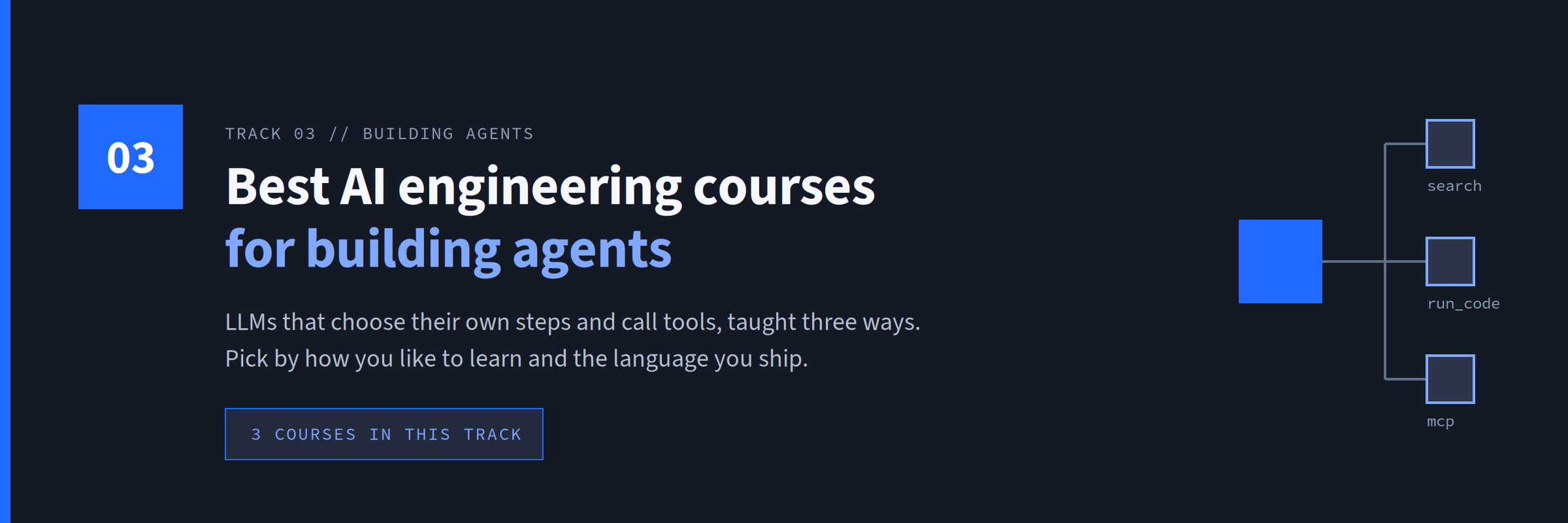
An AI agent is an LLM that decides which steps to take and which tools to call, rather than answering once. These three courses teach agents from different angles: design patterns in plain Python, several frameworks side by side, and agents in JavaScript. Pick based on how you like to learn and the language your team ships.
6. DeepLearning.AI Agentic AI
- Cost: Videos free. Labs and the certificate require DeepLearning.AI Pro at $25/month billed annually or $30/month billed monthly.
- Time to Complete: About 10 hours across 5 modules (31 video lessons and 8 graded assignments), self-paced. Last updated August 2026.
- Level: Intermediate.
- Prerequisites: Intermediate Python and a basic understanding of LLMs and APIs.
- What You'll Learn:
- The four core agentic design patterns: reflection, tool use, planning, and multi-agent collaboration
- Tool use and function calling, including code execution and MCP
- Evaluating and debugging agentic workflows
- Multi-agent communication patterns, from linear pipelines to manager–worker setups
- Industry Recognition: Taught by Andrew Ng, founder of DeepLearning.AI and co-founder of Coursera.
- Best For: Developers who want agent patterns that will outlast whichever framework is popular this year.
Why it works: Frameworks change faster than the ideas underneath them. This course builds each pattern from first principles in Python before introducing frameworks, so you understand what LangGraph or CrewAI is doing for you before you reach for one. It also gives evaluation its own module, which most agent courses skip.
Worth knowing: Because frameworks get only light coverage, you won't learn any one library's production features, such as LangGraph's state handling. The free tier is videos only, so you'll need Pro for the hands-on labs. If you want to practice tool calling in an interactive environment, Dataquest's Tool Use with LLMs in Python covers structured outputs, agentic loops, and MCP servers in about 8 hours.
7. Hugging Face AI Agents Course
- Cost: Free, with a free certificate.
- Time to Complete: 4 core units plus 3 bonus units, at a recommended 3–4 hours per week per unit.
- Level: Intermediate.
- Prerequisites: Basic Python and basic knowledge of LLMs.
- What You'll Learn:
- Agent fundamentals: tools, thoughts, actions, observations, and chat templates
- Building agents with smolagents, LlamaIndex, and LangGraph
- Agentic RAG as a hands-on use case
- A final project benchmarked against GAIA
- Bonus units on fine-tuning for function calling and agent observability and evaluation
- Industry Recognition: Built and maintained by Hugging Face engineers. A free fundamentals certificate follows Unit 1, and the full certificate requires a use-case assignment and the final challenge.
- Best For: Developers who want to see the same agent ideas implemented across several frameworks.
Why it works: Seeing one agent built three ways is the fastest route to knowing which parts are real concepts and which are a single library's conventions. The certificate is earned by shipping a working agent against a public benchmark, which carries more signal than a quiz. And it's free.
Worth knowing: The examples lean on open models and Hugging Face tooling, so if your team builds on OpenAI or Anthropic APIs, you'll translate some patterns. It's also self-directed, with a community Discord rather than instructor feedback. Budget real time: this isn't a weekend course.
8. Scrimba AI Engineer Path
- Cost: Scrimba Pro, $24.50/month billed annually ($294/year) or $49 billed monthly.
- Time to Complete: 11.4 hours of content.
- Level: Intermediate to advanced web developers.
- Prerequisites: Comfortable JavaScript. Scrimba points beginners to its free Learn JavaScript course first.
- What You'll Learn:
- The OpenAI API and open-source models with Hugging Face
- Embeddings, vector databases, and RAG
- AI agents and context engineering
- The Vercel AI SDK and Model Context Protocol (MCP)
- Multimodality and deployment
- Industry Recognition: Scrimba's interactive screencast format; the same material is also available as a Coursera specialization with a certificate.
- Best For: Web developers who ship JavaScript or TypeScript and want to learn AI engineering in the language they already use.
Why it works: Almost every AI engineering course on this list, ours included, assumes Python. If you build in Node or front-end codebases, learning the patterns in your own language first is faster. Scrimba's screencasts let you pause the instructor and edit their code in the browser, which keeps it hands-on.
Worth knowing: There's nothing here on model internals, fine-tuning, or classic machine learning, and no career services. You'll likely want Python eventually for open-model tooling and most evaluation libraries. Dataquest's Introduction to Python Programming is a quick bridge when you get there.
Best AI Engineering Courses for Evaluation and Production
An LLM feature rarely fails with an error. It fails quietly, with confident answers that are slightly wrong, costs that creep up, or quality that drops after a model update. These two courses focus on the work that catches those problems. They're best for learners who can already build a basic RAG app or agent and need to make it reliable.
9. DataTalks.Club LLM Zoomcamp
- Cost: Free.
- Time to Complete: About 10 weeks at 5–15 hours per week. The 2026 live cohort ran from June through late summer; materials stay available for self-paced study.
- Level: Intermediate.
- Prerequisites: Python and comfort with the command line. The course uses hosted LLMs such as OpenAI and Groq, so no GPU is needed.
- What You'll Learn:
- Building a RAG system with hosted LLMs over your own knowledge base
- Vector search and retrieval
- Offline and online evaluation, including LLM-as-judge scoring
- Monitoring a live LLM application with user feedback and dashboards
- A final, peer-reviewed project
- Industry Recognition: Run by DataTalks.Club, whose free Zoomcamps have drawn more than 150,000 registrations since 2021. Certificates go to live-cohort participants who complete graded homework and the project.
- Best For: Builders who want to learn the complete system around the LLM, not just the prompt.
Why it works: The course treats the LLM as a black box and spends its time on everything around it: retrieval, evaluation, and monitoring. That matches what most AI engineers actually do. The final project is a working assistant you designed, evaluated, and monitored, which makes for a strong portfolio piece.
Worth knowing: The cohort runs once a year, so outside that window you learn alone, with no certificate or peer review. The pace also assumes you're comfortable setting up your own environment. If you'd rather practice evaluation with in-browser feedback, Dataquest's Evaluating LLM Outputs course covers retrieval and answer metrics, LLM-as-judge calibration, and drift monitoring in about 6 hours.
10. AI Evals for Engineers & PMs (Maven)
- Cost: $4,200 per cohort, with 20%+ off when two or more teammates enroll together.
- Time to Complete: 7–8 weeks, live (33 sessions across 11 lessons), with recordings and lifetime access to future cohorts. The next cohort runs January 30 to March 27, 2027.
- Level: Intermediate to advanced.
- Prerequisites: Experience building or managing an LLM product.
- What You'll Learn:
- Error analysis: reading traces and grouping an AI system's failure modes
- Designing LLM-as-judge and code-based evaluators
- Calibrating evaluators against expert judgment
- Catching regressions in CI/CD and red-teaming for prompt injection and unsafe tool calls
- Industry Recognition: Taught by Hamel Husain, an ML engineer with 25+ years of experience, and Shreya Shankar, an ML systems researcher with a PhD from UC Berkeley. Rated 4.7/5 from more than 1,000 reviews on Maven, with a certificate of completion.
- Best For: Engineers and technical PMs who ship LLM features and have no systematic way to tell whether a change made things better.
Why it works: Evaluation is the skill most teams skip and most courses rush. This course makes it the whole curriculum. You instrument a real agent, find where it breaks, and build evals that catch those failures before users do. Nothing else on this list goes this deep on the topic.
Worth knowing: The price is the obvious limitation. At this level, it's usually a training budget decision rather than a personal one, and it only makes sense if you're already shipping an LLM product. It's also not a beginner course. If you're earlier in your journey, Dataquest's Evaluating LLM Outputs and Advanced RAG courses cover evaluation and production monitoring as part of the AI Engineer in Python Path.
When You Actually Need an AI Engineering Course
You need a structured course when you're new to programming, switching careers, or facing a skill gap that spans several layers of the AI stack at once.
The signs you'll benefit from a course, not just docs, YouTube tutorials, and provider cookbooks:
- You're starting without Python. AI engineering is built on Python. Without it, tutorials on RAG or agents won't stick, because every example assumes you can read and debug the code.
- You're switching from a non-technical role. A structured path gives you the order to learn things in, and a certificate or portfolio shows employers your move is deliberate.
- You need several layers at once. APIs, retrieval, agents, deployment, and evaluation are a lot to sequence alone. A course stops you from learning LangGraph before you understand a basic API call.
- You want accountability and feedback. Courses with projects, deadlines, or graded assignments are more likely to get finished than a free playlist you start on a Sunday.
- Your prototype works, but you don't know if it's good. If you've built something and can't measure its quality, an evaluation-focused course will save you weeks of guessing.
What Should You Look for in an AI Engineering Course?
AI engineering is harder to teach than most technical fields because the tools change every few months and the hardest problems only appear after launch. A good AI engineer calls models through APIs, grounds them in real data, connects them to tools, and, most importantly, can tell when the output is wrong. Most courses cover the first two and leave you to discover the rest on the job.
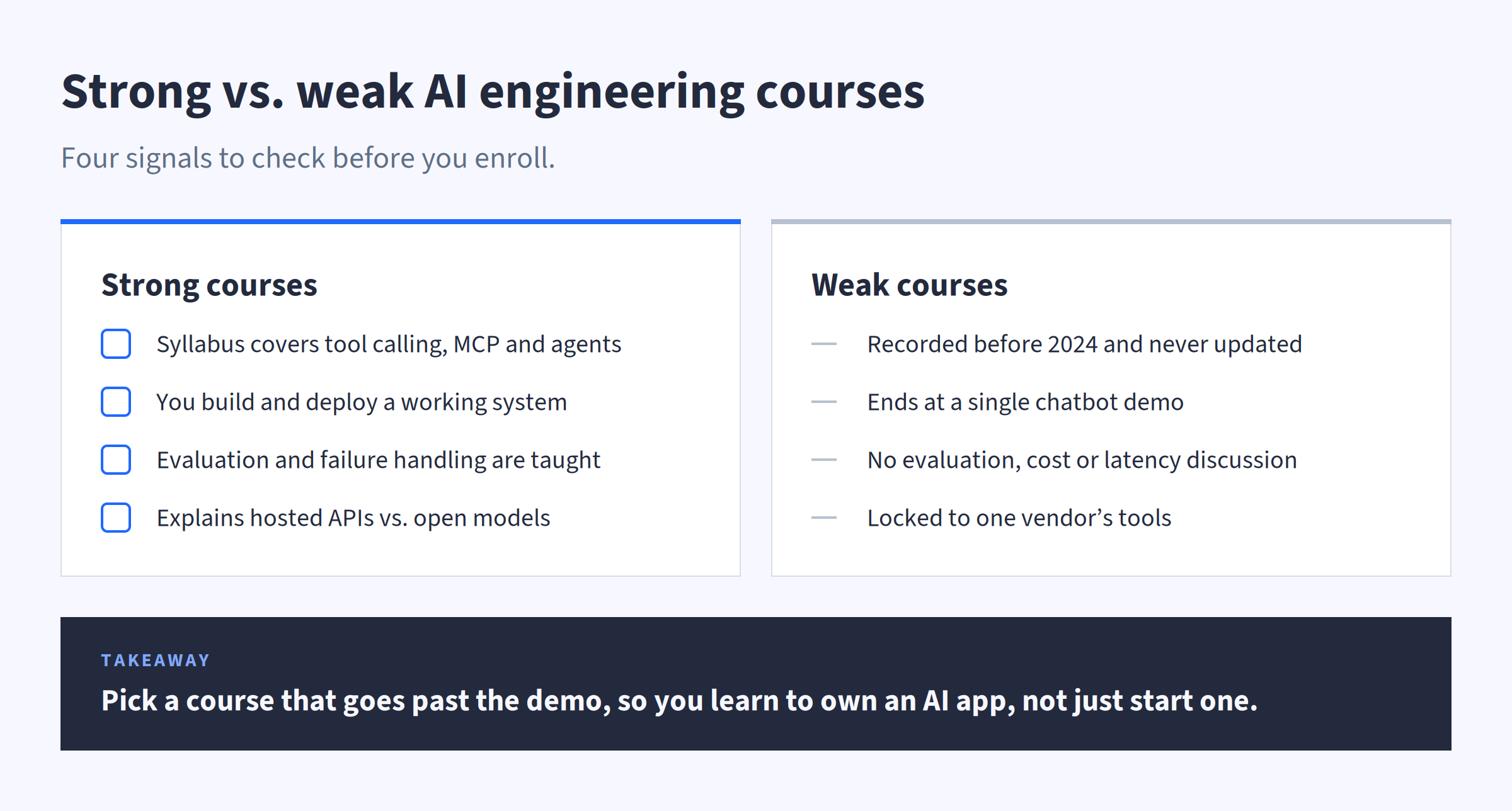
Four signals tell strong AI engineering courses from weak ones:
- A recent update date. Check when the course was last refreshed. A syllabus with no mention of tool calling, MCP, or agents may predate them. That doesn't rule it out, since the fundamentals still apply, but plan to pair it with provider docs or a newer course for current tooling.
- You build a system, not a demo. Look for projects that retrieve from real documents, call tools, and run behind an API. A single chatbot notebook teaches syntax, not engineering.
- Evaluation and failure handling are taught. A good course shows you how to measure output quality, catch hallucinations, track cost and latency, and defend against prompt injection. This is the part most courses skip.
- Provider and framework trade-offs are explained. Strong courses explain when to use a hosted API versus an open model, and when a framework helps versus when plain code is clearer. Be careful with courses that teach one vendor's tools as if they were the only option.
When You Should Skip the Course
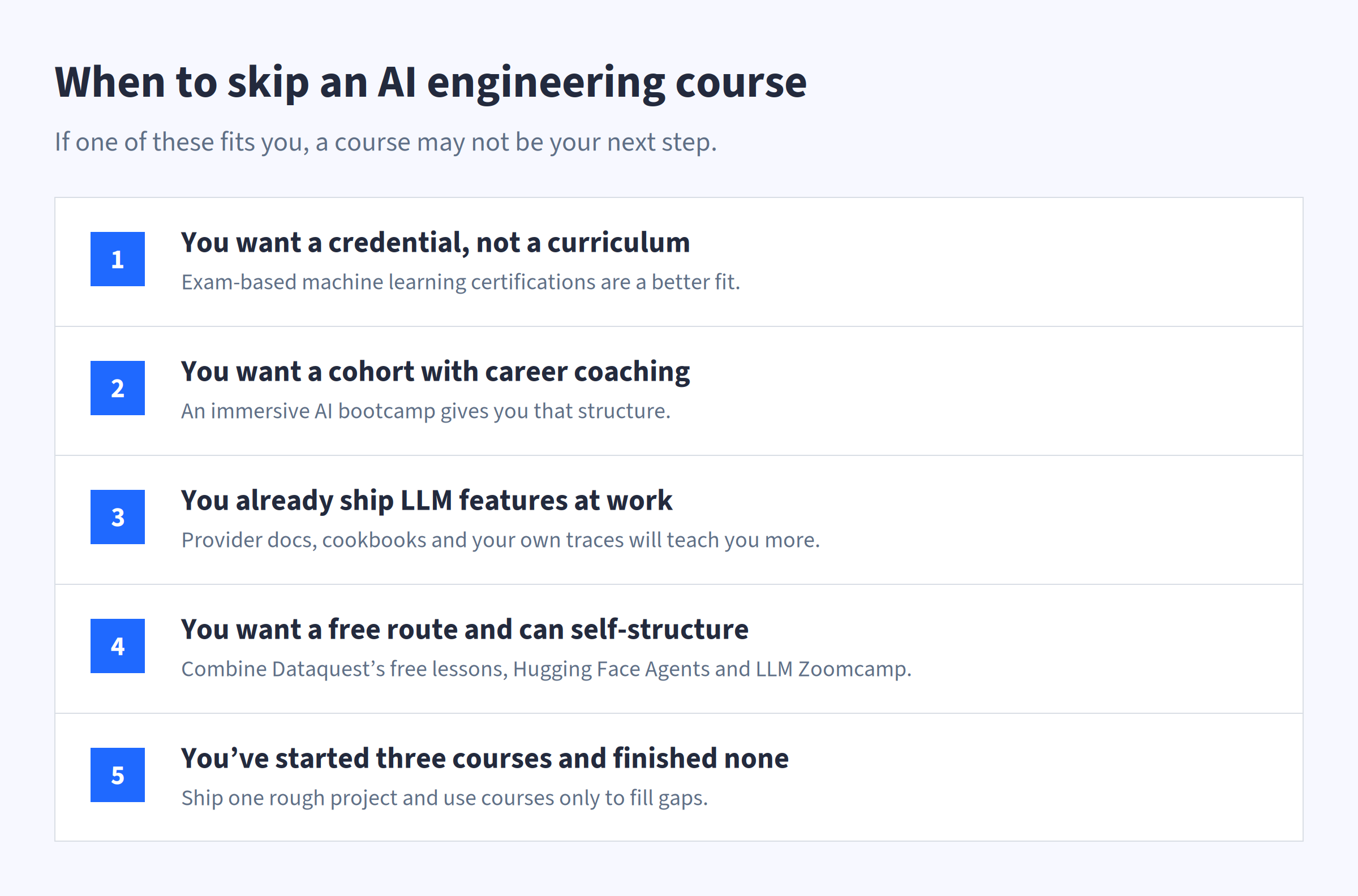
You can probably skip a course-based path if you fit one of these five scenarios:
- You want a credential, not a curriculum. See our Best Machine Learning Certifications guide for exam-based options.
- You want an immersive, cohort-based program with career coaching. See our Best AI Bootcamps guide.
- You already ship LLM features at work. Provider docs (OpenAI, Anthropic, Google), the OpenAI Cookbook, and your own production traces will teach you more than another generalist course.
- You want a free route and can build your own structure. Combine the free intro lessons of the Dataquest AI Engineer in Python Path, the Hugging Face AI Agents Course, and the LLM Zoomcamp.
- You've started three courses and finished none. A fourth won't fix it. Pick one project from our Best AI Projects to Build guide, ship a rough version, and use courses only to fill the gaps you hit.
Making Your AI Engineering Course Decision
The best AI engineering course is the one that matches where you're starting from and the kind of AI work you want to do. Pick based on your current skills and your target role, not on whichever course has the biggest name.
If you're starting from zero, choose a full path that teaches Python before it teaches LLMs. The Dataquest AI Engineer in Python Path is a strong hands-on choice that runs all the way to RAG evaluation and production monitoring, while the IBM Generative AI Engineering Professional Certificate is the most recognized credentialed option.
If you already write code, skip the foundations and go straight to the layer you're missing. Developers usually need retrieval, agents, and evaluation. Data scientists usually need APIs, software practice, and deployment. Everyone eventually needs evaluation.
Want a path-by-path recommendation?
- Complete beginner who wants to learn by doing: Dataquest AI Engineer in Python Path.
- Career changer who wants a recognized credential: IBM Generative AI Engineering Professional Certificate.
- Python developer who wants to move fast: DataCamp Associate AI Engineer for Developers.
- Beginner testing the waters before committing: Dataquest Generative AI Fundamentals in Python.
- Developer working with open-weight models: Hugging Face LLM Course.
- Developer who wants durable agent patterns: DeepLearning.AI Agentic AI.
- Developer comparing agent frameworks, for free: Hugging Face AI Agents Course.
- JavaScript or TypeScript developer: Scrimba AI Engineer Path.
- Builder who wants the full RAG, eval, and monitoring loop for free: DataTalks.Club LLM Zoomcamp.
- Engineer shipping an LLM product with a training budget: AI Evals for Engineers & PMs.
- Still deciding between using AI and building with it: Start with our Best AI Courses guide. If you only need the model layer, our Best LLM Courses and Best Generative AI Courses guides go deeper.
Pick one. Block study time on your calendar. Finish it before enrolling in another. Then build something real, measure how well it works, and fix what breaks. You'll learn AI engineering faster by owning one working system than by collecting more certificates.
Frequently Asked Questions
Are AI engineering courses worth it?
For career changers and developers new to LLMs, yes. A structured course gives you the order to learn things in, which matters when the field has dozens of tools and frameworks competing for your attention. Courses with real projects also leave you with portfolio work you can show.
For engineers already shipping LLM features, general courses are less useful. At that stage, you'll usually learn faster from provider docs, your own production traces, and a focused course on the one skill you're missing, which is often evaluation.
What's the difference between an AI engineer and a machine learning engineer?
An AI engineer builds applications on top of existing models: calling LLM APIs, building RAG systems and agents, and evaluating and monitoring output. A machine learning engineer trains, tunes, and deploys models, usually with PyTorch or scikit-learn.
The roles overlap in deployment and operations, and job titles blur in practice. Read the job description, not just the title. If it asks for LLM APIs, RAG, and vector databases, it's closer to AI engineering. If it asks for model training and feature pipelines, it's closer to ML engineering. For the training side, see our Best Machine Learning Courses guide.
How long does it take to become an AI engineer?
From zero, a realistic timeline is 9 to 12 months at 5 to 10 hours per week, including portfolio work. The Dataquest AI Engineer in Python Path is designed for 10 months at 5 hours a week. If you already know Python, 2 to 4 months of focused study can cover the LLM-specific skills.
Job-ready means more than finishing a course. Aim for 2 to 3 projects you can explain clearly: a RAG app over real documents with measured retrieval quality, an agent that calls tools, and one service deployed behind an API. Our AI engineer roadmap breaks down what to learn in each phase.
Do I need machine learning or math to become an AI engineer?
Not to get started. Most AI engineering work builds on models someone else trained, so Python, APIs, and software practice matter more early on. Machine learning and math become more useful later, when you fine-tune open models, debug embeddings, or need to judge evaluation metrics properly.
Should I learn LangChain or another framework first?
Learn the raw API first. Call a model directly, manage a conversation, and return structured output in plain Python. Then add a framework when you hit a problem it solves well. You'll understand what the framework is doing for you, and you'll be able to switch frameworks when your team does.
Can I learn AI engineering for free?
Yes, but you'll need more structure and discipline. A strong free route combines the Hugging Face AI Agents Course, the Hugging Face LLM Course, the free videos from DeepLearning.AI Agentic AI, and the LLM Zoomcamp. Dataquest's AI Chatbots course is a no-code starting point if you want to try the format first.
What paid courses add is structure: a sequenced curriculum, feedback, projects, and sometimes a recognized certificate. Free resources can teach the skills, but you have to build the roadmap yourself.
Do AI engineering certificates help you get hired?
Some help, most don't on their own. A certificate from a recognized provider can help you get past a résumé screen, especially for entry-level roles. What carries more weight is a portfolio: a few deployed projects with a README that explains your design choices and how you measured quality.
Will what I learn now be outdated next year?
The specific tools will change. The underlying skills won't: calling models through APIs, designing retrieval, structuring tool use, evaluating output, and monitoring cost and quality. Pick courses that teach principles alongside tools, so you can adapt when the next framework arrives.
