
How to Write a Business Analyst Resume (With an Entry-Level Example)
Maybe you've spent years figuring out what people need, or fixing a process that kept breaking. Or maybe you're a few months into learning the tools and haven't had an analyst job yet. Either way, you're trying to write a business analyst resume that proves you can do the job before you've held the title.
This guide shows you how. You'll learn how to read a job posting, write resume lines that prove your skills, and show work a hiring manager can open. It ends with a full example resume you can use as a model.
Table of Contents
- What Hiring Teams Look For on a Business Analyst Resume in 2026
- Which Business Analyst Job Are You Applying For?
- How to Write Business Analyst Resume Bullets
- Which Skills to List, and How to Group Them
- How to Show Business Analyst Work When You Have No BA Title
- How to Structure a Business Analyst Resume
- Which Business Analyst Certifications Matter
- A Complete Entry-Level Business Analyst Resume Example
- Common Business Analyst Resume Mistakes
- Where to Go From Here
- Frequently Asked Questions
What Hiring Teams Look For on a Business Analyst Resume in 2026
Software called an applicant tracking system (ATS) usually scans your resume first. Recruiters then search it for words from the job posting. After that, a hiring manager reads it to see if you fit the role and can get results.
Strong resume lines show a hiring manager some mix of four things:
- The problem
- The people you worked with
- The artifact you produced
- The decision, recommendation, or result it led to
A line with none of these reads like a job description.
| What the keyword filter checks | What the hiring manager checks |
|---|---|
| Role terms from the posting | Whether your experience fits this role |
| Named tools (Excel, SQL, Power BI) | Whether your entries show results |
| Method terms (requirements, process mapping) | Whether there's an artifact they can open |
| Section headings it can read | Whether you name who you worked with |
| Dates, titles, and education | Whether it ends on a decision, recommendation, or result |
Hiring teams are also getting far more applications, many of them written with AI. A Robert Half survey from March 2026 found that:
- 67% of US HR leaders say reviewing AI-generated applications has slowed hiring
- 65% of US hiring managers say the surge has made candidate skills harder to verify
So being specific is one of the easiest ways to stand out. Name the artifact and what it led to, and a hiring manager has something to check. The rest of this guide shows you how.
If you're still new to the field, start with our guide to getting into business analysis. It shows the route in before you write your resume.
Which Business Analyst Job Are You Applying For?
A job called "business analyst" might really be a BI analyst, systems analyst, or product owner job. The International Institute of Business Analysis (IIBA) counts all of these as business analysis. So the title won't tell you which one it is.
Most BA postings lean toward one of four focus areas. The table shows how to spot each one, which skills to lead with, and what your resume needs to prove.
| BA focus | Signals in the posting | Skills to lead with | Proof the resume needs |
|---|---|---|---|
| Process-focused (Business Analyst, Business Process Analyst) | Elicitation, business requirements document (BRD), user stories, process mapping, requirements workshops | Documentation, facilitation, process modeling | Documents produced, processes mapped, people aligned |
| Data-focused (BI Analyst, Reporting Analyst) | Dashboards, KPIs, reporting, SQL, Excel, Power BI, Tableau | Analysis, data modeling, visualization | Analyses run, dashboards built, recommendations made |
| Technical (Systems Analyst, IT Business Analyst) | Integrations, APIs, requirements tracing, user acceptance testing (UAT), system migration | Specification, testing, data mapping | Systems touched, specs written, testing owned |
| Product-focused (Product Owner, Agile BA) | Backlog, roadmap, Jira, sprints, acceptance criteria | Prioritization, story writing, trade-offs | Stories written, priorities set, features shipped |
Many postings mix two of these. To find the main one, count the responsibilities, which describe the work you'd actually do.
Say a posting lists six responsibilities, four about dashboards and two about requirements. That's a data-focused role with some process work, so your resume should lean the same way.
That count decides your summary, your top skills, and your lead project. Together they make up the front third of your resume, so keep one resume and reorder just those three parts for each application.
Hiring managers read the top of your resume first. If the posting is about process work and your summary is about dashboards, you've lost the hiring manager before they read your entire resume.
If a data-focused posting sounds a lot like a data analyst job, our business analyst vs. data analyst comparison shows how the two roles differ. If it names Power BI, our piece on why business analysts need to learn Power BI explains why employers ask for it.
How to Write Business Analyst Resume Bullets
On a resume, a bullet is one line under a job or project entry. The rest of this guide calls them lines. A strong line has four parts:
- An action verb
- What you analyzed or built
- The method or tool you used
- The decision, recommendation, or result it led to
This formula is how you fit the four things hiring managers look for into a single line.
Your verb is the first thing a hiring manager reads, so pick one that shows the kind of work you did.
| Function | Verbs that show it |
|---|---|
| Documentation | Documented, specified, standardized, validated |
| Analysis | Analyzed, modeled, reconciled, forecasted |
| Process | Mapped, automated, streamlined, elicited |
| Influence | Facilitated, recommended, aligned |
The last part is the hardest when you're starting out, since you may not have a company number to point to. These three kinds of evidence work instead:
- Scope. How many people you interviewed, processes you mapped, or records you analyzed. You counted these yourself.
- The before and after. What the old process cost in steps, handoffs, or hours, compared with the new one.
- The decision, recommendation, or result. A form the team stopped using, a rule that changed, or the recommendation you made in your own project.
Here's the formula in three examples from one career changer. Maya is an operations coordinator at a logistics company, and she's applying for data-focused BA roles. Her first example comes from her own project. The other two come from her current job.
Example 1: Analysis Project
Weak: Worked on a project analyzing retail order data.
Strong: Analyzed 18 months of public retail order data in SQL to compare return rates across four product categories, and recommended which category's returns process to redesign first, with the queries and write-up published on GitHub.
Why it works: it opens on a verb (Analyzed). It names the data (18 months of public retail orders across four categories) and the tool (SQL). It ends on a recommendation, with a repository a hiring manager can open.
Example 2: Process Improvement
Weak: Responsible for improving the claims process.
Strong: Mapped the carrier damage claims process end to end, interviewed six stakeholders across warehouse and finance, and documented requirements for a revised workflow the team adopted, cutting handoffs from seven to four.
Why it works: it opens on a verb (Mapped) and names what Maya produced (a process map and a requirements document). It shows her method (six stakeholder interviews) and ends on a real decision, the team adopting her workflow. She could also draw the before and after on a whiteboard.
Example 3: Dashboard
Weak: Built dashboards in Power BI.
Strong: Built a Power BI dashboard tracking carrier delivery performance by region, replacing a weekly spreadsheet that four team leads had been updating by hand.
Why it works: it opens on a verb (Built) and names what Maya built (a carrier delivery dashboard by region) and the tool (Power BI). It ends on a clear result, a hand-updated spreadsheet the team no longer needs, so no invented percentage is needed.
Which Skills to List, and How to Group Them
One long list of every tool you've used doesn't show a hiring manager what you're best at. Group your skills instead.
| Group | Example entries (Maya's resume) |
|---|---|
| Analysis and data | Excel (PivotTables), SQL, Power BI |
| Documentation | Requirements documents, user stories, acceptance criteria, process mapping |
| Collaboration and tooling | Jira, Confluence, Miro |
| Domain knowledge | Logistics operations, carrier claims, delivery performance |
Five rules keep your skills section honest and easy to scan:
- Use the posting's exact words. Some hiring software treats "Power BI" and "PowerBI" as different words. The same goes for "requirements gathering" and "requirements elicitation."
- Put the group that matches the posting's focus first.
- Treat domain knowledge from past jobs or studies as a listed skill. A finance background is a reason for a fintech team to interview you.
- Only list skills you could answer questions about for ten minutes.
- Skip proficiency bars and star ratings. Show soft skills through your project and job entries instead of listing them.
The Business Analyst with Power BI path teaches the analysis and data skills in order, from Excel to SQL to Power BI. The Business Analyst with Tableau path does the same but finishes in Tableau. Neither path covers documentation or collaboration, so you'll build those yourself with the artifacts below.
How to Show Business Analyst Work When You Have No BA Title
Three artifacts you build yourself can stand in for BA experience you don't have yet:
- A requirements document for a realistic scenario. Include the scope, the stakeholders, what the system must do, acceptance criteria, and user stories in Jira or Confluence.
- A process map in Miro or Visio. Show the before and the after, and mark the handoffs and decision points.
- A dashboard that answers one clear business question. Leave out anything that doesn't help answer it.
Our lists of Power BI project ideas and Tableau projects pair business questions with real datasets. So does our roundup of business analyst projects. Pick one, like the telecom customer churn project, and add your own question. Then use it for your requirements document and process map too.
Here's how Maya's follow-up to her returns analysis might look as a project entry:
Returns Intake Redesign | Independent project | 2026
Documented the returns intake process for a fictional mid-size retailer, mapped the current and proposed workflows, and wrote requirements for a redesign that reduces manual steps from twelve to five in the proposed flow.
Deliverables: process map in Miro (current and proposed), requirements document in Confluence with acceptance criteria, user stories in Jira.
[link to project folder]
Name each artifact, say what it was for, and link to it if you can share it. Put the link in your contact block or inside the project entry, since hiring software may not read a header or footer. Our guide to presenting your portfolio work shows how to write up each project so a reviewer can understand it without you there to explain.
Keep it to two or three project entries, set up like job entries. Leave off tutorials you didn't add your own question to, and anything you can't explain from start to finish.
Your past jobs probably include BA work under a different name:
- Operations roles often include process improvement and reporting.
- Admin roles often include documentation and working with stakeholders.
- Finance roles often include variance analysis and forecasting.
- Customer success roles often include requirements gathering, usually called feature requests or customer feedback.
Coming from school? Internships, part-time jobs, and student roles count too.
Keep your job title exactly as it appeared on your offer letter or pay stub. Maya's title stays Operations Coordinator. Only the lines under it change.
How to Structure a Business Analyst Resume
Once your content is ready, the order and format decide whether it gets read.
On an entry-level resume, start with your contact block, summary, and skills. Then add projects, experience, education, and certifications. If your current job gives you strong BA-style lines, you can put experience above projects. Once you have BA job history, experience moves above projects, and projects often drop off.
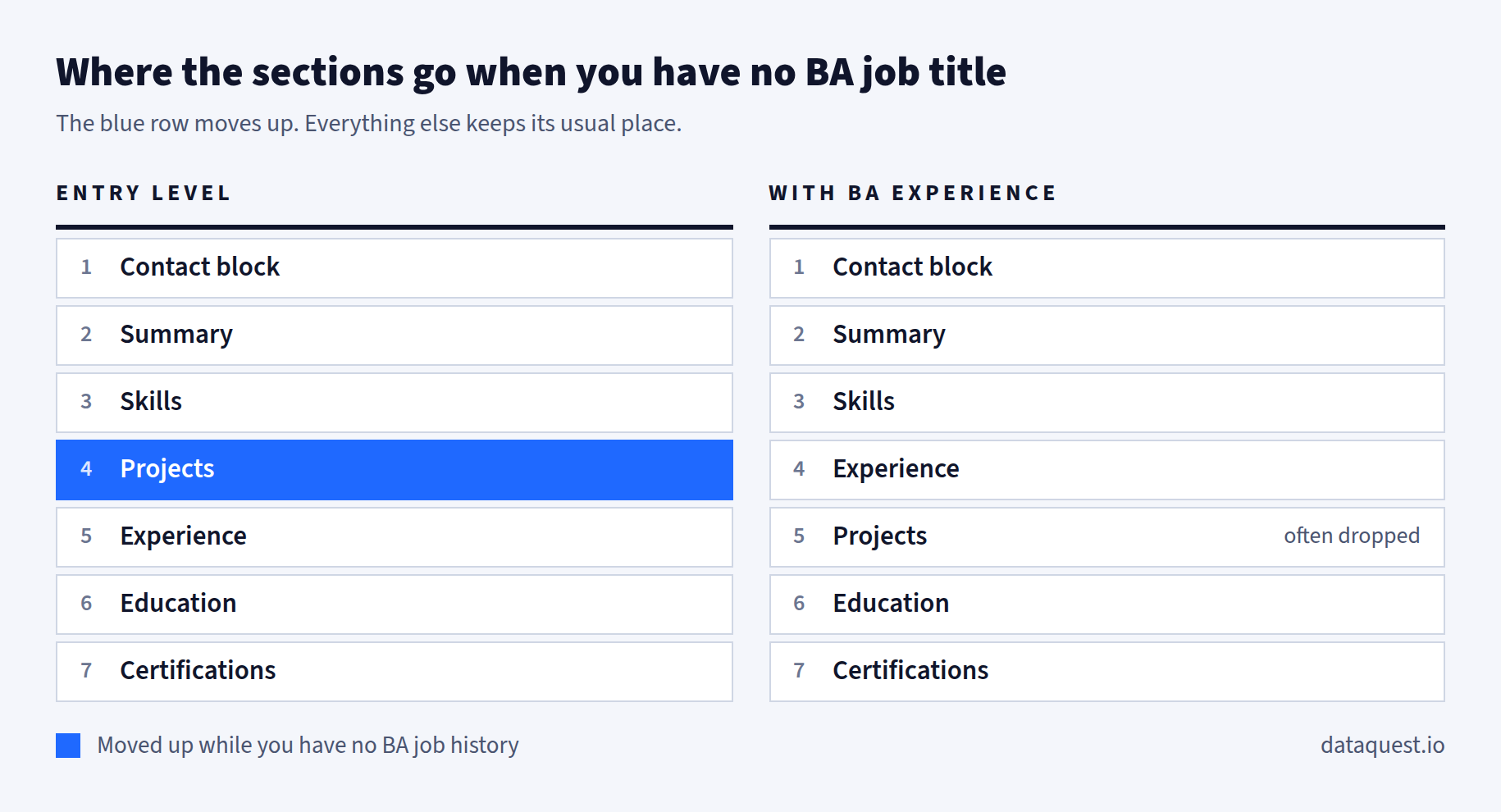
Keep it to one page, in reverse-chronological order (most recent first). Use a single column with standard headings. Send a PDF unless the posting asks for something else.
Write a two- to three-line summary aimed at the posting's BA focus. Skip the objective statement, which talks about what you want instead of what you've done.
Three choices help hiring software read your resume correctly:
- Use standard section headings.
- Don't use text boxes or tables inside the resume.
- Put keywords inside your project and job entries, not in a block at the bottom.
Which Business Analyst Certifications Matter
Certifications help, but they come second to the work you can show.
IIBA's Entry Certificate in Business Analysis (ECBA) is the only one of its three core certifications with no work-experience requirement. The next two, CCBA and CBAP, ask for about two to three years and five or more years of BA work. PMI-PBA is also a later goal, since it requires at least three years of BA experience.
For data-focused roles, the Business Analyst with Power BI path prepares you for Microsoft's Power BI Data Analyst certification (PL-300). If you lean toward Tableau, the Business Analyst with Tableau path prepares you for the Salesforce Certified Tableau Desktop Foundations (formerly Tableau Desktop Specialist). Our roundup of the best business analyst certifications compares more options.
List certifications next to your artifacts, not in place of them. If one is still in progress, list it with an expected date.
A Complete Entry-Level Business Analyst Resume Example
Maya Ortiz has worked as an operations coordinator for three years. She taught herself Excel, SQL, and Power BI, and she's applying for a data-focused BA job. Here's her resume with everything above applied.
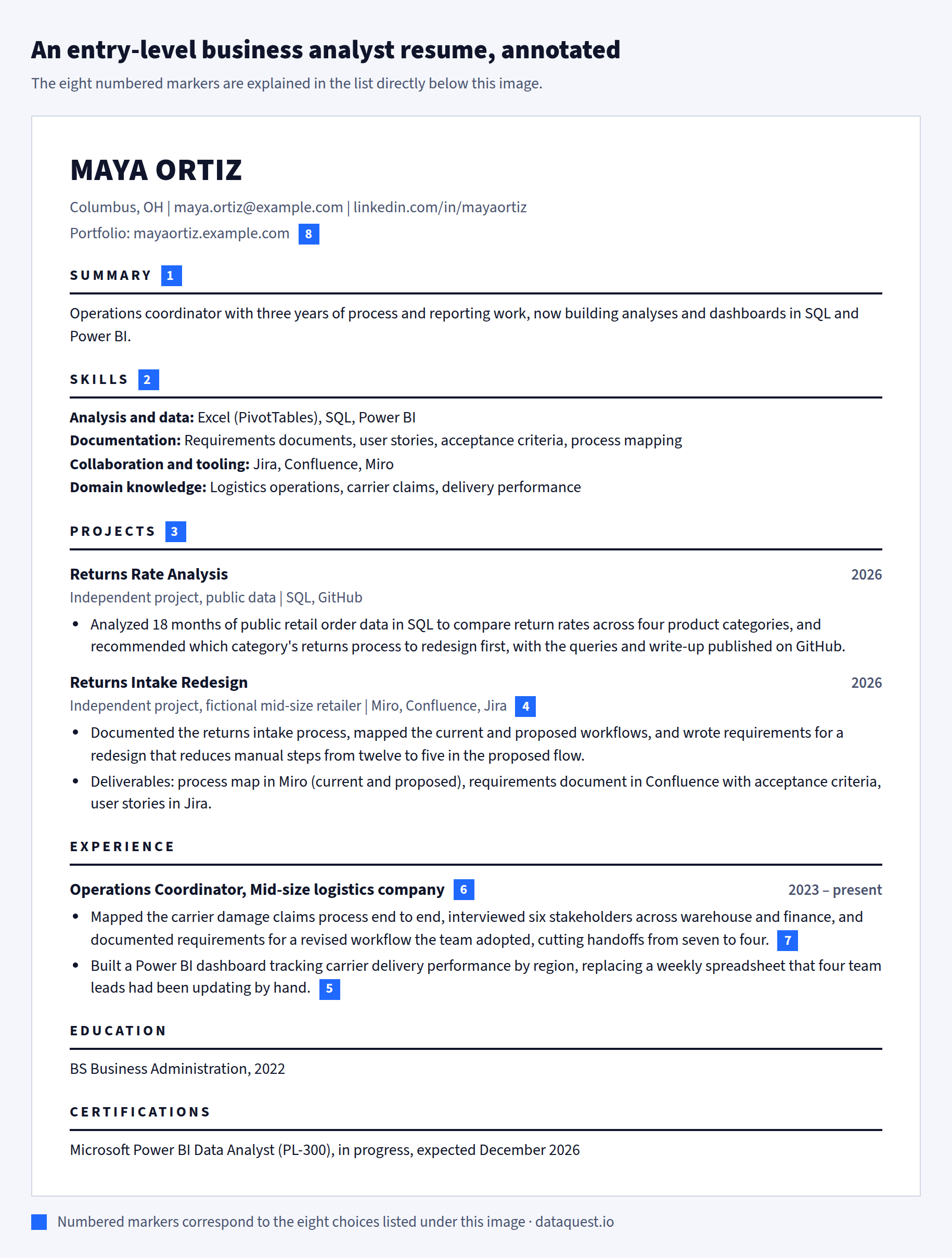
Each numbered marker on the resume matches one of these choices:
- The summary matches the posting's focus. "Operations coordinator with three years of process and reporting work, now building analyses and dashboards in SQL and Power BI" shows the match in the first line.
- Skills lead with analysis and data, because most of the posting's responsibilities were about dashboards and KPIs. For a process-focused posting, documentation would go first.
- Projects sit above experience because they hold the artifacts this posting looks for.
- The redesign project names its artifacts (a process map, a requirements document, and user stories).
- The dashboard line shows the before and after, a weekly spreadsheet updated by hand that the team no longer needs.
- The Operations Coordinator title is unchanged. Only the lines underneath were rewritten.
- Maya counted every number herself, so she can explain each one.
- The portfolio link sits in the contact block at the top of the page, not in the header.
Thin on skills? Follow the same sequence Maya followed. Build the Excel, SQL, and Power BI skills these postings ask for, then make the artifacts that prove them.
Common Business Analyst Resume Mistakes
Seven mistakes hurt entry-level BA resumes. Each one is easy to fix once you spot it.
- A number with nothing behind it. "Improved efficiency by 30%" sounds strong, but the first interview question will be how you measured it. Keep the percentage and show where it came from, such as the before and after counts.
- The same front third for every BA focus. A summary written for dashboard roles won't land with a process-focused team. Reorder your summary, skills, and lead project for each posting.
- Listing tools your entries don't prove. Say your skills list SQL, Power BI, BPMN, UML, and Jira. If only two show up in your projects or jobs, the rest look like padding. List only the tools your entries back up.
- Lines that describe duties. "Responsible for gathering requirements" only describes the job. Rewrite it around what you produced and what it led to.
- Burying domain knowledge from past jobs or studies. Knowing an industry is a real strength for a BA. Name it in your skills section so the reader doesn't have to guess.
- Certifications standing in for artifacts. A certification is worth having, but a hiring manager can't open it and read it. Pair it with at least one piece of work they can see.
- Two pages with no BA job history. A second page without BA experience reads as padding. Keep it to one page until you have BA work to fill more.
| Cut this | Write this instead |
|---|---|
| Improved efficiency by 30% | Documented requirements for a revised claims workflow the team adopted, cutting handoffs by 43%, from seven to four |
| Responsible for reporting | Built a Power BI dashboard that replaced a weekly spreadsheet four team leads updated by hand |
| Skills: SQL, BPMN, UML, Jira, Tableau, Power BI | Analysis and data: SQL, Power BI, Excel. Documentation: requirements documents, process mapping |
| Strong communicator who works well with stakeholders | Interviewed six stakeholders across warehouse and finance to agree on a revised claims workflow |
| Seeking a BA role where I can grow my skills | Operations coordinator with three years of process and reporting work |
Check your draft three times before you send it:
- Read only the verbs. Rewrite every line that starts with "responsible for" or "assisted with" as an outcome.
- Read only the numbers. Delete any you couldn't explain in an interview.
- Read your skills against the posting. Cut anything you wouldn't want a technical question about.
Send what's left.
Where to Go From Here
Sort the posting by its focus. Build your resume around the proof that role looks for. Then link the artifact that backs it up.
A resume can only describe work you've done. If yours still feels thin, build one more artifact. A process map often takes just a weekend.
If the postings you want are data-focused, the Business Analyst with Power BI path builds the analysis skills those roles screen for. It covers Excel, SQL, and Power BI across 15 courses and 10 projects. Extend those projects with your own question, and they can double as portfolio artifacts.
If you're aiming at process-focused roles instead, start with the requirements document and process map from the portfolio section. For technical or product-focused roles, the same two artifacts work too. Write the requirements as user stories with acceptance criteria, and the documents speak directly to what those teams screen for.
Before you apply, check how well you match. Kishawna Peck, CEO of Womxn in Data Science, treats the first two or three requirements as the must-haves. She calls the rest "the wish list of the employer." She suggests aiming for about a 60 to 70% match. Our data resume guide built on her advice explains more.
When your resume is ready, our walkthrough of the BA application process covers what comes next.
Frequently Asked Questions
How long should my business analyst resume be?
One page while you're entry-level. If you're over, cut in this order: unrelated jobs, lines that list duties, projects you can't explain from start to finish, and older coursework.
Do I need a degree to become a business analyst?
Not always. Some postings say a bachelor's degree in business, finance, IT, or a related field is required. Others say it's preferred. Check which one it is before you rule yourself out.
Is the ECBA worth it if I'm entry-level?
It depends on the BA focus you want. For process-focused roles, the ECBA teaches the shared language those teams use in interviews. It's also the only core IIBA certification with no work-experience requirement. For data-focused roles, Microsoft's PL-300 plus a dashboard project will do more.
Should my business analyst resume include a portfolio link?
Yes, whenever you have work you can share. Put it in the contact block at the top of the page or inside the project entry. If the work was confidential, name the type of document, the size of the process, and the decision it supported. Then say you're happy to discuss it.
What is the difference between a business analyst and a data analyst resume?
A data analyst resume leads with tools, techniques, and findings. A business analyst resume leads with the problem, the people, and the decision, with the tools supporting that story. The same dashboard project can appear on both. On a data analyst resume, it's about the modeling and the query. On a BA resume, it's about the question it answered and who acted on it. Our business analyst vs. data analyst comparison covers how the roles differ.
Can I become a business analyst from a non-technical background?
Yes. The documentation and process work BA roles ask for doesn't need a technical background. You can learn the analysis skills in order, starting with Excel, then SQL, then a BI tool. Process-focused roles are a good first target while you build those skills, since they care more about documents than tools.
How do I write a business analyst resume with no experience?
Start by sorting the posting, so you know which BA focus you're writing for. If you have no job to reframe, your projects fill the whole page. Build the project that matches that focus first, and put your education section right under it. Coursework, capstones, and group projects from school all count if you can explain what you made.