
Best Generative AI Courses in 2026
Generative AI courses age faster than almost any other technical content. A LangChain tutorial from 2023 already teaches partly deprecated patterns. A prompt engineering course from 2024 may not mention agents, MCP, or modern RAG. For engineers researching the best generative AI courses in 2026, the hard part isn't finding options. It's separating the ones that have kept up from the ones that haven't, and figuring out what to take in what order.
This guide compares the top 9 courses for developers building with generative AI. Every pick passed a recency check before making the list. Each entry includes real cost, realistic time commitments, honest limitations, and where it fits in your skill stack.
The Shortlist by Goal
If you only read this far, here are the strongest picks for the most common situations:
- Best for career changers starting from zero: Dataquest AI Engineer in Python
- Best credentialed full path: IBM Generative AI Engineering Professional Certificate
- Best fast foundations: Generative AI with LLMs (DeepLearning.AI + AWS)
- Best for open-source models: Hugging Face LLM Course
- Best budget-friendly option: Master LLM Engineering & AI Agents (Udemy)
Generative AI Courses Compared at a Glance
| Course | Cost | Time | Format | Focus | Best For |
|---|---|---|---|---|---|
| Dataquest AI Engineer in Python | Free intro / \$49 mo | 10 mo at 5 hr/wk | Interactive browser | Full stack | Beginners going full stack |
| IBM Generative AI Engineering Professional Certificate | Free audit / \$49 mo cert | 6 mo at 6 hr/wk | Video + labs | Full stack (credentialed) | Credential seekers |
| Generative AI with LLMs (DeepLearning.AI + AWS) | Free audit / \$49 mo cert | ~16 hr | Video + labs | LLM lifecycle | LLM newcomers |
| Hugging Face LLM Course | Free | ~30-50 hr | Text + code | Open-source ecosystem | Open-source builders |
| Master LLM Engineering & AI Agents (Udemy) | \$15-60 (Udemy) | 50+ hr | Video + projects | Portfolio building | Cost-conscious builders |
| IBM RAG and Agentic AI Professional Certificate | Free audit / \$49 mo cert | 8 wks at 3 hr/wk | Video + labs | RAG and agents | RAG and agent specialists |
| DeepLearning.AI Short Courses | Free | ~1-2 hr each | Video + Jupyter | Topic-specific | Targeted skill builders |
| Advanced RAG with LlamaIndex (Activeloop) | Free | ~20+ hr | Text + projects | Advanced RAG | Production RAG engineers |
| Building RAG Agents with LLMs (NVIDIA) | Free | ~8 hr | Self-paced + notebooks | RAG agents | Hands-on RAG learners |
What Generative AI Engineering Actually Covers
Generative AI engineering isn't one skill. It's a stack, and where you start depends on which layer you're missing.
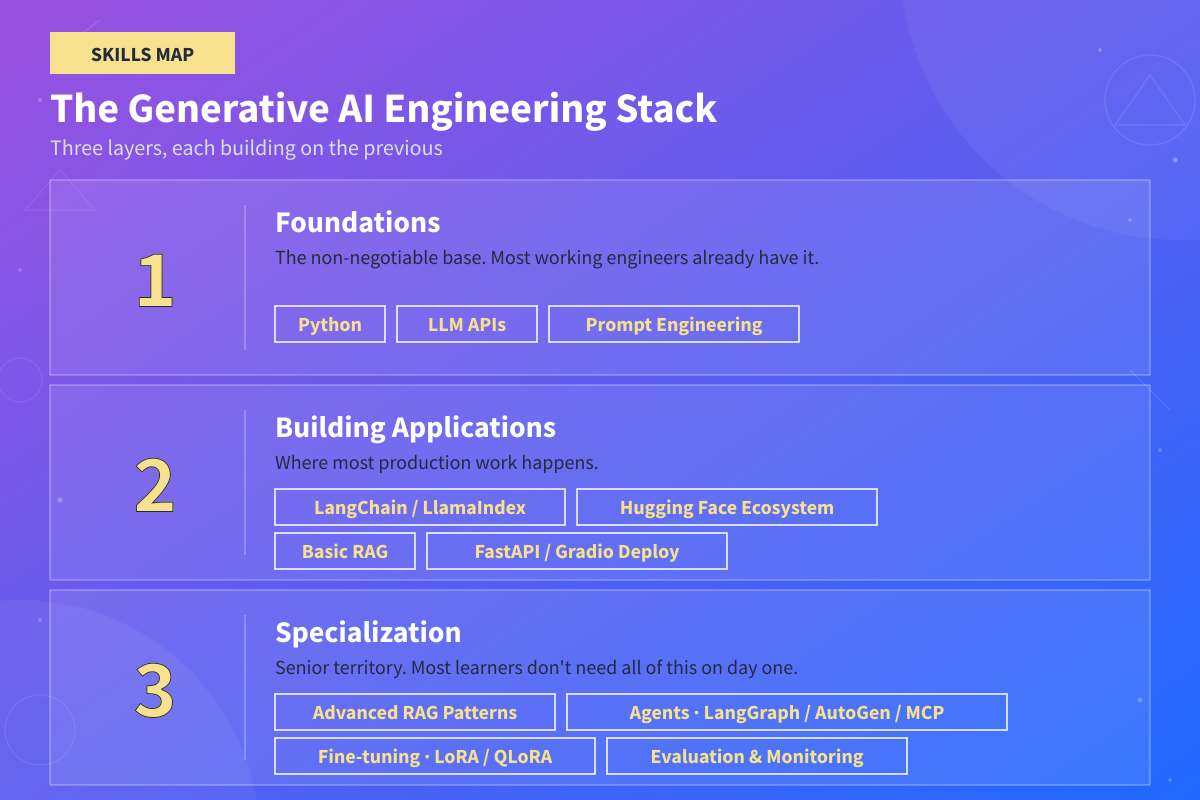
The diagram above shows the three layers:
- The foundations layer is Python, LLM APIs, and prompt engineering. You can't skip it, but if you're already shipping API-driven features at work, you probably have it.
- The application layer is where most production work happens. Frameworks like LangChain and LlamaIndex, the Hugging Face ecosystem, basic RAG, and deployment with FastAPI or Gradio. Most engineers spend the bulk of their time here.
- The specialization layer covers advanced RAG patterns, agents built with LangGraph or AutoGen or MCP, fine-tuning with LoRA and QLoRA, and production monitoring. Senior-engineer territory, and most learners don't need all of it on day one.
The strongest courses cover all three layers in sequence. Focused courses target a single layer, which works when you know exactly what's missing. The Focus column in the table tells you where each course lives in the stack.
Best Generative AI Courses
1. Dataquest AI Engineer in Python

- Cost: Free intro lessons (no credit card required). Full path access requires a paid plan at \$49/month
- Time to Complete: 10 months at 5 hours/week, self-paced
- Prerequisites: None. Designed for complete beginners.
- What You'll Learn:
- Python programming and developer tooling (command line, Git, virtual environments)
- Working with LLMs through APIs, prompt engineering, and tool use (including MCP)
- Building AI applications with FastAPI and deploying with Docker
- Embeddings, vector databases (ChromaDB, pgvector, Qdrant, Pinecone), and semantic search
- Designing and building retrieval-augmented generation (RAG) systems
- 30 courses and 20 guided projects, including a multi-provider LLM gateway and a containerized AI service
- Industry Recognition: 4.79/5 on CourseReport. 157,367 learners enrolled. Independently reviewed by LearnDataSci as a strong fit for hands-on, text-based interactive learning.
- Best For: Career changers who want to write code from day one, learning Python and generative AI engineering in the same browser window, with a portfolio of deployed AI projects by the end.
Why it works: The Dataquest AI Engineer in Python career path is built around one idea. You don't learn AI engineering by watching it. Interactive lessons run in the browser and pair with hands-on guided projects from the first course, so you write code where you're learning rather than copying from a video.
The curriculum takes you from Python fundamentals through LLM APIs, FastAPI deployment, Docker, embeddings, vector databases, and RAG systems. Twenty guided projects build a real portfolio along the way, including a multi-provider LLM gateway and a containerized AI service deployed to the cloud.
Worth knowing: Ten months at 5 hours a week is a serious commitment. It's the right size for a career transition, but more than some learners need.
If you already know Python, the shorter Generative AI Fundamentals in Python skill path covers the Python-plus-LLM-applications portion in about two months.
A few parts of the AI Engineer curriculum are still rolling out, including advanced RAG and AI agents. If your goal is heavy agent work today, pair this path with one of the specialist agent courses below.
2. IBM Generative AI Engineering Professional Certificate
- Cost: Free to audit / ~\$49-59/month for Coursera certificate (Coursera Plus subscription)
- Time to Complete: ~6 months at 6 hours/week, self-paced
- Prerequisites: Basic computer literacy. No prior Python or ML experience required.
- What You'll Learn:
- Python programming and AI application development with Flask
- Generative AI fundamentals, prompt engineering, and prompt patterns
- Machine learning and deep learning foundations with Keras and PyTorch
- Fine-tuning with LoRA and QLoRA, plus advanced techniques (RLHF, DPO, PPO)
- RAG and AI agents using Hugging Face and LangChain
- A capstone project building a generative AI application with RAG and LangChain
- Industry Recognition: 4.7/5 from 99,442 reviews across the program. 140,012 learners enrolled. ACE-recommended for up to 17 college credits at participating US institutions.
- Best For: Mid-career professionals who want an employer-recognized credential with college-credit eligibility from a name-brand provider.
Why it works: The IBM Generative AI Engineering Professional Certificate is the most thorough credentialed path for becoming a generative AI engineer. Across 16 courses, you move from Python through ML and deep learning basics, then into prompt engineering, fine-tuning with LoRA and QLoRA, and RAG systems with LangChain and Hugging Face. A capstone project ties it together with a working generative AI application.
The credential carries weight. It's recognized by employers and ACE-evaluated for up to 17 college credits, which can matter for mid-career professionals applying for AI engineering roles. At six hours a week, the pacing also fits people balancing study with full-time work.
Worth knowing: Sixteen courses is a lot of structure, and not all of it is generative-AI-specific. The earlier modules cover general Python, data analysis, and traditional machine learning. These are useful foundations, but they slow down learners who already have them.
If you already know Python and ML basics, IBM's RAG and Agentic AI certificate below assumes those foundations and goes deeper on the generative AI portion. The labs also lean on IBM watsonx.ai for some sections, which adds a small layer of vendor-specific tooling.
3. Generative AI with Large Language Models (DeepLearning.AI + AWS, on Coursera)
- Cost: Free to audit / \$49/month for Coursera Plus and certificate
- Time to Complete: ~16 hours across 3 weeks
- Prerequisites: Python familiarity and basic machine learning are helpful
- What You'll Learn:
- The LLM lifecycle from data through training to deployment
- Prompt engineering fundamentals and in-context learning
- Fine-tuning, RLHF, and model customization
- Model evaluation and benchmarking
- Responsible AI and deployment considerations
- Industry Recognition: Co-developed by DeepLearning.AI and AWS, taught by working AI engineers from both organizations. Strong reviews across Coursera and developer communities, with regular updates as models and techniques evolve.
- Best For: Busy professionals who already know Python and want a structured overview of how LLMs work end-to-end in around 16 hours.
Why it works: Generative AI with Large Language Models gives you a clean mental model of the entire LLM lifecycle in about 16 hours. You start with how transformer models work, then move through prompt engineering, in-context learning, fine-tuning, RLHF, and deployment. The lifecycle framing is the standout feature. Instead of jumping straight into prompts or APIs, you learn how each stage of the model's life feeds the next, which makes you a better engineer at every layer above it.
The hands-on labs use AWS SageMaker for fine-tuning, which gives you concrete practice with one of the major cloud platforms. The audit option also lets you preview the full course before committing.
Worth knowing: This course is about mental models, not day-two production operations. You'll finish with a strong understanding of how LLMs work, but for cost management, drift detection, evaluation pipelines, or production agent design, pair it with more applied content like the DeepLearning.AI Short Courses. The AWS-flavored labs also assume some willingness to navigate SageMaker, which can feel heavy if you just want to call an OpenAI API from a notebook.
4. Hugging Face LLM Course

- Cost: Free
- Time to Complete: ~30-50 hours, self-paced
- Prerequisites: Python basics required
- What You'll Learn:
- Transformer architecture in practice
- The Hugging Face library ecosystem (transformers, datasets, accelerate, PEFT, TRL)
- Tokenization and embeddings
- Fine-tuning open-source models with parameter-efficient methods
- Building and deploying NLP applications end-to-end
- Modern LLM training patterns including RLHF
- Industry Recognition: Hugging Face is the de facto open-source AI hub, and the course is widely referenced in community discussions and engineering onboarding plans. The active Hugging Face forum has working engineers and core team members regularly answering learner questions.
- Best For: Developers who want fluency in the open-source LLM stack, taught by the engineers who built it.
Why it works: The Hugging Face LLM Course is the most direct path to fluency in the open-source LLM stack. You learn the transformers library, datasets, accelerate, PEFT, and TRL. These are the tools working AI engineers reach for when they need to run an open-source model, fine-tune it efficiently, or deploy it without depending on a commercial API.
The teaching credibility is unusual. The course is written by the engineers who built the libraries, and it updates as the libraries evolve. When something changes in transformers, the course reflects it. That continuous-update model is rare in AI education.
Worth knowing: The self-directed format means motivation matters more than for video-led courses. There are no deadlines, no instructor check-ins, no required pace. If you tend to bounce off documentation-style learning, pair this with a more structured course for accountability. Or commit to one chapter per week to keep momentum.
5. Master LLM Engineering & AI Agents (Udemy)

- Cost: \$15-60 on Udemy (frequently on sale; lifetime access)
- Time to Complete: 50+ hours
- Prerequisites: Python comfort required
- What You'll Learn:
- 14 complete projects covering modern LLM engineering
- Working with frontier models (OpenAI, Gemini, Claude) and open-source models via Hugging Face and Ollama
- RAG pipelines with LangChain and ChromaDB
- Fine-tuning with LoRA and QLoRA
- Agent design with AutoGen, OpenAI Agents SDK, LangGraph, and MCP
- Production deployment patterns
- Industry Recognition: Strong reviews on Udemy. The course was substantially refreshed for 2026 to reflect current tooling, which is rare for the platform.
- Best For: Cost-conscious developers comfortable with video instruction who want lifetime access to a substantial LLM engineering curriculum for under \$60 during a Udemy sale.
Why it works: Ed Donner's Master LLM Engineering and AI Agents is built around 14 projects, with the explicit goal of giving you working code you can point to in interviews. You work with frontier models from OpenAI, Gemini, and Claude alongside open-source models from Hugging Face and Ollama, build RAG pipelines with LangChain and ChromaDB, fine-tune with LoRA and QLoRA, and design agents using AutoGen, OpenAI Agents SDK, LangGraph, and MCP.
The 2026 refresh matters for generative AI more than for most tech subjects. Older courses often teach deprecated patterns or skip recent additions like MCP entirely. This one stays current.
Worth knowing: The price-to-content ratio is genuinely excellent during Udemy sales, but the trade-off is breadth over depth. Fifty hours sounds like a lot, but spread across 14 projects, each topic gets working-level coverage rather than deep theoretical treatment. Pair this with the Hugging Face LLM Course if you want to go deeper on any single area. Udemy course quality also depends heavily on instructor diligence, so check the "last updated" date before enrolling.
6. IBM RAG and Agentic AI Professional Certificate
- Cost: Free to audit / ~\$49-59/month for Coursera certificate
- Time to Complete: 8 weeks at 3 hours/week, self-paced
- Prerequisites: Working knowledge of Python and fundamental knowledge of web development and AI concepts (advanced level recommended)
- What You'll Learn:
- Advanced retrievers with LlamaIndex and LangChain
- RAG applications integrating LangChain, FAISS, and Gradio
- Multimodal AI with IBM Granite, Meta Llama, OpenAI Whisper, DALL·E, and Sora
- Agentic AI with LangGraph, CrewAI, AG2 (AutoGen), and BeeAI
- MCP clients connecting to single and multiple servers via STDIO and Streamable HTTP
- A capstone designing and implementing a complete AI system from data to deployment
- Industry Recognition: 4.6/5 from 917 reviews. 75,450 learners enrolled. Recently updated in March 2026 to reflect current frameworks and MCP coverage.
- Best For: Engineers who already know LLM fundamentals and want to go deep on retrieval, agents, and MCP with a recognized credential on top.
Why it works: IBM's RAG and Agentic AI Professional Certificate is the most up-to-date credentialed path for engineers who have the basics and want to specialize. The 10-course curriculum focuses tightly on the two areas that have evolved most in 2024-2026, which are RAG (using LlamaIndex, LangChain, FAISS, and Gradio) and agent design (LangGraph, CrewAI, AG2, BeeAI, and MCP).
The MCP coverage stands out. Model Context Protocol is one of the most significant additions to the AI engineering stack in the last year, and most existing courses haven't caught up. IBM updated this certificate in March 2026 to teach MCP clients, server configuration with FastMCP, and permission-based approval workflows.
Worth knowing: This certificate is marked advanced and assumes you understand LLM fundamentals. If you're starting from scratch, the IBM Generative AI Engineering certificate above is the better entry point. Unlike that broader certificate, this one doesn't currently offer ACE college credit. The labs also lean on IBM watsonx.ai for parts of the curriculum, which adds a small layer of vendor-specific tooling to translate later.
7. DeepLearning.AI Short Courses
- Cost: Free during the DeepLearning.AI platform beta (ongoing)
- Time to Complete: ~1-2 hours per course; dozens available
- Prerequisites: Basic Python for most engineering-focused courses
- What You'll Learn (selected standouts for AI engineers):
- ChatGPT Prompt Engineering for Developers with Andrew Ng and Isa Fulford (OpenAI)
- LangChain for LLM Application Development with Harrison Chase (LangChain founder)
- Building Systems with the ChatGPT API
- Building and Evaluating Advanced RAG
- Functions, Tools and Agents with LangChain
- LLMOps with Google Cloud
- Industry Recognition: Short courses are co-built with OpenAI, Anthropic, LangChain, Google, AWS, and NVIDIA. Widely cited as the strongest free practitioner library in AI engineering education.
- Best For: Developers who want focused 1-2 hour courses on specific topics taught alongside the platforms that own each technology.
Why it works: DeepLearning.AI's Short Courses are the closest thing the field has to a free practitioner library. Each one runs 1-2 hours, focuses on a specific topic, and stays free during the platform's ongoing beta. The standouts for engineers building generative AI applications include ChatGPT Prompt Engineering for Developers, LangChain for LLM Application Development, Building and Evaluating Advanced RAG, and LLMOps.
The format works because it matches how engineers actually need to learn. When something specific is missing from your toolkit, you don't have time for a 40-hour bootcamp. You want 90 minutes from someone who built the library, with working Jupyter notebooks alongside the lessons.
Worth knowing: These are completion certificates, not formal credentials. They show you took the course but don't carry the weight of a Professional Certificate. Use them as targeted learning tools, not resume centerpieces. The catalog is also easy to drift through. If you find yourself collecting completed short courses without shipping anything, stop and build with what you already know.
8. Retrieval Augmented Generation with LlamaIndex (Activeloop)

- Cost: Free (paid OpenAI account or open-source LLM substitution recommended for hands-on projects)
- Time to Complete: ~15-20+ hours
- Prerequisites: Python and basic coding experience
- What You'll Learn:
- Advanced retrieval methods including sentence-window retrieval and auto-merging
- Hybrid search, re-ranking, and metadata filtering
- Evaluation patterns for measuring retrieval quality
- 10 practical projects across legal, biomedical, financial, and e-commerce domains
- Production deployment considerations for RAG systems
- Earn the Gen AI 360 Certification on completion
- Industry Recognition: Built in collaboration with LlamaIndex and taught by Jerry Liu, the company's CEO and co-founder. Part of the Foundational Model Certification series produced by Activeloop, Towards AI, and the Intel Disruptor Initiative.
- Best For: Engineers building production RAG features at work who want deep retrieval expertise taught by the LlamaIndex team directly.
Why it works: Activeloop's Retrieval Augmented Generation with LlamaIndex course is the deepest free treatment of production RAG available in 2026. It's built with LlamaIndex and taught by Jerry Liu, the company's CEO.
You work through 25+ lessons and 10 practical projects covering advanced retrieval methods (sentence-window retrieval, auto-merging, hybrid search), evaluation patterns, and production deployment. The projects span legal, biomedical, financial, and e-commerce domains, so the learning transfers to real organizational needs.
Worth knowing: This course is genuinely advanced. If you've never built a basic RAG pipeline, start somewhere lighter. The Generative AI with LLMs course covers the basics, and the DeepLearning.AI short course on Advanced RAG is a gentler on-ramp.
You'll also need a paid OpenAI account or willingness to substitute open-source LLMs for the hands-on projects.
9. Building RAG Agents with LLMs (NVIDIA)
- Cost: Free
- Time to Complete: ~8 hours, self-paced
- Prerequisites: Introductory deep learning with comfort using PyTorch and transfer learning. Intermediate Python experience including object-oriented programming.
- What You'll Learn:
- End-to-end RAG agent architecture
- LLM inference interfaces and microservices
- Pipeline design with LangChain, Gradio, and LangServe
- Dialog management and document reasoning
- Embeddings for semantic similarity and guardrailing
- Vector stores with FAISS for document retrieval
- Industry Recognition: NVIDIA Deep Learning Institute (DLI) course with an issued certificate on assessment completion. Frequently recommended in the AI engineering community as the fastest way to get a working RAG agent built end-to-end.
- Best For: Developers who want a short, free, hands-on introduction to building a complete RAG agent over a weekend.
Why it works: NVIDIA's Building RAG Agents with LLMs is the most efficient short course for assembling an end-to-end RAG agent in a weekend. The curriculum covers document chunking, embeddings, retrieval, augmented generation, and agent orchestration in roughly eight hours. The final assessment has you ingest arXiv papers into a FAISS vector store, expose endpoints via LangServe, wire everything into a Gradio frontend, and validate quality with RAGas metrics.
The short format is the point. If you've been reading about RAG agents but haven't built one, this course gets you from concept to working prototype faster than any of the longer options. The NVIDIA-issued certificate carries some weight when you're early in your AI engineering career.
Worth knowing: The course leans on NVIDIA AI Foundation Endpoints for parts of the LLM inference, which adds a small amount of setup overhead if you don't already have an NVIDIA developer account. The prerequisites are also stricter than they look. You'll want basic PyTorch comfort and intermediate Python (object-oriented programming, working with libraries) before starting. If you need to ship production RAG features at work, the Activeloop course above is the better fit.
How to Tell If a Generative AI Course Is Still Current
Every course in this guide passed a recency check before making the cut. But the field moves fast enough that any course you find outside this list deserves a fresh look before you commit time to it.
Generative AI tooling changes faster than almost any other technical topic. A course recorded in 2023 may already teach deprecated patterns, miss agent frameworks entirely, or reference model versions that no longer exist. This makes recency a unique evaluation criterion that doesn't apply nearly as much to, say, Python fundamentals or SQL.
Five signals to check before enrolling in any generative AI course:
- When was the course last updated? Most platforms display this on the course page. A course last updated in 2024 covering "modern AI" should raise a flag in 2026.
- Does the curriculum mention agents, MCP, or modern RAG patterns? Model Context Protocol, LangGraph, AutoGen, and advanced retrieval patterns are 2024-2025 developments. Their absence is a strong signal that the content is dated.
- Which model versions appear in examples? If everything is GPT-3.5 with no mention of newer model families (GPT-4-class, Claude 3+, Gemini 2+, Llama 3+), the content predates significant capability shifts.
- What do recent comments and reviews say? Sort reviews by newest and scan for "outdated," "deprecated," or "doesn't work anymore." Active learners flag these issues quickly.
- Does the platform update aggressively? Hugging Face, DeepLearning.AI, and the major cloud vendors stay current. Some individual instructors (especially on Udemy) update only when they choose to, so check the "last updated" date.
This framework matters most for hands-on engineering courses where tooling specifics matter. Foundational content like transformer architecture, basic prompt engineering principles, and embedding theory ages much more slowly. A course from 2023 on what an embedding is conceptually is probably still fine. A course from 2023 on how to use LangChain probably isn't.
When You Don't Need a Generative AI Course
A course isn't always the right move. You can probably skip one if any of these apply:
- You're already shipping generative AI features at work. The OpenAI Cookbook, Anthropic docs, LangChain documentation, and Hugging Face tutorials will move faster than any course when you have a concrete problem to solve.
- You have a narrow specific goal. Need to fine-tune one model on your data? A targeted tutorial or a focused weekend project beats a 50-hour course every time.
- You're already in tutorial hell. If you've started three generative AI courses and finished none of them, the fourth course won't fix the pattern. Building something will. Pick one project, ship it badly, learn from the failure, iterate.
- You want free, project-based practice instead of structured learning. Dataquest has free projects and blog content covering key AI concepts you can work through at your own pace.
Courses work best when you don't already have a concrete problem in front of you. If you do, build first and use the course to fill in what you don't understand afterward.
Picking the Best Generative AI Course for You
Choice paralysis is one of the most common reasons learners researching generative AI courses never start one. The truth is, another month of comparing options actually costs more than picking the "wrong" course.
If you're starting from zero and want everything in one path, take the Dataquest AI Engineer in Python career path. If you already program in Python and want a fast mental model of how LLMs work, take Generative AI with Large Language Models. If you want to specialize after the basics, pick the matching course from the list above.
Not ready for a full career path? Dataquest's AI Chatbots course is free, takes about 3 hours, and gives you a feel for the format. Already know some Python? The Generative AI Fundamentals in Python skill path is the middle step, at two months of part-time study.
Pick one this week. Block study time on your calendar. Finish it before enrolling in another. The biggest predictor of whether you'll learn generative AI engineering isn't which course you pick. It's whether you finish what you start.
Frequently Asked Questions
Do I need to learn machine learning before generative AI?
Not for most AI engineering work. If your goal is to build applications on top of existing models (which is what most working AI engineers do today), you can start with prompt engineering and LLM application development. You'll pick up the ML concepts you need along the way.
If your goal is to train models from scratch or work in research, ML fundamentals come first. The two paths converge eventually, but in 2026 the API-first path gets you shipping faster.
Should I learn LangChain, LlamaIndex, or just the raw APIs?
Learn the raw APIs first (OpenAI, Anthropic, or any provider's SDK), then add a framework when you hit problems the raw API doesn't solve well. LangChain is the most popular general-purpose framework and the most widely listed in job postings. LlamaIndex is stronger specifically for RAG and document-heavy applications. Many production systems use both.
If you've never called an LLM API directly, start there. You'll appreciate what the frameworks abstract away once you've felt the pain they solve.
Is fine-tuning still worth learning in 2026?
Yes, with perspective. Fine-tuning is still useful for tone and voice customization, domain vocabulary, structured output reliability, and cost optimization on high-volume tasks. But many problems that used to call for fine-tuning are now better handled by prompt engineering or RAG, which are faster to iterate on and don't require retraining when your data changes.
Learn the basics of parameter-efficient methods like LoRA and QLoRA so you can recognize when fine-tuning is the right tool. Don't reach for it as your default.
How important is MCP, really?
Model Context Protocol matters for engineers building agents that connect to external tools and data sources. It standardizes how agents discover and call tools, which is replacing a lot of the custom plumbing earlier agent frameworks required.
If your work is primarily prompt engineering or basic RAG, MCP isn't urgent. If you're building agents that touch databases, APIs, or other systems, learning MCP now will save you rebuilding integrations later. The IBM RAG and Agentic AI certificate and the Udemy LLM Engineering course both teach it directly.
Do generative AI course certificates carry weight with employers?
Some do, most don't. Certificates from recognized providers (IBM, AWS, Google, university partners, DeepLearning.AI Professional Certificates) help, especially for entry-level roles. Completion certificates from unknown providers carry very little.
Portfolio matters more than any certificate. A GitHub profile with three to five thoughtful generative AI projects (a working RAG system, an agent that does something useful, a fine-tuned model with documented evaluation) beats a stack of completion certificates. Build the portfolio first.
How long until I'm job-ready as a generative AI engineer?
Realistic timeline: 6 to 12 months at 10-15 hours per week of focused study, including portfolio project work. Faster if you already program in Python and have ML basics. Slower if you're starting from zero.
Job-ready means more than completing a course. It means a portfolio of 3-5 generative AI projects on GitHub, comfort with the modern stack (LLM APIs, vector databases, RAG, basic deployment, at least one agent framework), and the ability to debug unfamiliar AI code without panic.
Will what I learn now be obsolete in a year?
The specific tools will shift. The underlying skills won't. Prompt engineering, retrieval design, evaluation patterns, agent orchestration concepts, and how to think about LLM behavior in production are durable. Specific library APIs and model versions are not.
Pick courses that teach principles alongside tools. When the tools change, you'll adapt fast. When you've only learned tools, you start over each cycle.
Should I pay for a course or stick with free ones?
The free options in this list (Hugging Face, DeepLearning.AI Short Courses, Activeloop, NVIDIA, IBM audit mode) are genuinely good and cover most of what an engineer needs. Pay when you want structured pacing, certification, project review, or a curriculum that takes you end-to-end from beginner to job-ready.
The honest test. If you've finished free courses before without abandoning them, free is probably enough. If you tend to lose momentum without structure, the cost of a paid course buys you a finished curriculum, which is worth more than the money.
