
How to Write Your First Data Engineer Resume
Data engineer resume examples written for experienced hires quote uptime, cost savings, and terabytes per day. You can't quote those figures, because your pipelines have only ever run on your laptop. You might have Airflow running locally, PostgreSQL in Docker, and a pipeline that loads real data every hour. None of it has run for a real company yet.
This guide shows you how to write your first data engineer resume anyway. You'll get a four-part bullet formula that works without production numbers, a way to present your projects, and advice for moving in from another job. It includes one complete annotated resume, where every claim is one you could explain in an interview.
Table of Contents
- What Hiring Teams Look For on a Data Engineer Resume
- How to Order Your Resume Sections
- How to Format a Data Engineer Resume
- How to Write Data Engineer Resume Bullets
- How to List Your Technical Skills
- How to Present a Pipeline Project
- Moving Into Data Engineering From Another Job
- A Complete Entry-Level Data Engineer Resume Example
- Common Data Engineer Resume Mistakes
What Hiring Teams Look For on a Data Engineer Resume
Your resume is often checked twice before anyone calls you. First, an applicant tracking system (ATS) may scan it for the tools named in the job posting. Then a recruiter or hiring manager looks for signs that you've built something that runs.
| What an ATS checks | What a hiring manager checks |
|---|---|
| The exact tool names from the posting | Whether anything runs on a schedule |
| Job titles and dates it can read | Whether the repo link opens |
| A single column it can scan in order | Whether the data sources are named |
| Standard section headings it recognizes | Whether you could explain each number |
| A file type it can open | Whether your tools match the team's |
A posting lists the tools the team uses, like Airflow, PostgreSQL, and a cloud platform. If your resume shows you've used those tools, that can make up for a missing job title. It's one reason people move into data engineering from other jobs.
Hiring teams are also checking more carefully. A Robert Half survey released on March 10, 2026, found that:
- 67% of HR leaders said reviewing AI-generated applications has slowed hiring.
- 65% of hiring managers said a surge in applications, many written or polished with AI, has made skills harder to verify.
- 42% of HR leaders said they now spend more time reviewing applications.
A resume that's quick to check gives a busy reviewer a reason to trust it. That means named tools, named data sources, and a repo link that opens. A polished resume can't fake that kind of proof. The rest of this guide shows you how to give hiring managers something they can check.
Named tools only help when they're the ones the posting wants. Before you decide which of your skills to lead with, look at the skills data engineering postings ask for.
How to Order Your Resume Sections
If you don't have a data engineering job title yet, order your resume sections like this:
- Contact details
- Summary
- Technical skills
- Projects
- Work experience
- Education
- Training and certifications
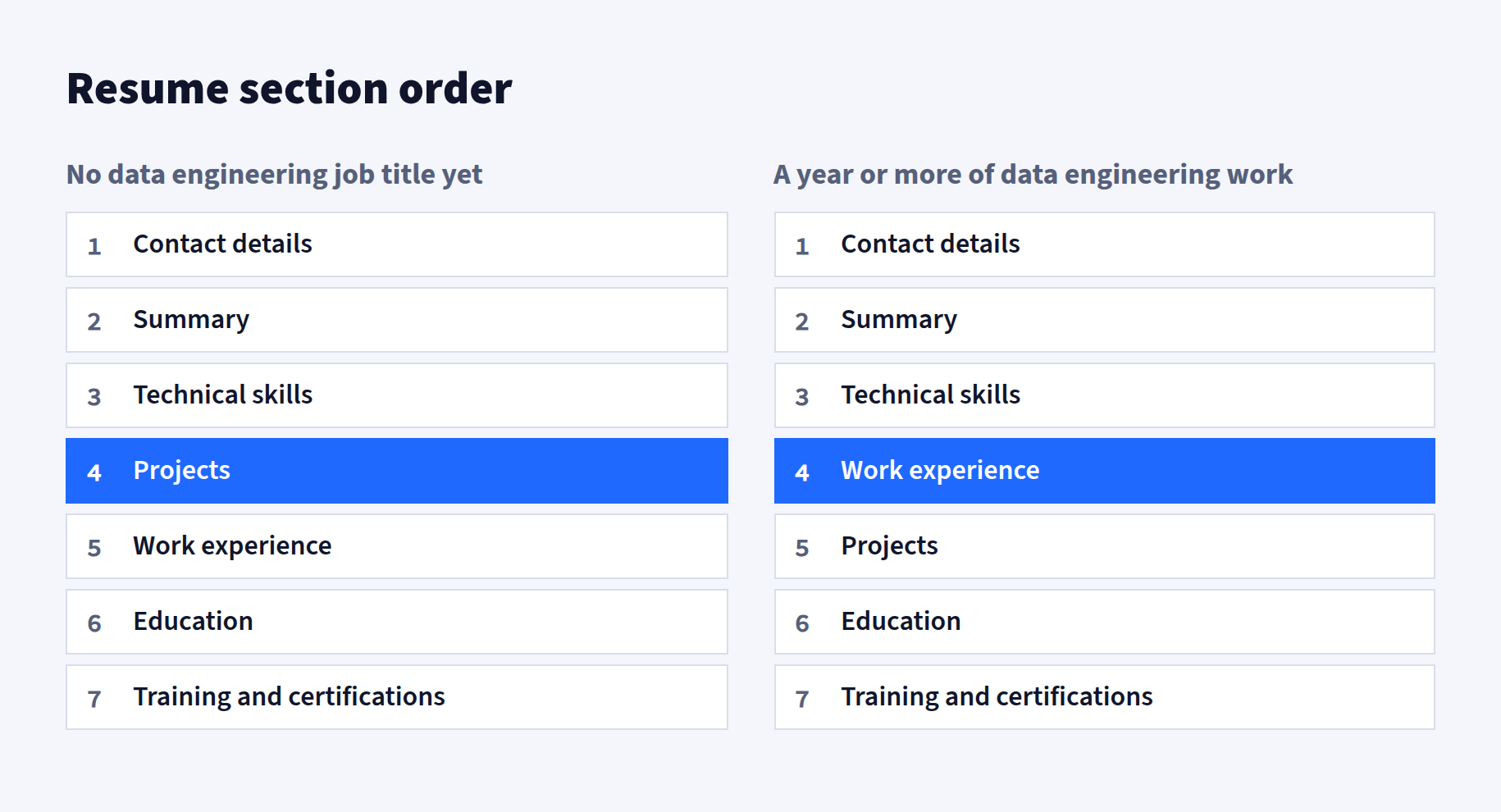
Technical skills go near the top because recruiters and applicant tracking systems often scan first for the tools listed in the job posting. Projects go above work experience because your past jobs probably aren't in data engineering. If a reviewer reads those first, they may decide you're not a fit before they see what you've built.
Moving projects above experience is temporary. Once you have a year of data engineering work, experience moves back above projects.
Your summary is the one place where you frame everything below it. Use two or three lines to say what you build and what kind of role you want. Skip words like detail-oriented and passionate, which give a reviewer nothing to check.
If your skills section looks thin, more learning will help more than better wording. Our data engineering roadmap shows what to learn first and in what order. The Data Engineer path teaches those skills through 14 projects you can extend and add to this page.
How to Format a Data Engineer Resume
A few formatting choices decide whether your resume reaches a person at all.
- Keep it to one page. A two-page resume with no data engineering job history often reads as padding.
- Use one column, most recent first. Some applicant tracking systems read multi-column layouts in the wrong order. List jobs and projects in reverse-chronological order (most recent first).
- Use standard section headings. Headings like "Technical Skills" are safer for applicant tracking systems and easier for recruiters to scan than "My Toolbox."
- Send a PDF unless the posting asks for another file type. A PDF keeps your layout the same on every screen.
- Put your GitHub link at the top of the page, with your email and phone number. Keep it out of the word processor's header or footer, because some applicant tracking systems skip header content.
- Name the file so a recruiter can find it. "Nadia-Farrell-Data-Engineer.pdf" is easy to spot in a folder of 200 downloads. "resume-final-v3.pdf" isn't.
How to Write Data Engineer Resume Bullets
A bullet is one line under a job or project entry. A strong line has four parts, and together they make up the bullet formula:
- An action verb that shows you did the work yourself.
- What you built, described clearly enough to picture.
- The stack, named the way job postings name it.
- A detail you can explain in an interview, like how often it runs or what question it answers.
Here's how the first line of Nadia's bike-share project, from the full example later in this guide, fits the formula:
| Part of the formula | Words from Nadia's first project line |
|---|---|
| Action verb | "Built" |
| What you built | "a Python pipeline that loads station status from three public bike-share feeds" |
| The stack | "Python," "PostgreSQL," and "Airflow" |
| A detail you can explain | "every hour, to track which stations run out of bikes at rush hour" |
Your verb is the first thing a reviewer reads, so it should show what kind of work you did and that you did it yourself. Verbs like built, loaded, scheduled, modeled, partitioned, containerized, validated, and automated describe data engineering work. Assisted, helped, worked on, and was involved in only show you were nearby.
The fourth part is the hardest on a first resume, because nothing has run for a real company yet. Here are three kinds of details you can back up in an interview:
- Scope. How many sources you pull from, how often the pipeline runs, and how much history it holds.
- How it behaves. Idempotent reruns (running the pipeline twice doesn't duplicate data), retries, alerts, schema checks, and tests.
- Time saved. What the pipeline replaced, shown as a before and after you can walk through.
A percentage is fine if it comes from a benchmark you ran and can walk through. Made-up production numbers are what fall apart in an interview.
Here's what that looks like in practice. Each pair below shows a common resume line, a stronger rewrite, and why the rewrite holds up in an interview.
A Project Line
Weak: Built an ETL pipeline in Python to collect bike-share data.
Strong: Built a Python pipeline that loads three public bike-share feeds into PostgreSQL hourly with Airflow, to track which stations run out of bikes.
Why it works: "ETL pipeline" (a pipeline that extracts, transforms, and loads data) tells a reviewer nothing to ask about. The rewrite names the sources, the destination, the schedule, and the question it answers. Each one is something you can explain for ten minutes.
A Benchmark Line
Weak: Worked with large datasets and improved query performance by 40%.
Strong: Partitioned a 14-month service-request table by month in PostgreSQL, cutting the slowest monthly reporting query by 95%, from 4 minutes to 12 seconds, on a local benchmark.
Why it works: The percentage comes with its before and after, and it's tied to a specific change. You ran the benchmark yourself, so you can show how you measured it.
A Line From a Non-Data Job
Weak: Responsible for weekly reporting at a logistics company.
Strong: Replaced a weekly spreadsheet report with a scheduled SQL job, saving the operations team about three hours of manual work each week.
Why it works: This wasn't a data engineering job, and the line doesn't pretend it was. It shows scheduled, repeatable data work, which is the part that carries over.
Two rules keep your lines honest:
- Never invent uptime, speed, or cost-saving numbers. A data engineering interview will ask how you measured them.
- Quote the row counts your own pipeline reported. Don't quote a row count from a dataset's documentation if you only loaded part of it. Be ready to show the query.
Need projects to write about? Our list of SQL projects worth building first is a good place to start. You'll want to set each one up to run on a schedule and load its results into a database.
How to List Your Technical Skills
Group your skills the way a posting groups them, so a reviewer can match them line by line. Here's a layout with realistic entry-level entries.
| Category | Realistic entry-level entries |
|---|---|
| Languages & Scripting | Python, SQL, Bash |
| Storage | PostgreSQL, SQLite |
| Processing | pandas, NumPy, PySpark |
| Orchestration | Apache Airflow |
| Infrastructure | Docker, Docker Compose, Git |
| Cloud | AWS, GCP, or Azure, whichever you've deployed to |
Follow these rules when you fill in the table:
- Match the posting's exact wording. Some applicant tracking systems treat Apache Spark and PySpark as different keywords. List whichever the posting names, or both if you've used both.
- Only list what you've used and can explain. Expect questions on every tool you list, and read these data engineering interview questions beside your own skills list. Apache Airflow is a common ask, but listing it without a working pipeline to show for it can end the conversation early. Postings often ask for dbt, Kafka, Snowflake, and Terraform too. It's worth knowing what they are, but they don't go on your resume until you've built something with them. Name them in a cover letter as tools you're learning.
- Skip skill bars, star ratings, and percentage charts. Applicant tracking systems can't read them, and a reviewer can't check them.
- Keep soft skills out of the list. Show them inside your project and job lines instead.
- Keep each row to no more than three or four entries. Order them by how much you've used each tool, not alphabetically. A row of eleven items looks like a list of things you've heard of.
How to Present a Pipeline Project
List two or three projects. Format each one like a job entry, with a name, a stack line, dates, two or three lines, and a repo link. Two projects that run look better than six half-finished repos.
Name the sources and the question the pipeline answers. "Loaded three public transit APIs into PostgreSQL every hour to track which routes run late most often" tells a reviewer what you built and why. "Built an ETL pipeline" gives them nothing to ask about.
Five details separate a data pipeline project from a notebook:
- A schedule. Something triggers the run without you.
- Idempotent reruns. Running twice does not double the data.
- Failure handling. Retries, and some way you find out when it breaks.
- Data quality checks. Schema validation, row count assertions, null checks on the columns that matter.
- A README with a run command. Someone else can start it in under five minutes.
Leave off tutorial follow-alongs you didn't change, single-notebook analyses with no pipeline, and anything you couldn't run in front of someone.
Here's one complete project entry as it appears on the page:
Bike Share Availability Pipeline                          Mar 2026 - present
Python, Airflow, PostgreSQL, Docker | github.com/[your-username]/bike-share-pipeline

- Built a Python pipeline that loads station status from three public
  bike-share feeds into PostgreSQL every hour with Airflow, to track which
  stations run out of bikes at rush hour.
- Made loads idempotent with upserts on a station and timestamp key, and
  packaged the pipeline with Docker Compose so it starts with one command.
- Added schema and null checks on station capacity, with task retries and
  an email alert on final failure. Documented the run command and schema
  in the README.
Your repo does as much work as the line on your resume. Make sure its README explains what the pipeline does and how to run it. Our guide to building and presenting your data portfolio covers what else to include, like the question it answers and where the data comes from.
Moving Into Data Engineering From Another Job
A first data engineering role is often a move from a nearby job, like analytics or software development. Plenty of people come from somewhere else entirely. Your background decides what you lead with.
| Coming from | What carries over | What to lead with | What to keep short |
|---|---|---|---|
| Analytics | SQL depth, data modeling, domain knowledge | Complex joins, query tuning, anything you automated or scheduled | Dashboard design, presentations, lists of BI tools |
| Software development | Version control, testing, containers, APIs, code review | Git workflow, Docker, services you shipped and maintained | Front-end work, framework-specific detail |
If you come from a non-technical job, your projects section carries the resume, and the rest of the page is context. Keep the old job entry to two factual lines. Don't stretch unrelated work into data work. Put that effort into a third project instead.
State the move in your summary in plain words, like "Reporting analyst moving into data engineering, building scheduled pipelines in Python, Airflow, and PostgreSQL." That tells a reviewer exactly how to read the rest of the page. They'll ask about your background anyway.
Reframing changes which parts of a real job you highlight. It never changes your job title. If your official title was Reporting Analyst, it stays Reporting Analyst. What changes is which responsibility gets the first line.
If you're moving from data science instead, our comparison of data science and data engineering covers how people switch between the two.
A Complete Entry-Level Data Engineer Resume Example
Here's everything above applied to one page. Nadia Farrell is a fictional reporting analyst at a logistics company. She's working through a data engineering curriculum and has built two pipelines that run in Docker.
Her day job already includes some scheduled SQL work, so her page shows how to use nearby experience without overstating it. If your past job has nothing like it, the same layout works with a shorter experience section.
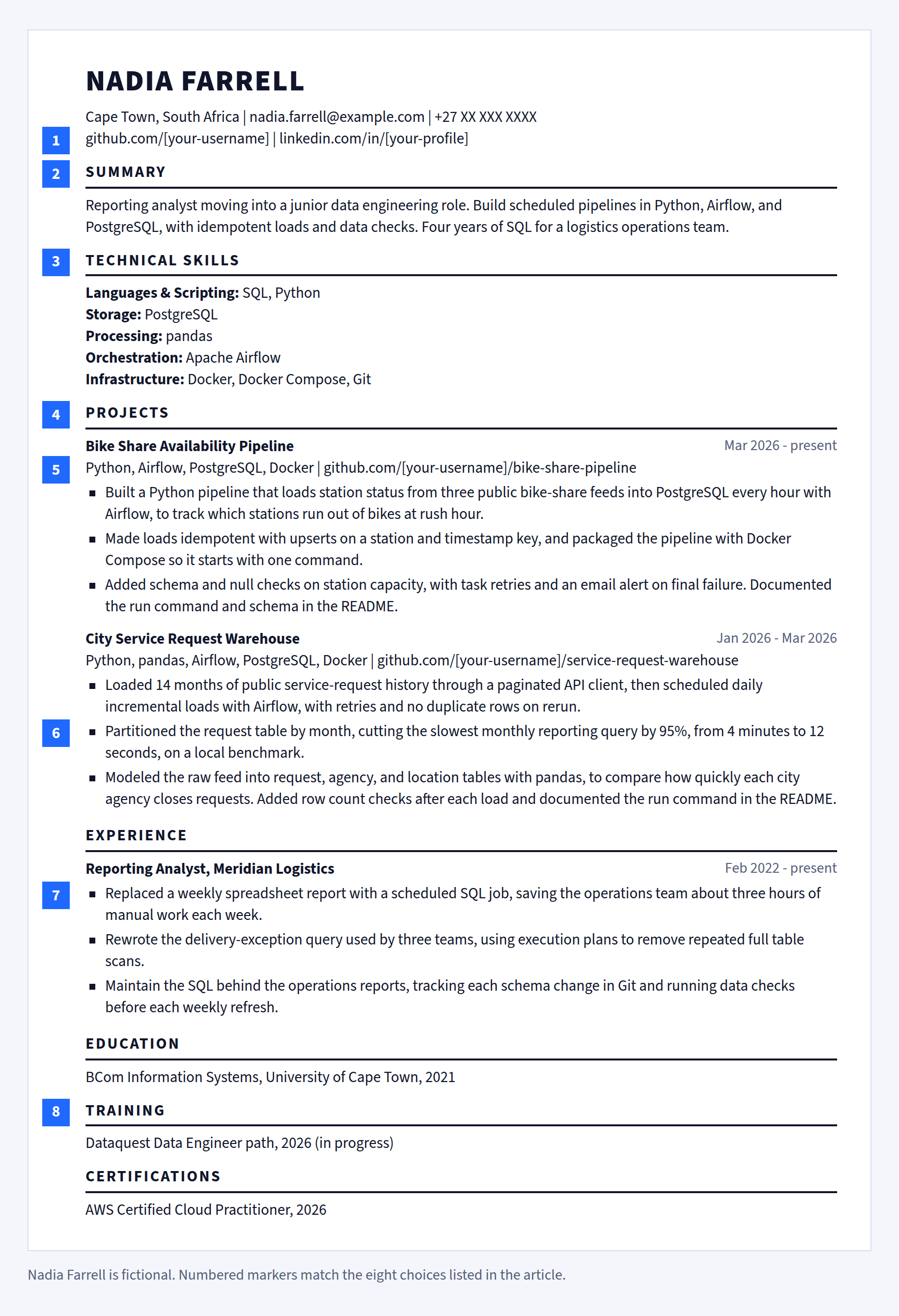
Eight choices on that page are worth naming:
- The GitHub link sits in the contact details at the top. It stays out of the word processor's header, because some applicant tracking systems skip header content.
- The summary states the move in its first sentence. A reviewer knows how to read the page before reaching the projects.
- Every skill shows up in a project or job line. Nothing in the skills block is there just for the keyword match.
- Projects sit above experience. That's where her data engineering evidence is.
- Every project entry has a repo link, a stack line, dates, and a question it answers. A reviewer can open each one and ask about it.
- The only percentage comes with its before and after. No line claims uptime or a production result she can't show.
- The job lines lead with scheduled SQL work and query tuning. Her title stays Reporting Analyst.
- The path is marked "in progress," and training and certifications sit last. AWS appears only as a foundational certification, because no project of hers runs on AWS yet. Her next project is the place to change that.
The page is also one column, one page, and uses standard section headings, so applicant tracking systems can read all eight of those choices.
Common Data Engineer Resume Mistakes
Check your entry-level data engineer resume for these seven mistakes before you send it:
- A tool you list but never show. If Kubernetes is in your skills block and nowhere in a line, a reviewer may assume you've only read about it. Name it in the line where you used it, or take it off.
- Invented uptime, speed, or cost-saving numbers. They can get past an applicant tracking system, then fall apart in the first technical interview. Use only numbers you measured, with the before and after.
- "Built an ETL pipeline" with no sources, schedule, or destination. It gives a reviewer nothing to ask about. Name the feeds, how often it runs, and where the data lands.
- A repo link that's broken, has no README, or holds one untouched tutorial. The link invites a reviewer in, so make sure it opens onto something that runs.
- Row counts copied from a dataset's documentation. If the dataset has 30 million rows and you loaded three months, quote the number you loaded.
- Two pages with no data engineering job history. Without that history, one page is plenty. Trimming to fit usually makes the page better.
- A certification in place of a project. A certification helps you get past filters and gives your learning structure. Keep it next to a project that a reviewer can open and ask about.
What to Do Next
A data engineer resume can only describe what you've built. If your lines feel thin, the fix is usually in the projects, not the writing. When three rewrites of the same line still leave you nothing to explain, build another pipeline instead of writing another draft.
The first line of Nadia's bike-share entry uses all four parts of the bullet formula. Use it as the model for each new line you add.
When you're ready to add the next project to that page, try our Data Engineer path. It includes 14 projects, with courses covering Python, PostgreSQL, Spark, Docker, Airflow, and cloud deployment.
Frequently Asked Questions
How do I write a data engineer resume with no experience?
Put your projects above your work experience, and make every claim something a reviewer can check. Name the tools, the data sources, and how often each pipeline runs. Link to repos that have a README and a run command. Use only numbers your own pipeline or benchmark produced.
How long should my data engineer resume be?
One page, for most entry-level or transitioning candidates. If yours runs longer, cut coursework you haven't used first. Then cut early jobs with no data work, then lines that repeat the same skill. Last, cut any project that isn't among your strongest three.
What skills should I put on a data engineer resume?
Start with SQL and Python, then add the tools your projects use, such as PostgreSQL, Airflow, and Docker. Group them the way the posting groups them, and match its exact wording. Only list a tool if a project or job line shows you using it. Our guide to data engineering skills covers what postings ask for in more detail.
Do I need a GitHub on my data engineer resume?
Yes, and your profile page matters as much as the repos. Pin the two or three repos your resume links to, and archive or delete forks you never changed. Give each pinned repo a one-line description that names its sources and stack.
Before you send anything, search your commit history for API keys and passwords. Deleting a key from your code doesn't remove it from old commits in a public repo. If you find one, rotate the key first, then remove it from the history.
Can a data analyst become a data engineer?
Yes. SQL sits at the center of the job, and years of SQL against real business data is exactly what an analyst background gives you. Target postings that name SQL and Python before they name Spark and Kubernetes. Look for "analytics engineer" and "junior data engineer" alongside the main title.
Do I need a cloud certification to get a data engineering job?
A cloud certification helps in two ways. It gets your resume past filters that look for AWS, GCP, or Azure by name, and it gives structure to learning a platform. It doesn't answer the next question a hiring manager asks, which is what you've deployed.
Hold the certification and ship a project on that platform. Look at data engineering certifications worth holding before you pay for one.
Can I list a course project on my data engineer resume?
Yes, if you can say what you did beyond the brief. A guided project you extended with a new source, a schedule, or tests is your project, and the line should lead with the part you added. A project you finished exactly as written belongs under training as coursework, not under projects.
Is it okay to use AI to write my data engineer resume?
Use it to check your resume, not to write it. Ask it to list every tool in your skills block that no line mentions, and every number you couldn't show the query for. Never accept a number it adds. Read the final version aloud, because a sentence you wouldn't say in an interview doesn't belong on the page.
What should I do when a posting asks for five years of experience?
Apply anyway if you can show most of the tools the posting names. Requirements lists often mix must-haves with nice-to-haves, and where a tool appears in the posting tells you which is which.
| Where the tool appears | How to read it |
|---|---|
| Responsibilities section | The role uses it daily, so show it in a line before you apply |
| Requirements block only | Often a nice-to-have, and a gap here is worth applying through |
| Neither, only in the company blurb | Context about the stack, not something you're screened on |