
How to Become an AI Engineer in 2026 (A Complete Roadmap)
This AI engineer roadmap shows you how to become an AI engineer, one phase at a time. You'll see what the job involves, the skills employers check for, and the project to build in each phase. You'll also see how long it takes and how to land your first AI engineer job.
AI engineers build the systems that connect large language models to real products. Think of a customer support chatbot that actually resolves tickets, an internal search tool that finds answers across thousands of company documents, or an AI agent that automates multi-step workflows. It's building production software with AI at the core, not research or model training.
We built this guide to match what the job market actually rewards in 2026, not what looked impressive two years ago. At Dataquest, our AI Engineer in Python path follows the same overall order with hands-on projects from day one. Let's get into it.
Table of Contents
- Why AI Engineering?
- What Does an AI Engineer Actually Do?
- Is AI Engineering Right for You?
- How Long Will This Take?
- The Complete AI Engineer Roadmap
- What Should Your AI Engineer Portfolio Include?
- How Do You Land Your First AI Engineer Job?
- Common Mistakes to Avoid
- Your Next Steps
- Wrapping up
- FAQ
Why AI Engineering?
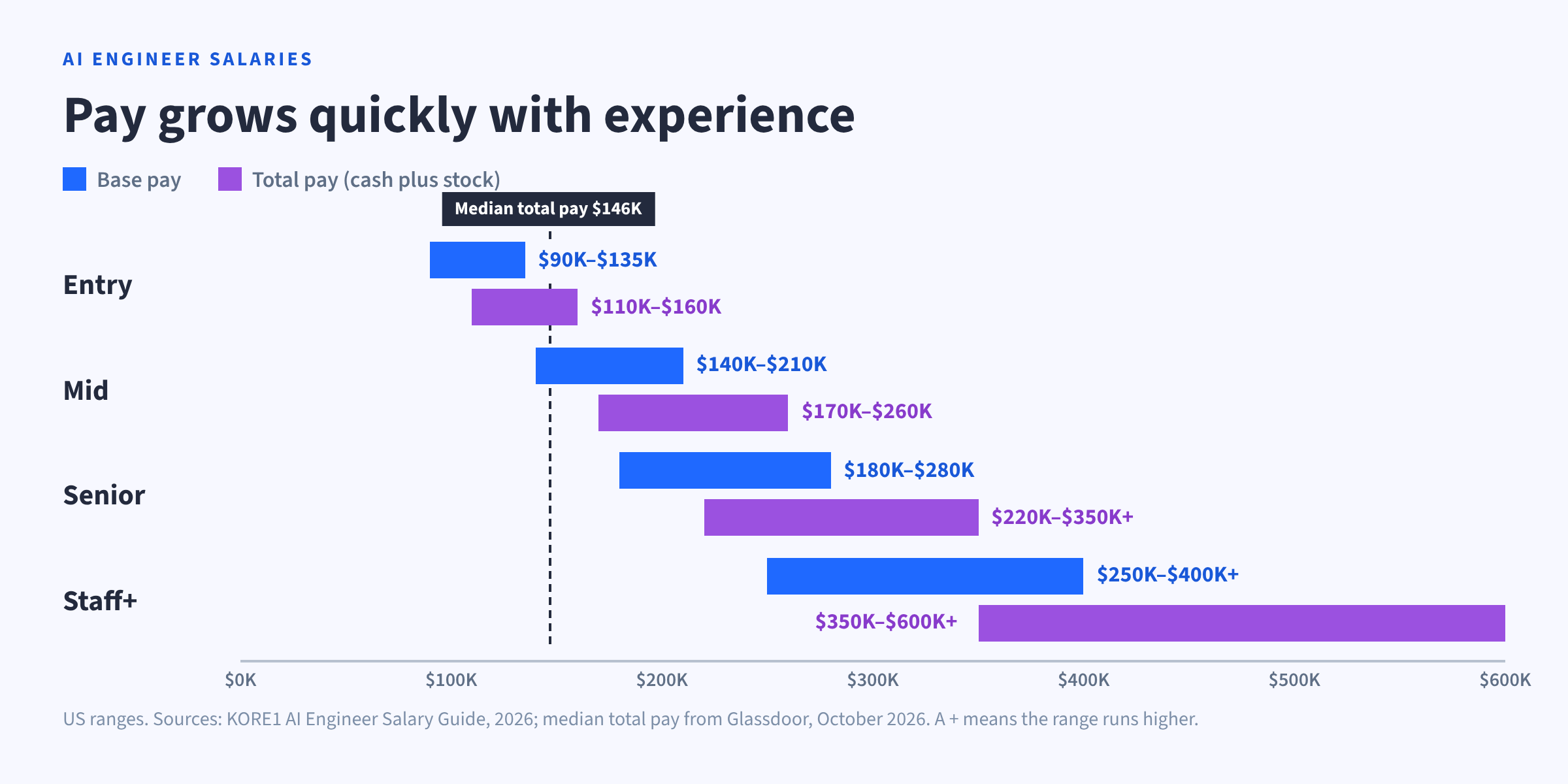
AI engineers in the United States earn a median of about $146K a year in total pay, according to Glassdoor. Levels.fyi, which collects pay data from tech workers, puts the median at $151K.
Pay rises quickly with experience. KORE1's 2026 AI engineer salary guide puts entry-level base pay at $90K to $135K. Mid-level base pay is $140K to $210K, and senior base pay runs from $180K to $280K.
AI skills also add a premium. In Levels.fyi's 2025 analysis, entry-level AI engineers earned about 6% more than engineers at the same level outside AI. At staff level, the tier above senior, the gap was about 19%.
The job market is growing fast. The Bureau of Labor Statistics projects 22% growth for computer and information research scientists from 2025 to 2035, well above the 3% average across all occupations. BLS doesn't track "AI engineer" as a standalone category yet, but this is the closest proxy for the broader growth of advanced computing and AI-related work.
LinkedIn ranked AI Engineer the #1 fastest-growing job title in the US for both 2025 and 2026. LinkedIn data published by the World Economic Forum shows AI has already created 1.3 million new roles globally, including AI Engineers, Forward-Deployed Engineers, and Data Annotators.
The tools will change. The fundamentals won't. Connecting models to real products, building reliable pipelines, and deploying systems that actually work in production? That's software engineering, and it stays valuable no matter what the next wave looks like.
What Does an AI Engineer Actually Do?
AI engineers build applications with pre-trained models. They don't typically train models from scratch. That distinction matters because it shapes what you need to learn.
Picture a typical team. A data scientist designs a model that reads customer reviews and labels each one positive or negative. A machine learning engineer trains that model and makes it fast and reliable.
As the AI engineer, your job is to build that model into a product that customers actually use. More often, you'll start from a pre-trained large language model (LLM) from OpenAI, Anthropic, or Google. You might also use an open-weight model, which is one anyone can download and run.
You connect models to real data, handle edge cases, build evaluation pipelines, and deploy the whole system to production. Let's walk through a realistic Tuesday for a mid-level AI engineer at a mid-sized tech company.
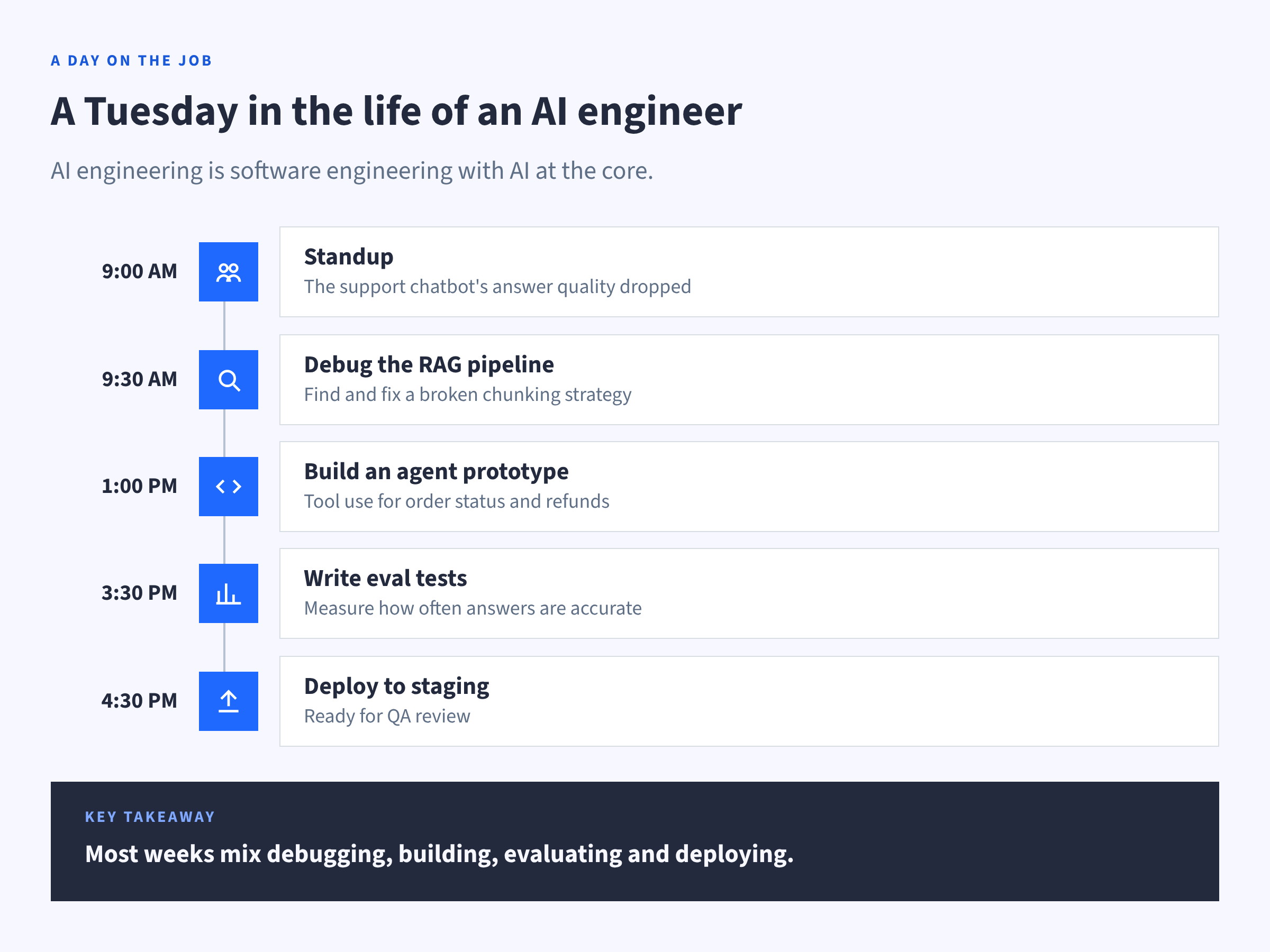
Your morning starts with a standup where you learn that the customer support chatbot's answer quality dropped over the weekend. The chatbot uses retrieval-augmented generation (RAG), so it looks up the right help articles before it answers. You spend two hours checking that lookup step. You find that a recent document update broke the chunking strategy, the rule for splitting long articles into small pieces, and you fix it.
After lunch, you build a prototype agent that uses tool use, so the chatbot can look up order status and start refunds itself. You write evaluation tests to measure answer accuracy. Then you deploy the updated pipeline to a staging environment, a test copy of the product, for quality checks (QA).
That mix of debugging, building, evaluating, and deploying is what most of your weeks look like. The work has more in common with software engineering than with academic research or model training.
AI Engineer vs. Related Roles
AI engineering overlaps with several technical roles, and the boundaries are still being drawn. You'll see job postings that use "AI engineer" and "ML engineer" interchangeably, or list data science responsibilities under an AI engineering title. The confusion is real, and it matters because studying for the wrong role wastes months. Each role has a distinct focus, and understanding where AI engineering sits relative to its neighbors will help you target your learning.
| Role | Core Focus | Primary Output | Key Tools | Math Depth |
|---|---|---|---|---|
| AI Engineer | Building apps using models | Chatbots, RAG systems, AI agents | LangChain, LLM APIs, vector DBs, FastAPI | Moderate |
| ML Engineer | Building and training models | Trained models, ML pipelines | PyTorch, TensorFlow, SageMaker | Deep |
| Data Scientist | Extracting insights from data | Analyses, dashboards, predictions | pandas, scikit-learn, SQL, Tableau | Deep |
| Software Engineer | Building software systems | Web apps, APIs, infrastructure | Java, JS, Python, Go, AWS | Low–Moderate |
You'll also see a newer title, the forward-deployed engineer. OpenAI describes the role as leading "complex end-to-end deployments of frontier models in production." Think of it as an AI engineer who works directly with one customer to get a system live. If you like both building and talking with users, it's worth adding to your job search.
Is AI Engineering Right for You?
Before investing months of your time learning these skills, it's worth asking whether the day-to-day reality matches what you're looking for in a career.
Take this quick quiz to see how well AI engineering aligns with your working style and interests.
How Long Will This Take?
Timelines vary based on your starting point. The table shows our estimates for getting job-ready at about 5 hours a week. They're estimates, not measured averages. The shorter timelines assume you move fast through the parts you already know.
| Starting Background | Estimated Timeline | Why |
|---|---|---|
| From scratch (no programming) | 8–12 months | Need Python + software engineering fundamentals before AI-specific skills |
| Transitioning from software engineering | 3–5 months | Strong coding foundation; need AI/LLM domain knowledge |
| Transitioning from data science / ML | 3–6 months | Statistical foundations set; need software engineering and deployment skills |
| Transitioning from data analysis | 6–9 months | SQL and analytics transfer; need Python depth and software engineering fundamentals |
These are "job-ready" timelines, meaning you can apply for AI engineering roles and have a portfolio to show. They're not "expert" timelines.
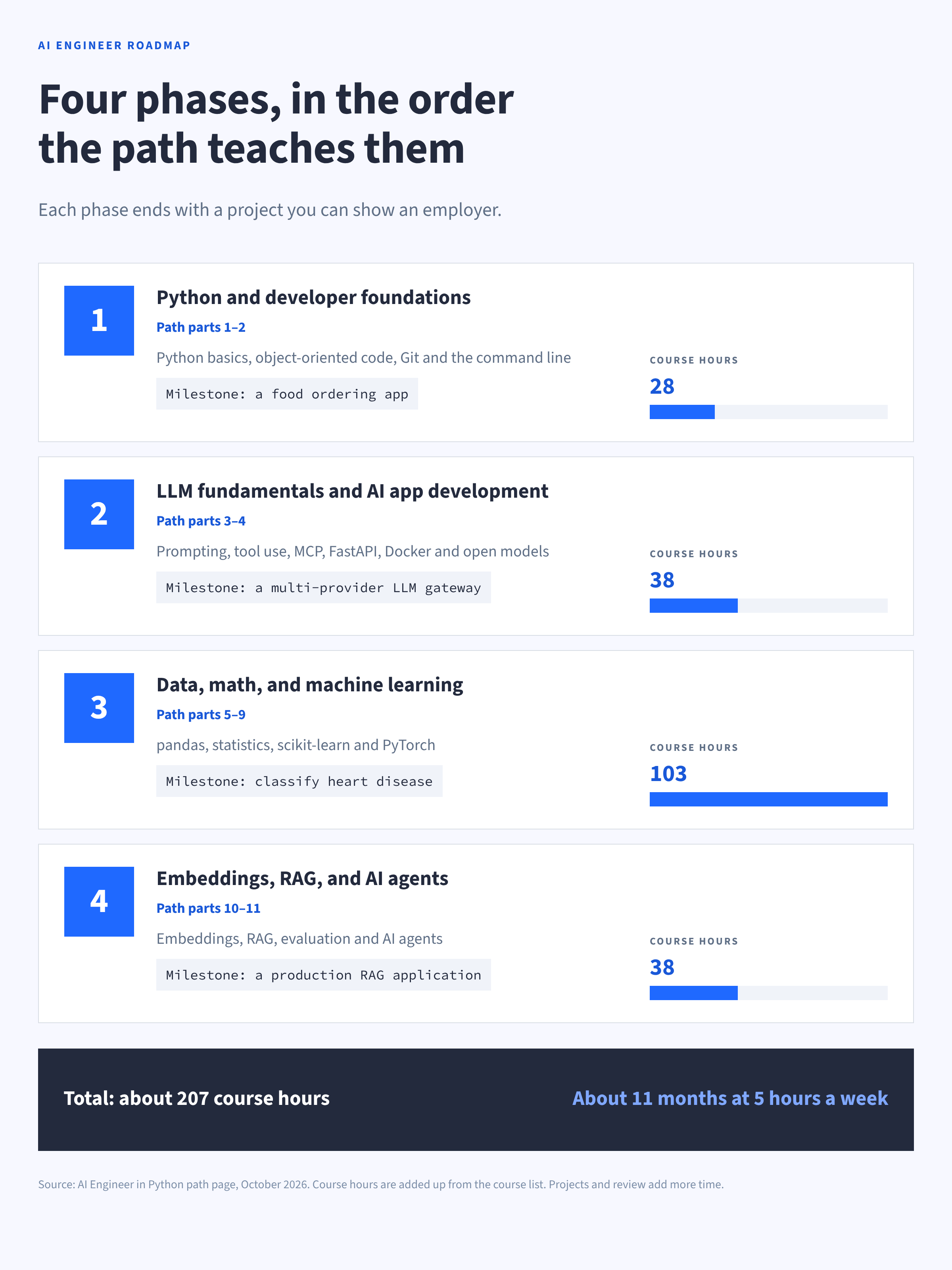
Our AI Engineer in Python path is built for about 11 months at 5 hours a week. Its 33 courses add up to about 207 hours, and projects and practice fill the rest of that time.
If you want the course hours for each stage, our guide on how to learn AI programming breaks them down.
The Complete AI Engineer Roadmap
The roadmap has four phases. Each one builds on the last, and each one follows the order our AI Engineer in Python path teaches.
You start with Python. Next, you learn to call language models from code and turn that into an app you can deploy. Then you learn the data and machine learning skills behind the models. Last, you connect a model to your own documents, measure how well it answers, and learn to build AI agents.
Phase 1: Python and Developer Foundations

Path parts 1 and 2 · about 28 hours of courses
Everything in AI engineering runs on Python. This phase gives you the programming fundamentals, developer tools, and coding habits you'll rely on for the rest of the path.
You'll learn variables, loops, dictionaries, and functions first. Then you move to object-oriented programming, error handling, and the tools developers use every day. These include the command line, virtual environments, and Git, which saves versions of your code.
Employers often check that you can read code you didn't write, fix an error from its message, and use Git without help.
Milestone project: Build a Food Ordering App with menus, cart management, and order processing. Push it to GitHub with a clean README.
def add_to_cart(cart, item, price, qty=1):
    if item in cart:
        cart[item]["qty"] += qty
    else:
        cart[item] = {"price": price, "qty": qty}
    total = cart[item]["price"] * cart[item]["qty"]
    print(f"Added {qty}x {item} - subtotal: ${total:.2f}")
    return cart
Phase 2: LLM Fundamentals and AI App Development

Path parts 3 and 4 · about 38 hours of courses
This is where you start building with AI. You learn to send text to a large language model (LLM) from your code and use its reply. You also learn prompt writing, how to manage tokens (the chunks of text a model reads and writes), and tool use. Tool use, also called function calling, is when a model asks your code to run a function, like a search, and then uses the result.
You'll also meet the Model Context Protocol (MCP). It's an open standard for connecting models to tools and data. It's now run by the Agentic AI Foundation under the Linux Foundation, so it isn't tied to one company.
Then you turn your code into an app. You build a web API with FastAPI and package it with Docker so it runs the same way anywhere. You also try open-weight models from Hugging Face and compare them with paid ones.
Employers often check that you can call a model, handle a bad or slow reply, and deploy a working API.
Milestone project: A multi-provider LLM gateway. That's one API that can send a request to more than one model provider. Deploy it with FastAPI and Docker. Along the way, you also build an AI chatbot and deploy a containerized AI service.
Phase 3: Data, Math, and Machine Learning

Path parts 5 to 9 · about 103 hours of courses
This is the longest phase. It teaches you how models learn, so you can tell when one is wrong and why.
You'll clean and chart data with pandas, NumPy and matplotlib. Then you learn statistics and probability, and train models with scikit-learn. Last, you build neural networks with PyTorch. Calculus and linear algebra show up in two short courses, about 2 hours each.
Employers often check that you can explain why a model got something wrong. They'll also check that you test on data the model hasn't seen.
Milestone project: Guided projects with real data, including a model that classifies heart disease. You also build a PyTorch model that spots pneumonia in chest X-rays.
Phase 4: Embeddings, RAG, and AI Agents

Path parts 10 and 11 · about 38 hours of courses
Parts 10 and 11 cover embeddings, RAG, and evaluation. The path already teaches the building blocks for agents, including tool use, MCP, and agent memory. A dedicated AI agents part, Part 12, is coming soon, right after the path's RAG courses.
On its own, a model only knows what it learned in training. It doesn't know your company's documents. This phase teaches you to fix that.
First, you learn embeddings. An embedding turns text into a list of numbers that captures its meaning. You store these in a vector database like Chroma, which finds the closest match fast.
Then you build retrieval-augmented generation (RAG) systems. Your code finds the most useful document first, then hands it to the model with the question.
You also learn to test your system. That means checking if it found the right document and if the answer stayed true to it. Many people skip this step, so it can help your portfolio stand out.
Then you learn to build AI agents. An agent is a system where the model plans steps and calls tools in a loop until a task is done. A useful agent does more than call tools. It recovers when a step fails, keeps notes between runs (called agent memory), and asks before it does anything risky.
In production, agents also need to run on their own, pick up where they left off after a crash, and stay within a budget. Frameworks like LangGraph help with that.
Employers often check that you can show numbers for how often your system answers correctly. A demo that works once isn't enough. They also check that you can limit what an agent is allowed to do. And they want to see what happens when a tool call fails.
Milestone project: A production RAG application that answers questions from a set of documents. Before that, you build a knowledge base search system with a vector database.
The roadmap is designed to get you building from day one. Each phase produces something real, not just notes from a lecture. By the time you finish the AI Engineer in Python path, you'll have worked through more than 20 projects.
What Should Your AI Engineer Portfolio Include?
Hiring managers look for proof that you can build and release working software. A few finished projects show that better than a long list of courses.
Aim for three projects. Each one shows a different part of the job.
| Project | What it proves | What to show with it |
|---|---|---|
| A deployed AI app | You can turn a model call into a working service | A live link or a Docker setup someone else can run |
| A RAG system with evaluation | You can ground answers in real documents and measure quality | A short report with your test questions and scores |
| An AI agent that uses tools | You can let a model take actions safely | A demo video and notes on what you blocked it from doing |
Your milestone projects give you a head start. The Phase 2 LLM gateway is a deployed AI app, and the Phase 4 production RAG application is a RAG system. Add an evaluation report, your own data, or a feature the guided version doesn't have, so your project doesn't look like everyone else's.
You don't need all three projects before you apply. The next section explains when to start.
Every project needs a README. It should say what the project does, how to run it, and what you'd improve next. That last part shows you can judge your own work.
Pick a problem you actually care about. A search tool for your old course notes is more convincing than another movie chatbot.
How Do You Land Your First AI Engineer Job?
We recommend applying after Phase 3, even if you don't feel "ready" yet. Keep building your Phase 4 project while you interview.
Search for more than one job title. The same work shows up under different names.
| Job title | What it usually means |
|---|---|
| AI engineer | Builds products on top of language models |
| Applied AI engineer | Same work, often on a product team |
| LLM engineer | Focuses on prompts, retrieval, and model calls |
| Forward-deployed engineer | Builds AI systems on site with one customer |
Hiring steps vary by company. OpenAI's interview guide, for example, lists these steps.
- An intro call about your background and the role.
- A skills check, such as pair coding, a take-home project, or a technical test.
- Final interviews, usually 4 to 6 hours with 4 to 6 people.
At startups, you may be asked to design a system out loud. A common example is a tool that answers questions about a set of PDFs, which is a RAG system. A 2026 hiring guide for startups also suggests take-home tasks where you write tests that score a model's answers. Your Phase 4 work on RAG and evaluation prepares you for both, so finish it early in your job search.
If you're still deciding which AI career fits you best, our guide on how to get into AI covers the other routes in.
Common Mistakes to Avoid
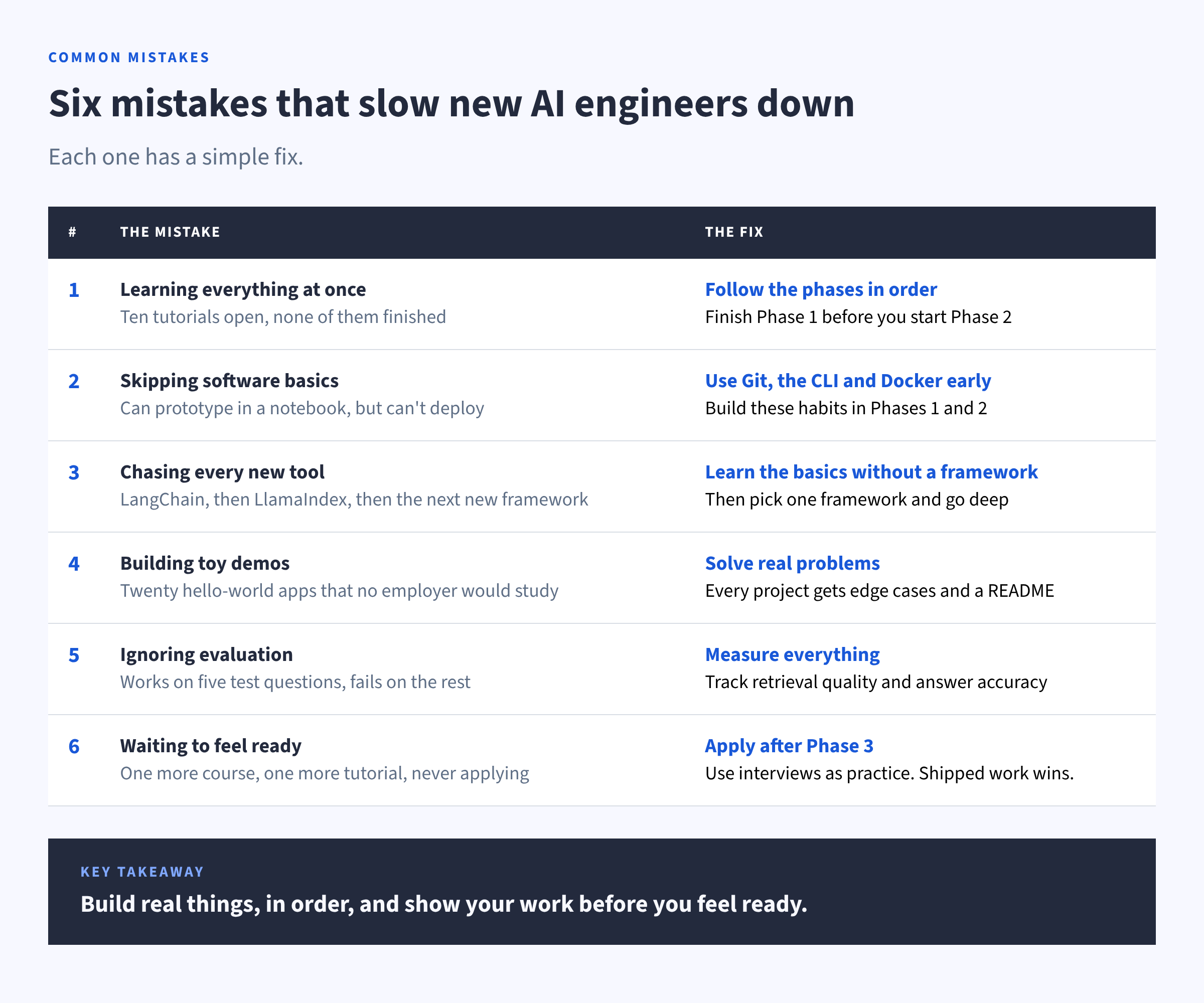
We've seen the same patterns trip up learners across our community, Reddit threads, and support conversations. Most of them come down to skipping the uncomfortable work in favor of something that feels more productive.
The six mistakes in the graphic below share one fix. Build real things, in order, with one tool at a time, and start showing your work before you feel ready. The roadmap above is sequenced specifically to prevent these traps.
Your Next Steps
In the next 24 hours:
- Bookmark this roadmap
- Create a GitHub account if you don't have one
- Start the AI Engineer in Python path. It starts from the basics, so you don't need any coding experience.
- Write your first Python function
This week:
Complete 3–5 Python lessons. Get comfortable with variables, data types, and basic control flow. If you already know Python, move quickly through the Python basics in Part 1 of the path and spend your time on the developer tools in Part 2. Join one community (Reddit or Dataquest Community).
This month:
Make real progress on Phase 1 foundations. Build your first small project and push it to GitHub. If you want a structured path, start the full AI Engineer in Python path.
Documentation to bookmark: LangChain, LlamaIndex, OpenAI API, Claude API, FastAPI. You can also explore our full catalog of AI courses.
Wrapping up
AI engineering pays well, the problems are interesting, and the path is clearer than you might think. Plan on 8 to 12 months of consistent work at about 5 hours a week. You'll move through Python foundations, LLM fundamentals and app building, data and machine learning, and finally RAG, evaluation, and AI agents.
The roadmap is a guide, not a prescription. Move at your pace. What matters is consistent progress and building real things you can show. The Dataquest AI Engineer in Python path follows the same overall order with hands-on projects, so you're building your portfolio from day one.
FAQ
What does an AI engineer do?
AI engineers build software that uses AI models, usually large language models, to solve real problems. A typical week mixes building features like chatbots and search tools, debugging AI pipelines, testing answer quality, and deploying updates. Most AI engineers use pre-trained models instead of training their own.
What skills do you need to become an AI engineer?
You need strong Python, plus developer tools like Git, the command line, and Docker. On top of that, you need to know how to call LLM APIs, build retrieval-augmented generation (RAG) systems, and test how well they work. Employers also look for a working grasp of machine learning and experience building AI agents.
How long does it take to become an AI engineer?
Starting from scratch, plan on 8 to 12 months at about 5 hours a week. Our AI Engineer in Python path is built for about 11 months at that pace. Software engineers can usually get there in 3 to 5 months because they can skim what they already know, data scientists in 3 to 6, and data analysts in 6 to 9.
Do I need a degree to become an AI engineer?
No. While a CS or math degree helps, most employers prioritize demonstrated skill over credentials. A portfolio of deployed projects carries more weight than a diploma for the majority of AI engineering roles. That said, some research-oriented positions at major tech companies may prefer advanced degrees. For more on credentials, see our guide to the best AI certifications in 2026.
Can I become an AI engineer without a computer science background?
Yes. Many successful AI engineers transitioned from data analysis, software engineering, or non-technical fields. The key is investing time in Python and software engineering fundamentals (Phase 1 of this roadmap). Career changers without coding experience should plan for 8–12 months of focused learning.
How much do AI engineers make?
AI engineers in the US earn a median of about $146K a year in total pay, according to Glassdoor. Levels.fyi reports a median of $151K, and the top 10% earn $280K or more. Pay depends a lot on level, company, and location.
Is Python enough for AI engineering?
Python covers most of the work. You'll also need to be comfortable with basic command-line tools, Git, and web technologies (HTTP, REST, JSON). SQL is useful but not essential for most AI engineering roles.
What's the difference between an AI engineer and a machine learning engineer?
AI engineers build applications using pre-trained models, connecting LLMs to products via APIs, RAG, and agents. ML engineers build, train, and optimize the models themselves. AI engineering requires less math and more software engineering. ML engineering requires a deeper understanding of statistics and model architecture.
Can I learn AI engineering in 6 months?
It depends on your starting point and your pace. If you already know Python and have software engineering experience, 3 to 5 months is realistic. Starting from scratch, 6 months is possible at about 8 to 10 hours a week. At 5 hours a week, plan for 8 to 12 months.
What should I learn first for AI engineering?
Python, along with Git and the command line. Everything else builds on them. Next, learn to call LLM APIs and write good prompts, then turn that into an app you can deploy. Don't skip to RAG or agents before you're comfortable making API calls and handling JSON data.
Do I need to be good at math?
Not to start. You can build your first AI apps with Python alone. Math matters more once you learn how models are trained, and statistics and probability come first there. You only need the basics of calculus and linear algebra, and our AI Engineer in Python path covers each in one short course.
Will AI replace AI engineers?
AI tools are changing how AI engineers work. At Google, 75% of all new code is now AI-generated and approved by engineers, according to CEO Sundar Pichai. This makes AI engineers more productive, not redundant, because someone still needs to architect systems, evaluate quality, handle edge cases, and make product decisions. The role is evolving, not disappearing.
What certifications do AI engineers need?
No certification is required, but cloud certifications such as the Google Cloud Professional Machine Learning Engineer and the AWS Certified Machine Learning Engineer – Associate are the most recognized supplements to a portfolio. Avoid expensive bootcamp certificates with no brand recognition. For a breakdown of options, see our best AI certifications guide.
Are AI agents the future of AI engineering?
Agents are a growing part of the field. More production systems now use multi-step workflows where a model plans, calls tools, and checks its own work. Open standards like MCP (Model Context Protocol) and frameworks like LangGraph make agents easier to build. Agents still rest on the same skills as the rest of this roadmap, so learn those first.