

Best LLM Courses in 2026
Search for the best LLM courses and you'll find a 90-minute prompt engineering tutorial listed next to a 50-hour engineering program that assumes you already know PyTorch. A free YouTube series from a former OpenAI researcher sits alongside a paid Udemy bootcamp with 14 projects. They're all called LLM courses, but they prepare you for completely different work.
That disconnect wastes time. A career switcher who wants to start prompting in Python doesn't need a 16-week NLP specialization. A senior developer who wants to build a transformer from scratch doesn't need another ChatGPT walkthrough. The right course depends entirely on what you're trying to accomplish.
We reviewed the top 10 LLM courses in 2026, evaluating each on cost, time commitment, prerequisites, content depth, recency, and instructor credibility. Then we organized them by goal: getting started with LLMs, building with Python, and going deep into how language models actually work. Every pick includes honest limitations alongside strengths.
Best LLM Courses in 2026: Top Picks by Goal
Want the short version? Here are the strongest picks for the most common goals:
- Best hands-on LLM in Python: Dataquest Prompting Large Language Models in Python
- Best free prompt engineering primer: ChatGPT Prompt Engineering for Developers (DeepLearning.AI)
- Best end-to-end LLM lifecycle overview: Generative AI with LLMs (DeepLearning.AI + AWS)
- Best for the open-source LLM stack: Hugging Face LLM Course
- Best for understanding LLMs from first principles: Neural Networks: Zero to Hero (Andrej Karpathy)
LLM Courses Compared at a Glance
| Course | Cost | Time | Format | Level | Best For |
|---|---|---|---|---|---|
| Dataquest Prompting LLMs in Python | Free intro / \$49 mo | 6 hr | Interactive browser | Intermediate | Hands-on prompting with Python |
| ChatGPT Prompt Engineering for Developers | Free | ~1.5 hr | Video + Jupyter | Beginner | Fast prompt engineering foundations |
| Microsoft Generative AI for Beginners | Free | ~15-20 hr | Text + code (GitHub) | Beginner | Broad LLM landscape overview |
| LLM Engineering (Ed Donner) | ~\$20 on sale | ~33 hr | Video + projects | Intermediate | Comprehensive LLM engineering |
| LangChain: Agentic AI Engineering (Eden Marco) | ~\$20 on sale | ~12 hr | Video + code | Intermediate | LangChain and LangGraph |
| Generative AI with LLMs (DeepLearning.AI + AWS) | Free audit / \$59 mo | ~16 hr | Video + labs | Intermediate | LLM lifecycle overview |
| Hugging Face LLM Course | Free | ~50+ hr | Text + code | Intermediate-Advanced | Open-source LLM ecosystem |
| Fine-tuning & RL for LLMs (DeepLearning.AI) | Free | ~5 modules | Video + Jupyter | Intermediate-Advanced | Post-training and fine-tuning |
| Neural Networks: Zero to Hero (Karpathy) | Free | ~20 hr | YouTube + notebooks | Advanced | Building an LLM from scratch |
| NLP Specialization (DeepLearning.AI) | Free audit / \$59 mo | ~3 mo | Video + labs | Advanced | Transformer foundations |
For the full breakdown of what each course delivers and where it falls short, keep reading.
What This Guide Covers (and How It Differs from Our Other Guides)
Three related categories of courses often get mixed together:
- AI tools courses teach you how to use ChatGPT, Gemini, or Copilot at work without writing code. If that's your goal, our Best AI Courses guide is a better starting point.
- Generative AI engineering courses teach you to build production applications on top of LLMs: RAG pipelines, agent frameworks, deployment infrastructure. If that's your goal, our Best Generative AI Courses guide covers that.
- LLM courses sit between those two. They focus on the language model itself: what it is, how it generates text, how to prompt it effectively, how to connect it to tools, and how to fine-tune or build one. That's what this guide covers.
The diagram below shows where each learning goal sits and which courses from this guide map to it.
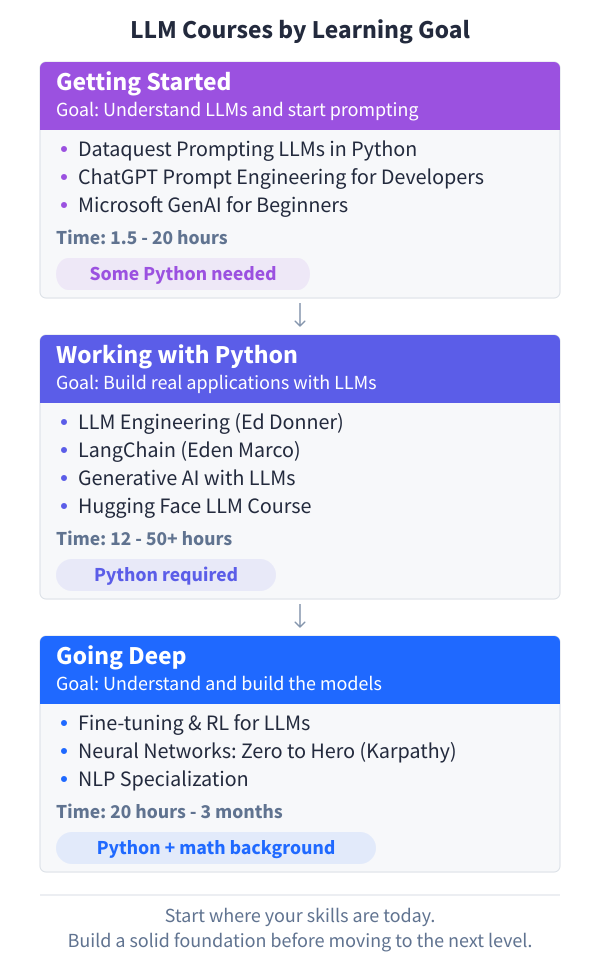
Each section below is organized from beginner-friendly to deeper commitment, so you can start wherever your current skills allow.
Best LLM Courses for Getting Started
These courses are the shortest path to understanding what LLMs are and how to prompt them effectively. They require some Python but no machine learning background, and none takes more than 20 hours.
1. Dataquest Prompting Large Language Models in Python

- Cost: Free to enroll. Full course access requires a paid plan: \$49/month or \$399/year.
- Time: 6 hours, self-paced. 4 lessons plus a guided project.
- Prerequisites: Intermediate Python. Familiarity with APIs is helpful but not required. Dataquest provides supplementary beginner courses to Learn Python, as well as APIs and Web Scraping for those starting from zero.
- What you'll learn:
- The OpenAI Chat Completions API and how to structure requests
- Managing conversation histories for multi-turn interactions
- Core prompt engineering techniques: zero-shot, few-shot, and chain-of-thought prompting
- Token usage and how it affects cost and context limits
- Building an AI chatbot workflow from scratch
- Testing and iterating on prompts systematically
- Industry recognition: 4.79/5 on CourseReport. 4.8/5 stars from 359 course reviews, 2,279 learners enrolled. Part of Dataquest's Generative AI and AI Engineer paths.
- Best for: Python developers who want hands-on experience with LLM APIs and practical prompt engineering, with immediate feedback on every prompt they write.
Why it works: Dataquest's Prompting LLMs course is built around doing, not watching. You write code directly in the browser, call real LLM APIs, and see the output immediately. That feedback loop is the actual skill you're building, and the course structures it deliberately across 6 hours.
The coverage of conversation history management is a practical highlight that shorter courses skip. Multi-turn context handling is essential for building anything beyond a single-shot prompt.
Worth knowing: This course focuses on prompting and API usage. It doesn't cover tool use, function calling, or connecting LLMs to external systems.
For learners ready to go further, Dataquest's Tool Use with LLMs in Python picks up exactly where this course leaves off, teaching function calling, Pydantic validation, and MCP server integration. And if you want a no-code entry point before diving into Python, Dataquest's AI Chatbots course lets you explore LLM interactions through Chandra, Dataquest's AI tutor, without writing any code.
2. ChatGPT Prompt Engineering for Developers (DeepLearning.AI)
- Cost: Free
- Time: ~1.5 hours
- Prerequisites: Basic Python. No machine learning background required.
- What you'll learn:
- How LLMs work at a high level and why prompt wording matters
- Two types of prompting patterns: zero-shot and few-shot
- Systematic prompt engineering principles for reliable outputs
- Five core LLM tasks: summarizing, inferring, transforming, expanding, and building chatbots
- Iterative prompt development methodology
- Industry recognition: Taught by Isa Fulford (OpenAI) and Andrew Ng (DeepLearning.AI). Widely regarded as the starting point for developer-focused prompt engineering.
- Best for: Developers who want the fastest possible introduction to effective prompting from the team behind ChatGPT, before committing to a longer course.
Why it works: ChatGPT Prompt Engineering for Developers is the closest thing to a canonical prompt engineering primer. In 90 minutes, Isa Fulford and Andrew Ng cover the principles that determine whether a prompt produces useful output. The iterative development approach (write, test, observe, refine) is more useful than any list of prompt templates because it teaches a repeatable process.
The Jupyter notebook format means you run every example in your browser and see results in the same session.
Worth knowing: At 90 minutes, this course stays conceptual. You'll understand what good prompting looks like but won't have enough practice to make it automatic. It's best treated as a starting point. If you want sustained practice afterward, the Dataquest Prompting LLMs course provides 6 hours of structured coding exercises that build on the same foundations.
3. Microsoft Generative AI for Beginners

- Cost: Free (MIT licensed open-source curriculum)
- Time: 21 lessons, self-paced (~15-20 hours depending on engagement with coding exercises)
- Prerequisites: Basic knowledge of Python or TypeScript. Microsoft provides supplementary beginner courses for those starting from zero.
- What you'll learn:
- What generative AI is and how LLMs work
- Prompt engineering principles and techniques
- Text, chat, and image generation with LLMs
- Function calling and connecting LLMs to external data
- Retrieval-augmented generation (RAG) basics
- Open-source models and responsible AI practices
- AI agent fundamentals
- Industry recognition: 111,000+ GitHub stars, 59,600+ forks. Translated into 50+ languages. One of the most-starred educational repositories on GitHub.
- Best for: Learners who want a free, self-paced introduction to LLMs and generative AI that covers the full landscape without deep technical prerequisites.
Why it works: Microsoft's Generative AI for Beginners covers more ground than most paid courses at the same level. The 21 lessons move from foundational concepts through prompt engineering, function calling, RAG, agents, and responsible AI, with code examples in both Python and TypeScript. The GitHub-based format means the content is version-controlled and community-maintained.
The 111,000+ GitHub stars reflect broad adoption, and the open-source format makes updates and community contributions visible.
Worth knowing: The breadth is also a limitation. Each topic gets one lesson, so depth on any single area is limited. This is a landscape course, not a deep-dive. You'll know what questions to ask and which direction to go next, but you'll need more focused courses to build working skills in any one area.
Best LLM Courses for Working with Python
These courses require Python comfort and take you from calling LLM APIs to building complete workflows. They're for learners ready to write code that works with language models in practice.
4. LLM Engineering: Master AI, Large Language Models & Agents (Ed Donner, Udemy)

- Cost: Udemy pricing varies. Typically \$14.99-\$19.99 on sale (Udemy runs sales frequently). List price is higher.
- Time: ~33.5 hours of content, 208 lectures. Expect 6-8 weeks with projects.
- Prerequisites: Python required. Basic familiarity with APIs and working in a code editor.
- What you'll learn:
- Transformer architecture and how LLMs generate text
- Working with OpenAI, Anthropic, and open-source model APIs
- Prompt engineering for production use
- RAG (retrieval-augmented generation) with vector databases
- Fine-tuning with LoRA and QLoRA
- Building AI agents that use tools and make decisions
- 8 complete projects from chatbots to autonomous agent systems
- Industry recognition: 4.7/5 stars from 34,700+ ratings. 245,000+ students enrolled. Bestseller badge. Last updated February 2026. Instructor Ed Donner is a former AI startup CEO and former Managing Director at JPMorgan Chase, with a patent for a deep learning matching engine.
- Best for: Developers who want a comprehensive path through LLM engineering, covering both commercial and open-source models.
Why it works: LLM Engineering covers the full stack: transformers, prompt engineering, RAG, fine-tuning with LoRA and QLoRA, and multi-step agents. The 8 projects are varied and practical, including a brochure generator that scrapes company websites, a customer support agent with function calling, and a capstone that fine-tunes an open-source model for a focused prediction task and compares it with frontier models.
Ed Donner's background in production AI systems shows in how the projects build on each other. The capstone ties everything together.
Worth knowing: At 33.5 hours, this is a significant time commitment. If you want something shorter and more conceptual, the Coursera course below (#6) covers the LLM lifecycle in 16 hours. Udemy's pricing model means the listed price is almost never what you actually pay. Wait for a sale (they happen almost weekly) and you'll typically pay under \$20.
5. LangChain: Agentic AI Engineering with LangChain & LangGraph (Eden Marco, Udemy)
- Cost: Udemy pricing varies. Typically \$14.99-\$19.99 on sale.
- Time: ~12 hours of content. Re-recorded in 2026 for LangChain version 1.2+.
- Prerequisites: Python proficiency required. Experience with LLM APIs is helpful.
- What you'll learn:
- LangChain architecture and how it connects LLMs to tools
- Building chains, agents, and document loaders
- Prompt engineering theory: chain-of-thought, ReAct, few-shot prompting
- RAG with vector databases (Pinecone, FAISS)
- LangGraph for stateful, multi-step agent workflows
- Model Context Protocol (MCP) integration
- Context engineering for complex applications
- Industry recognition: 4.6/5 stars from 50,500+ ratings. 181,000+ students enrolled. Last updated April 2026.
- Best for: Developers who want fluency in LangChain and LangGraph, two of the most popular frameworks for building LLM-powered applications.
Why it works: LangChain is the orchestration layer most LLM application developers work in day to day, and this course is the most enrolled LangChain course available. Eden Marco re-recorded it in 2026 for LangChain 1.2+ and LangGraph. The course covers when to use chains vs. agents, how to manage memory across conversations, and how to structure RAG pipelines that retrieve relevant context.
The MCP coverage is a notable addition. Model Context Protocol is one of the more significant recent additions to the LLM tooling ecosystem, and most courses haven't caught up.
Worth knowing: This course assumes you already understand LLM fundamentals and can call APIs on your own. If you haven't worked with LLM APIs directly yet, start with one of the courses in the "Getting Started" section first. LangChain also changes frequently, so some code examples may need minor adjustments depending on when you take the course relative to when it was last updated.
6. Generative AI with Large Language Models (DeepLearning.AI + AWS, on Coursera)

- Cost: Free to audit. \$59/month for Coursera Plus subscription (includes certificate).
- Time: ~16 hours across 3 weeks
- Prerequisites: Python familiarity and basic machine learning concepts are helpful.
- What you'll learn:
- Transformer architecture and how LLMs generate text
- The full LLM lifecycle: pretraining, fine-tuning, and deployment
- Prompt engineering fundamentals and in-context learning
- Parameter-efficient fine-tuning with LoRA
- Reinforcement learning from human feedback (RLHF)
- Model evaluation, benchmarking, and responsible deployment
- Industry recognition: 436,000+ learners enrolled, 4.8/5 stars from 3,600+ reviews. Co-developed by DeepLearning.AI and AWS.
- Best for: Developers who want a structured, end-to-end mental model of how LLMs actually work, from data through training to deployment, in about 16 hours.
Why it works: The lifecycle framing is what makes Generative AI with LLMs stand out. You start with how transformer models process tokens, why pretraining creates general-purpose models, and what fine-tuning changes under the hood. That conceptual foundation makes every downstream skill more intuitive.
The labs use AWS SageMaker alongside the theory. The audit option lets you preview the full course before paying.
Worth knowing: This course is stronger on mental models than on day-to-day engineering. You'll finish with a clear understanding of the LLM lifecycle but without deep practice in production tooling. The AWS SageMaker labs can also feel heavy if your goal is simply calling an OpenAI or Anthropic API from a notebook.
7. Hugging Face LLM Course

- Cost: Free
- Time: ~50+ hours, self-paced
- Prerequisites: Python required. PyTorch or TensorFlow familiarity is helpful.
- What you'll learn:
- The Hugging Face library ecosystem: transformers, datasets, accelerate, PEFT, and TRL
- Transformer architecture in practice
- Tokenization and embeddings
- Fine-tuning open-source models with parameter-efficient methods
- Building and deploying NLP applications end-to-end
- Modern LLM training patterns including RLHF and reasoning models
- Industry recognition: Hugging Face is the de facto open-source AI hub. The course is available in 30+ languages, Apache 2 licensed, and continuously updated by the engineers who build the libraries.
- Best for: Developers who want fluency in the open-source LLM stack, meaning the tools working AI engineers reach for when they need to run, fine-tune, or deploy a model without depending on a commercial API.
Why it works: Hugging Face's LLM Course teaches the open-source LLM stack from the engineers who built it. The transformers, datasets, accelerate, PEFT, and TRL libraries are common tools production teams use when working with open-source models. Learning from Hugging Face means the course updates as the libraries do.
The active community forum has working engineers and Hugging Face core team members answering questions regularly.
Worth knowing: The self-directed format demands discipline. No deadlines, no instructor check-ins, no required pace. Setting a fixed schedule (one chapter per week) before starting is the most reliable way to finish. The course is also documentation-style rather than video-led, which works well for developers comfortable reading technical writing but may feel dry compared to video alternatives.
Best LLM Courses for Going Deep
These courses are for learners with Python and some ML background who want to go further: fine-tuning models, understanding transformer architecture, or building a language model from scratch.
8. Fine-tuning & RL for LLMs: Intro to Post-training (DeepLearning.AI)
- Cost: Free
- Time: 5 modules, self-paced
- Prerequisites: Strong familiarity with Python and a basic understanding of how LLMs work.
- What you'll learn:
- Where post-training fits in the LLM lifecycle
- Core techniques: fine-tuning, RLHF, reward modeling, and RL algorithms (PPO, GRPO)
- Using LoRA for efficient fine-tuning
- Evaluation, error analysis, and detecting reward hacking
- Red teaming to test model robustness
- When to fine-tune vs. use prompt engineering or RAG
- Industry recognition: Taught by Sharon Zhou (VP of AI at AMD). Built in partnership with AMD with hands-on labs powered by AMD GPUs. Part of the DeepLearning.AI course library.
- Best for: Developers who want to understand post-training from decision framework through implementation, covering both fine-tuning and reinforcement learning in one course.
Why it works: Post-training is one of the most misunderstood areas in LLM engineering. It gets reached for too early, too late, or not at all. Fine-tuning & RL for LLMs addresses the full picture: when fine-tuning or RL is the right tool, how each method works, and how to evaluate whether it's actually improving your model.
The coverage of GRPO (the reinforcement learning technique behind DeepSeek's reasoning capabilities) and reward hacking detection reflects genuinely current practice.
Worth knowing: For deeper implementation with specific open-source models, the Hugging Face LLM Course and Generative AI with LLMs provide more extended practice. This course gives you the decision framework and core techniques; those courses give you the extended reps.
9. Neural Networks: Zero to Hero (Andrej Karpathy)
- Cost: Free (YouTube)
- Time: ~20 hours of video content, plus significant additional time if you code along (strongly recommended).
- Prerequisites: Strong Python. Basic calculus (derivatives, chain rule). No prior deep learning experience required, but mathematical comfort matters.
- What you'll learn:
- Backpropagation and gradient descent implemented from scratch
- Character-level language modeling: bigrams through progressively deeper architectures
- Multilayer perceptrons, batch normalization, and residual connections
- Tokenization: how raw text becomes model input
- Transformer architecture built step by step in pure PyTorch
- A small GPT-style language model written from scratch
- Industry recognition: Andrej Karpathy is the former Head of AI at Tesla and a former researcher at OpenAI. His Zero to Hero series teaches neural networks by building them from scratch in pure Python and PyTorch, progressing from basic backpropagation to a working GPT-style transformer.
- Best for: Learners who want the deepest possible understanding of how LLMs work, built by constructing one rather than calling one.
Why it works: Neural Networks: Zero to Hero is a course about building. Karpathy walks you through implementing backpropagation by hand, writing a character-level language model, and constructing a GPT-style transformer from scratch. By the end, you've written the code that makes attention heads work.
That construction creates intuition no lecture can replicate. When a model produces unexpected output, you know where in the architecture to look.
Worth knowing: This is the most demanding course on this list. The math is real, the code is non-trivial, and the reward comes from actively building rather than watching. Learners who skip the coding exercises miss the deeper payoff. There are also no assignments, no certificates, and no structured checkpoints. The accountability is entirely yours.
10. Natural Language Processing Specialization (DeepLearning.AI, on Coursera)
- Cost: Free to audit individual courses. \$59/month for Coursera Plus subscription (includes certificate).
- Time: ~3 months at 10 hours/week (4 courses)
- Prerequisites: Intermediate Python, basic linear algebra, and some probability. Prior exposure to machine learning is helpful.
- What you'll learn:
- NLP fundamentals: sentiment analysis, word vectors, named entity recognition
- Probabilistic models: n-grams, Markov models, the Viterbi algorithm
- Sequence models: RNNs, LSTMs, GRUs, and their applications to language tasks
- Attention mechanisms and transformer architecture from first principles
- Pre-training and transfer learning: the foundations that make BERT and GPT-style models work
- Industry recognition: 155,000+ learners enrolled. 4.6 stars on 6,100+ reviews across the program. Taught by Eddy Shyu, Younes Bensouda Mourri, and Lukasz Kaiser. Kaiser is one of the authors of the original "Attention Is All You Need" transformer paper.
- Best for: Learners who want to understand the mathematical and architectural foundations that LLMs are built on.
Why it works: The NLP Specialization builds understanding from the ground up. Course 1 covers classical NLP. Courses 2 and 3 introduce sequence models and show why they struggled with long-range dependencies. Course 4 covers the attention mechanism and transformer architecture. That progression gives you genuine insight into why LLMs work the way they do.
Having Lukasz Kaiser as an instructor on Course 4 is notable. He co-authored the transformer paper, and his architectural intuitions reflect a firsthand perspective.
Worth knowing: This specialization predates instruction-tuned chatbots and closed-API LLMs. It covers transformers and pretraining but doesn't extend to RLHF, instruction fine-tuning, or modern inference patterns. Think of it as the foundation layer: what you learn here explains the behavior of every LLM you'll use, but you'll need more recent courses to work with models directly.
At 3 months, this is also the longest commitment on the list. Worth the investment for deep foundational knowledge, but not where you should start if your primary goal is building LLM applications quickly.
How to Spot an Outdated LLM Course
Every course in this guide passed a recency check before making the list. But LLM tooling changes fast, so if you're evaluating courses outside this guide or revisiting it later, here are five signals to look for.
- When was the course last updated? Most platforms display this on the course page. A course covering modern LLM engineering that was last updated in early 2024 should prompt a closer look.
- For applied LLM engineering courses, does the curriculum mention function calling, tool use, or MCP? These are now foundational to building LLM applications. Their absence suggests the course predates a significant shift in how these applications are architected.
- Which model versions appear in examples? If the examples only reference models from 2023 or early 2024 with no mention of newer releases from major providers, the content likely predates significant capability shifts that change how you design LLM applications.
- What do recent learner comments say? Sort reviews by newest and scan for "deprecated," "doesn't work anymore," or library version complaints. Active learners flag these quickly.
- Does the platform update aggressively? Hugging Face and DeepLearning.AI update course content as the field evolves. Some individual instructors on Udemy do not.
That all said, there is one exception: foundational content ages slowly. The transformer architecture covered in the NLP Specialization is still accurate. The attention mechanism Karpathy implements is the foundation behind modern transformer-based LLMs. Recency checks matter most for applied engineering courses where specific library APIs are taught.
When You Don't Need an LLM Course
A course isn't always the right move. You can probably skip one if:
- You already have a concrete problem to solve. If you need to fine-tune a model on your company's data or build a chatbot for one specific workflow, the OpenAI Cookbook, Anthropic documentation, and Hugging Face tutorials will get you there faster than a structured course.
- You're stuck in tutorial hell. If you've started three LLM courses and finished none, the fourth won't fix the pattern. Pick one project, build it badly, learn from what broke, and iterate.
- You just want to use a chatbot more effectively. Prompt engineering best practices are well-covered by free documentation. Anthropic's prompting guide and the OpenAI docs are thorough and kept current. You don't need a course for that.
- You want practice without course structure. Dataquest's free projects and blog content on key AI concepts provide applied work at your own pace.
Picking Your LLM Course (and Where to Start This Week)
If you're still comparing options, here's the direct version based on where you are:
- You want to start prompting LLMs in Python with real code: Start with Dataquest Prompting Large Language Models in Python. Six hours, interactive, feedback on every prompt.
- You want a fast, free prompt engineering foundation: Take ChatGPT Prompt Engineering for Developers. Ninety minutes, free, from the team at OpenAI.
- You want a comprehensive LLM engineering curriculum: Take LLM Engineering by Ed Donner. Wait for a Udemy sale and pay under \$20 for 33 hours.
- You want to understand LLMs end-to-end in 16 hours: Take Generative AI with LLMs. Free to audit.
- You want to build an LLM from scratch and truly understand the architecture: Commit to Karpathy's Neural Networks: Zero to Hero. Code along. Don't just watch.
Pick one this week. Block study time on your calendar. Finish it before enrolling in another. The biggest predictor of whether you'll learn LLMs isn't which course you choose. It's whether you finish what you start and build something with what you learn.
Frequently Asked Questions
Do I need to learn Python before taking an LLM course?
It depends on the course. The first three courses in this guide require little to no Python. Microsoft Generative AI for Beginners offers both Python and TypeScript tracks, and ChatGPT Prompt Engineering for Developers only requires basic Python.
For the coding-heavy courses (Dataquest, Ed Donner, LangChain, Hugging Face, Karpathy), you'll need at least intermediate Python: functions, classes, working with libraries, and reading error messages. If you're starting from zero, Dataquest's Learn Python skill path is designed to get you to that level before moving into AI work.
What's the difference between prompt engineering and fine-tuning?
Prompt engineering shapes how you communicate with an existing model. You change the input; the model weights stay fixed. It's fast to iterate, costs very little, and works well for a wide range of tasks. It's the right starting point for most LLM work.
Fine-tuning updates the model's weights on a specific dataset, changing how the model behaves at a fundamental level. It's useful when you need consistent tone or format that prompting can't reliably produce, domain-specific vocabulary the base model handles poorly, or cost savings on high-volume tasks where a smaller fine-tuned model can replace a larger prompted one. The DeepLearning.AI Fine-tuning & RL for LLMs course covers exactly when each approach is the right choice.
Should I learn to use commercial LLMs (OpenAI, Anthropic) or open-source ones?
Learn both, starting with commercial APIs. OpenAI and Anthropic APIs are faster to start with: no infrastructure setup, strong documentation, highly capable models. The Dataquest courses and DeepLearning.AI short courses use them for that reason.
Open-source models (Llama, Mistral, Qwen, and others through Hugging Face) matter when you need data privacy, cost control at scale, or the ability to fine-tune on proprietary data without sending it to a third party. The Hugging Face LLM Course is the best path to open-source fluency. In practice, most AI engineers are comfortable with both.
How is this guide different from the Best Generative AI Courses guide?
This guide focuses on the LLM itself: how it works, how to prompt it effectively, how to connect it to tools, and how to customize it through fine-tuning.
The Best Generative AI Courses guide focuses on the application stack built on top of LLMs: RAG pipelines, agent frameworks, deployment infrastructure, and production monitoring. If your goal is building complete AI applications rather than understanding the model layer, that guide is the better starting point.
Are LLM courses still worth it when models update so frequently?
Yes, with one condition: pick courses that teach principles alongside tools. Specific model versions and library APIs shift every few months. The underlying skills (how to structure a prompt, when to fine-tune, how attention mechanisms work, how to evaluate outputs) are durable.
The recency checklist earlier in this guide helps you identify which courses have kept up with the field. Courses that pass those checks are worth the time.
How long does it take to become proficient with LLMs?
Many learners can reach practical prompting proficiency (writing effective prompts, debugging bad outputs, using LLMs reliably for daily tasks) after roughly 20-40 hours of focused learning and practice. The shorter courses in this guide get you there in a few weeks of part-time study.
For engineering-level proficiency (building reliable LLM-powered systems, working with open-source models, fine-tuning for specific tasks), expect 3-6 months at 10 hours per week, including project work. The most important accelerator isn't which course you pick. It's building something real alongside your studying.
Do LLM course certificates matter to employers?
Moderately, and mostly for entry-level screening. Certificates from recognized providers (DeepLearning.AI, Coursera-partnered institutions) signal structured learning. Certificates from unknown providers signal very little.
Portfolio matters more than any certificate at every experience level. A GitHub profile with working LLM projects (a fine-tuned model with documented evaluation, a tool-calling workflow that solves a real problem) tends to outweigh a stack of completion certificates in technical hiring. Build the portfolio first. Certificates are a nice-to-have, not a substitute.
