

How Long Does It Take to Learn Python? (Data Jobs)
How long does it take to learn Python? If you study 5 hours a week, you can learn the basics in about a month. That's enough to write small programs, work with lists and dictionaries, and finish your first projects.
Getting hired takes longer. At the same pace, Dataquest's career paths for data analysts, data scientists and AI engineers take 8 to 11 months. If you're starting from zero, plan for 8 to 18 months, depending on the role.
That's because Python is the language you'll work in, but it's a small part of what a data job asks of you. In our career paths, Python fundamentals take up only 10 to 15 percent of your course hours.
This guide gives you a timeline for each goal, shows where your time goes, and helps you scale it to the hours you actually have.
| Goal | Guided path at 5 hrs/week | Plan from scratch, at 5 hrs/week |
|---|---|---|
| Python basics | About 1 month | About 1 month |
| Data analyst | About 8 months | 8 to 12 months |
| Data scientist | About 9 months | 12 to 18 months |
| AI engineer | About 11 months | 8 to 12 months |
Sources: Dataquest path pages and Dataquest's data analyst, data scientist and AI engineer roadmaps, November 2026.
Table of Contents
- How long does it take to learn Python basics?
- Why does learning Python for a data job take longer than learning Python?
- How long does it take to learn Python for data analysis?
- How long does it take to learn Python for data science?
- How long does it take to learn Python for AI engineering?
- How many hours a week do you need to learn Python?
- Do AI coding assistants make learning Python faster?
- What slows people down, and how do you stay on track?
- Final thoughts
- FAQ
How long does it take to learn Python basics?
At 5 hours a week, you can learn the Python basics in about a month. That's the pace the Learn Python skill path is built for: three courses with about 20 hours of lessons, plus guided projects.
By the end, you'll be able to store values in variables, work with numbers and text, keep data in lists and dictionaries, repeat steps with loops, make decisions with if statements, and package your code into functions. You'll also learn to read data from a file, which is when Python starts to feel useful.
You'll spend the rest of the month on projects, review and the slower parts of learning, like getting stuck on an error and working out why.
Here's the kind of program you'll be able to write once the basics click. It reads a small file of app data and counts how many apps fall into each genre.
import csv

genre_counts = {}

with open("apps.csv") as f:
    for row in csv.DictReader(f):
        genre = row["genre"]
        genre_counts[genre] = genre_counts.get(genre, 0) + 1

for genre, count in genre_counts.items():
    print(f"{genre}: {count}")
Run on a five-row sample file (fictional data), it prints:
Finance: 2
Health: 1
Games: 2
It's a small program, but it uses most of the basics at once: a library import, a dictionary, a loop, a file and formatted output. The projects in the Learn Python path work the same way on real datasets. In one, you'll work out which kinds of apps are most profitable, using App Store and Google Play data. Once you can write programs like this, our list of beginner Python projects gives you more to build.
How many weeks this takes depends more on how steady you are than on your total hours. Five hours spread across the week will get you further than one long weekend session followed by two weeks off, because you'll spend less time relearning what you forgot.
Why does learning Python for a data job take longer than learning Python?
Python is the quick part. Most of your time on the way to a data job goes into what you do with Python once you know it.
Here's how much of each Dataquest career path is Python fundamentals:
- Data Analyst in Python career path: about 15 percent of course hours
- Data Scientist in Python career path: about 10 percent
- AI Engineer in Python career path: about 14 percent, including Python tooling
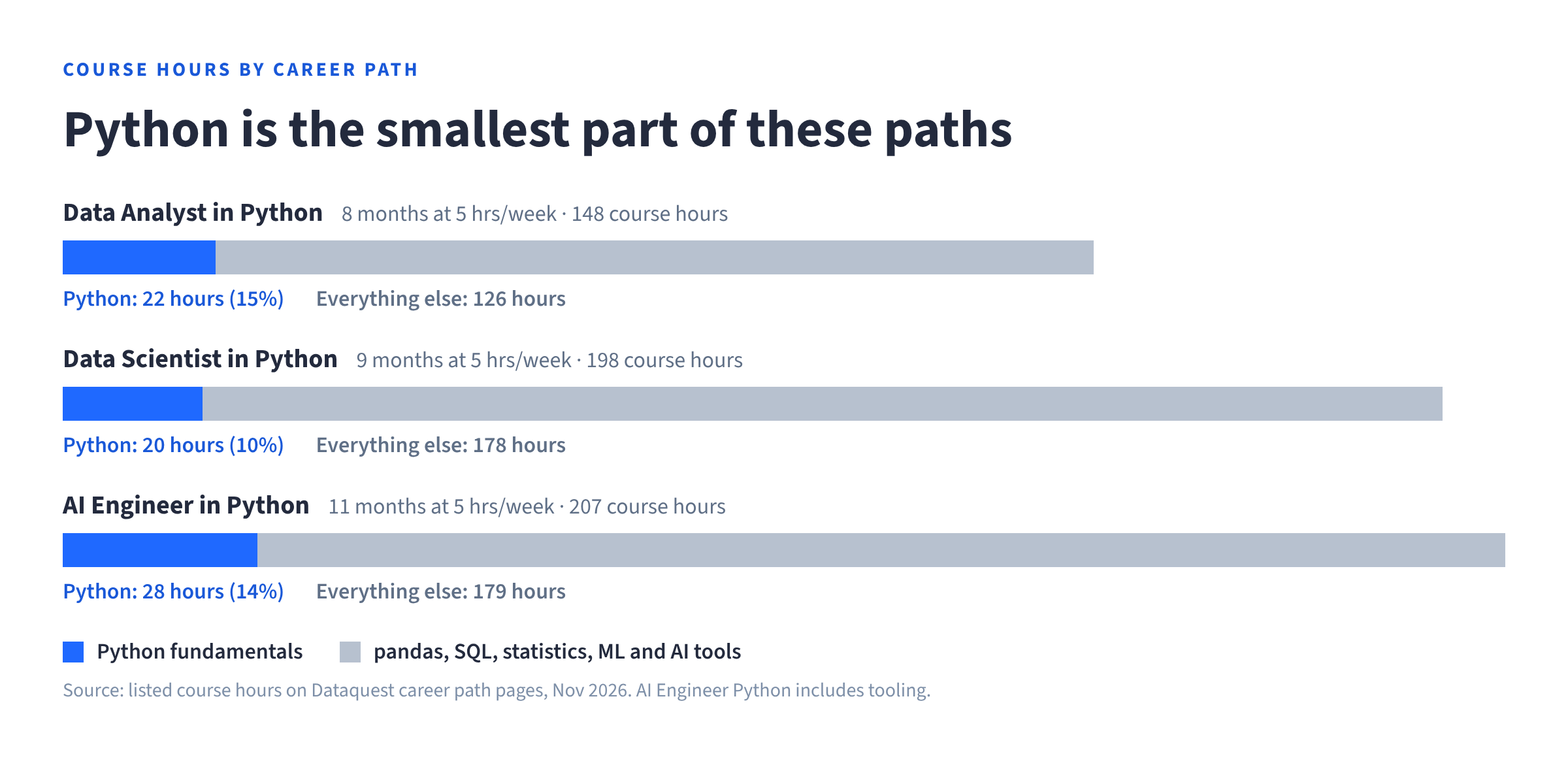
Python fundamentals are the smallest part of each career path
You'll spend the rest on the skills employers check. As an analyst, you'd spend far more time on pandas, data cleaning, SQL and statistics than on Python syntax. If you aim for data science, you'll add machine learning on top of that. As an AI engineer, you'll work with large language models (LLMs), APIs, embeddings and retrieval systems.
That doesn't make Python less important. You'll use it for every one of those skills, so gaps in your basics will slow down everything you learn after them. If dictionaries feel shaky, for example, you'll struggle with JSON, the format most APIs send data in. And if you can't read a loop, you'll have a hard time debugging your pandas code.
So plan for more than Python. If someone tells you that you can learn Python in a month, they may be right about the language, but that's only your first step toward a data job.
It's also why the timelines in the rest of this guide differ so much. Your Python step is about the same whichever role you choose. What changes is everything you learn after it.
How long does it take to learn Python for data analysis?
If you want to become a data analyst, plan on about 8 months at 5 hours a week. That's what the Data Analyst in Python career path is built for, with 27 courses and 19 projects. If you're starting from zero, our data analyst roadmap suggests planning for 8 to 12 months at that pace, because you'll also need time to build a portfolio and apply for jobs.
Here's where your course hours go, in the order you'll learn them.
| Phase | What you learn | Course hours (share) | Approx. timing at 5 hrs/week |
|---|---|---|---|
| Python fundamentals | Variables, data structures, loops, functions | 22 (15%) | Month 1 |
| Data analysis and cleaning | pandas, NumPy, visualization, data cleaning | 51 (34%) | Months 2 to 4 |
| Command line and SQL | Shell basics, querying and joining tables, window functions | 30 (20%) | Months 4 to 6 |
| APIs and business analysis | Pulling data from APIs, web scraping, business questions | 11 (7%) | Month 6 |
| Statistics | Descriptive statistics, probability, hypothesis testing | 28 (19%) | Months 7 to 8 |
| Version control | Intermediate command line, Git | 6 (4%) | Month 8 |
Course hours from the Data Analyst in Python career path page, November 2026. Shares are of the path's 148 listed course hours. Timing is our estimate, spread in proportion to course hours.
You're job-ready as an analyst when you can take a messy dataset, clean it with pandas, answer a business question with SQL and statistics, and explain the result to someone who doesn't code. Three to five portfolio projects that show you can do this are what will get you interviews.
Your starting point changes your timeline more than anything else. If you already work with data in a role like marketing, finance or operations, the roadmap's estimate drops to 5 to 8 months. You already know what a business question looks like, and spreadsheets have taught you a lot about tables.
How long does it take to learn Python for data science?
If you're aiming for data science, the Data Scientist in Python career path is built for about 9 months at 5 hours a week, with 37 courses and 27 projects. Our data scientist roadmap suggests planning for 12 to 18 months if you're starting from scratch, and 3 to 6 months if you already work as a data analyst.
You'll start with much the same skills as an analyst, then add machine learning and deep learning.
| Phase | What you learn | Course hours (share) | Approx. timing at 5 hrs/week |
|---|---|---|---|
| Python fundamentals | Variables, data structures, loops, functions | 20 (10%) | Month 1 |
| Data analysis and cleaning | pandas, NumPy, visualization, data cleaning | 51 (26%) | Months 1 to 3 |
| Data sources | Command line, SQL, APIs and web scraping | 42 (21%) | Months 4 to 5 |
| Statistics | Descriptive statistics, probability, hypothesis testing | 28 (14%) | Months 5 to 6 |
| Machine learning | Supervised and unsupervised learning, regression, trees, deep learning in PyTorch | 47 (24%) | Months 7 to 8 |
| Advanced tools | Git, Spark for large datasets | 10 (5%) | Month 9 |
Course hours from the Data Scientist in Python career path page, November 2026. Shares are of the path's 198 listed course hours. Timing is our estimate, spread in proportion to course hours.
You don't need advanced math to start. You'll need to be comfortable with basic statistics and know enough calculus and linear algebra to understand what a model is doing, and the career path teaches both before the machine learning courses that use them.
Data science takes longer because it builds on analysis. You'll still clean data and write SQL, and then you'll train, evaluate and explain models on top of that work.
It's also a field that's still growing. The BLS Occupational Outlook Handbook projects employment of data scientists to grow 35 percent from 2025 to 2035, with a median annual wage of $120,230 in May 2025.
How long does it take to learn Python for AI engineering?
If you want to become an AI engineer, the AI Engineer in Python career path is built for about 11 months at 5 hours a week, with 33 courses and 21 projects. Our AI engineer roadmap suggests 8 to 12 months from scratch at that pace, and 3 to 5 months if you're already a software engineer.
You'll start with Python and the tools you'll use around it, such as the command line, virtual environments and Git. Then you'll build applications with LLMs before you go deeper into data and models.
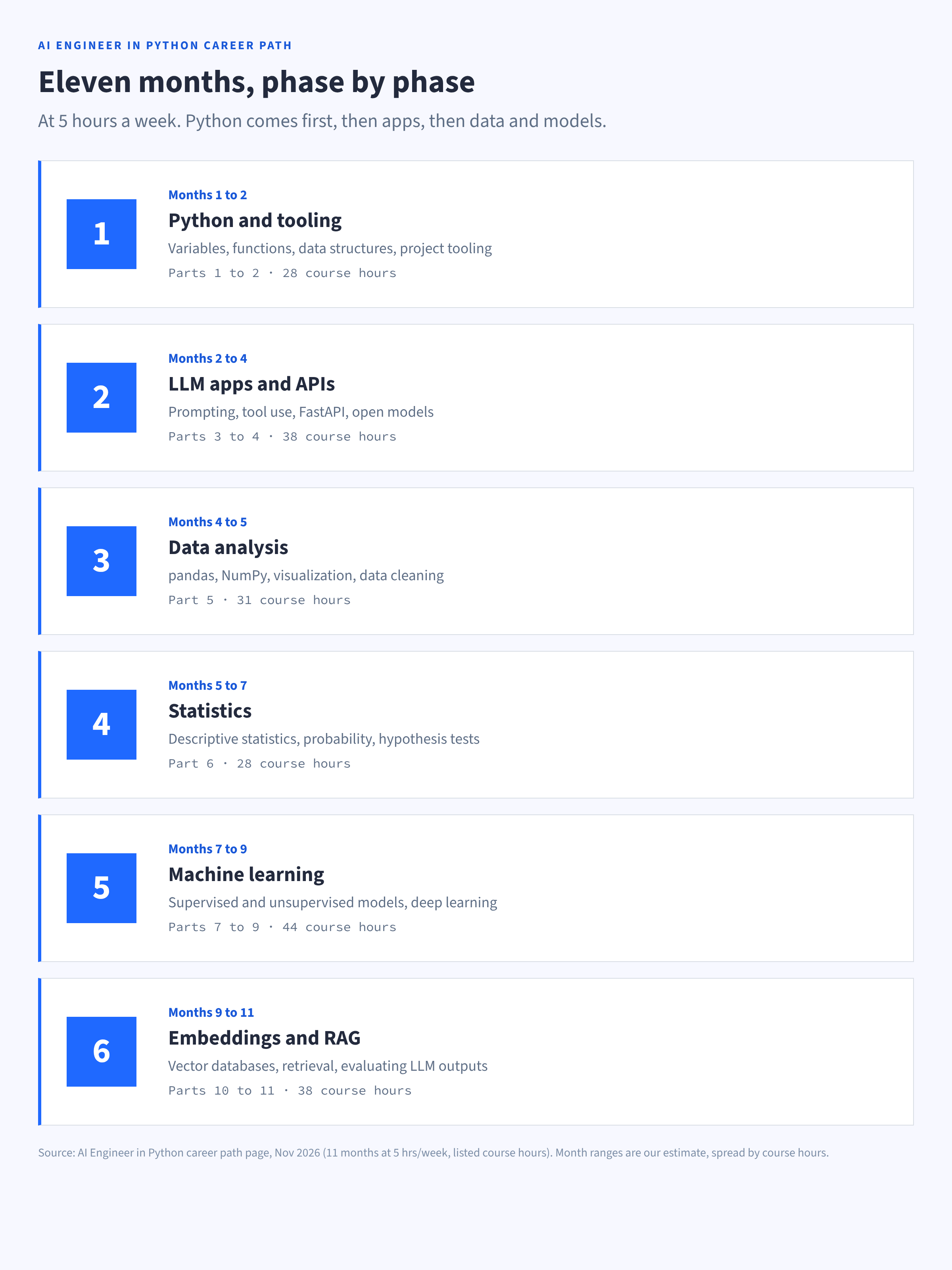
The AI Engineer in Python career path, phase by phase over 11 months
This order helps you stay motivated, because you'll build your first LLM app within the first few months. After that, you'll learn pandas, statistics and classic machine learning, which you need to evaluate and improve AI systems. You'll finish with embeddings, vector databases, retrieval-augmented generation (RAG) and evaluating LLM outputs.
Python carries more weight here than in the other career paths. You'll write API servers, handle errors from external services and structure code that other people maintain. Our guide to Python for AI covers which Python skills matter most for this work.
If you only want to build with LLMs and don't need a data role, Generative AI Fundamentals in Python is a shorter option, built for about 2 months at 5 hours a week. It teaches Python, prompting and app building, but it doesn't cover pandas, NumPy or statistics, so it won't prepare you for analyst or data scientist roles.
How many hours a week do you need to learn Python?
Five hours a week is enough to learn Python and reach a data job, and it's the pace every Dataquest path is built around. If you can give it more time, you'll finish sooner, but not in proportion.
| Goal | 5 hrs/week | 10 to 15 hrs/week | 20+ hrs/week |
|---|---|---|---|
| Python basics | About 1 month | 2 to 3 weeks | 1 to 2 weeks |
| Data analyst, from scratch | 8 to 12 months | 5 to 7 months | 3 to 5 months |
| Data scientist, from scratch | 12 to 18 months | 6 to 9 months | 4 to 6 months |
| AI engineer, from scratch | 8 to 12 months | About 6 months (at 8 to 10 hrs/week) | Under 6 months |
Sources: Learn Python skill path page; Dataquest's data analyst, data scientist and AI engineer roadmaps, November 2026. Python basics at 10+ and 20+ hours a week and AI engineer at 20+ hours are our estimates. The AI engineer roadmap gives "about 6 months" at 8 to 10 hours a week.
Doubling your hours won't halve your timeline. What you learn needs time between sessions to stick, and long study days lead to more forgetting and faster burnout.
So choose a schedule you can keep for months. An hour on five weeknights, or two evenings plus a weekend morning, will work better than a big push you abandon in week three.
If your week is unpredictable, set a minimum instead of a target. Twenty minutes on a busy day keeps the habit alive and makes your next long session easier to start.
Do AI coding assistants make learning Python faster?
AI coding assistants can speed up some parts of learning. They can explain an error message, remind you of syntax you forgot, or suggest a cleaner way to write a loop.
But they can't build your understanding for you, and that's what takes the most time. In a data job, you'll read code, debug it and check whether the output makes sense for the data. Interviews test the same skills, often without an assistant in the room.
The risk is that an assistant makes you feel further along than you are. You can have code that runs and still not be able to explain it, and you'll find that out the first time something breaks.
Used well, an assistant works like a patient tutor. Used badly, it skips the practice that makes you job-ready. A few ground rules help:
- Do write your own solution first, then ask the assistant to review it.
- Do paste an error and ask what it means and why it happened.
- Do ask for a hint or a simpler example when you're stuck.
- Don't ask for a full solution to an exercise you haven't tried.
- Don't run code you can't explain line by line.
- Don't skip the debugging, because that's where most of the learning happens.
To build the skills an assistant can't give you, work through our Python practice exercises without help first.
What slows people down, and how do you stay on track?
Five habits stretch most people's timelines, and each has a simple fix.
| Pitfall | What it costs you | Fix |
|---|---|---|
| Watching tutorials without building anything | You recognize code but can't write it | Write code from the first lesson, then finish a project every few weeks |
| Switching courses or resources often | You relearn the basics several times | Pick one structured path and finish it |
| Learning syntax without a goal | You can't tell what to learn next | Choose a target role, then follow its skill order |
| Studying in irregular bursts | You spend each session relearning | Set a weekly schedule with a small minimum |
| Waiting until you "know enough" for projects | You reach month six with no portfolio | Start guided projects early, then build your own |
Projects matter most because they're where you combine skills. A project makes you decide what to do next, which no exercise does.
Our guide to the best way to learn Python goes deeper on how to structure your study so your hours count.
Final thoughts
At 5 hours a week, you can learn the Python basics in about a month. Becoming job-ready for a data role takes longer, around 8 to 12 months for an analyst or AI engineer starting from scratch, and 12 to 18 months for a data scientist.
Most of that time goes to what you learn after Python, from pandas and SQL to statistics, machine learning and LLM tools. Your weekly hours and your starting point will shift your timeline more than anything else.
Start with the Learn Python skill path, which you can begin for free. Once the basics feel solid, pick the career path that matches your goal and keep the same steady pace.
FAQ
Can I learn Python in a month?
Yes. At 5 hours a week, you can learn the basics in about a month, which is the pace the Learn Python skill path is built for. A month of Python gets you started, but on its own it won't make you job-ready for a data role.
Is Python enough to get a data analyst job?
No. Employers will also expect SQL, pandas, basic statistics and the ability to explain your findings. Python is your foundation, and the Data Analyst in Python career path covers the rest in the order you need it.
Do I need to be good at math to learn Python for data science?
You don't need to be good at math to start. Learning Python itself takes no more than arithmetic. For data science, you'll need statistics and some calculus and linear algebra, which you can learn along the way.
I'm over 30 with no coding background. Is it too late to learn Python?
No. How long it takes depends on the hours you put in, not your age. Many people learn Python while working full time, and experience from another job often helps you understand the data problems you're solving.
Should I learn SQL or Python first for a data job?
Dataquest's career paths teach Python first, then SQL, because pandas and SQL share many ideas and Python makes both easier. If your current job already uses SQL, though, starting there gives you something useful at work right away.
How long does it take to master Python?
Mastery takes years, and even experienced developers keep learning. You don't need it for a data job. You need to be comfortable writing, reading and debugging the Python your role uses every day.