
AI Engineer vs Software Engineer: Differences and How to Choose
Should you become an AI engineer or a software engineer? Search for AI engineer vs software engineer, and most answers fall into one of two camps. One says AI engineering is the future and plain software engineering is getting crowded out. The other says AI engineering is just software engineering with a new label.
Both stories hold a piece of the truth. At most companies, software engineers build and maintain the applications people use, while AI engineers build the parts of those applications that run on AI models, like a support assistant or a tool that reads invoices. Both write production code, and both ship to the same users.
The practical difference shows up in how each role checks its work. Both rely on tests that pass or fail. AI engineers add another layer on top: because model outputs vary, they also evaluate quality across hundreds of examples.
We'll look at what fills each role's week, what you'd need to learn, and what 2026 pay and hiring data actually shows, then follow both roles through a single feature build. The later sections are organized by starting point, because the right move looks different for a student, a working developer, or a career changer.
Table of Contents
- How AI Engineering Differs From Software Engineering
- Why Job Titles Don't Tell the Whole Story
- A Week in Each Role
- Same Feature, Two Jobs
- AI Engineer vs Software Engineer Skills
- AI Engineer vs Software Engineer Salary and Job Demand
- Education and Experience Requirements
- How to Decide Between AI Engineering and Software Engineering
- Moving Between the Two Roles
- Where to Start Learning
- Frequently Asked Questions
How AI Engineering Differs From Software Engineering
Here's how the two roles compare at a glance.
| Software Engineering | AI Engineering | |
|---|---|---|
| Primary focus | Building and maintaining software systems across different domains | Specializing in AI-powered functionality within software systems |
| Technical emphasis | Architecture, application logic, performance, and reliability | Model integration, retrieval, output quality, and evaluation |
| Main challenges | Scalability, maintainability, and system reliability | Model reliability, accuracy, cost, and latency |
| Testing approach | Unit, integration, and end-to-end tests | Software tests plus model evaluations |
The roles overlap considerably. AI engineers use the same software engineering foundations, but spend more time working with models and evaluating their outputs.
Why Job Titles Don't Tell the Whole Story
AI engineering draws on both software engineering and machine learning, but today it sits closest to software engineering. Before 2023, building AI features usually meant training your own models, which put the work with machine learning teams.
That changed when large language models (LLMs) became available through APIs. In June 2023, Shawn "swyx" Wang described the rise of the AI engineer: software engineers who build on foundation models instead of training them. Around the same time, Andrej Karpathy, a co-founder of OpenAI, predicted there would be far more AI engineers than ML engineers, since you could succeed in the role without training anything.
The title has spread quickly, but it's still far from universal. In Pave's compensation dataset, the share of companies employing at least one AI engineer grew from 2.7% in January 2023 to 8.4% in January 2026, according to Pave. Pave also notes that many companies are expanding what "software engineer" means instead of creating new AI engineering job families.
That's why the job description matters more than the title. A "software engineer" posting might ask you to build RAG pipelines, while an "AI engineer" posting might be mostly backend work with one LLM integration. If you're also comparing AI engineering with model-training roles, our guide to AI engineer vs machine learning engineer covers that split.
A Week in Each Role
On paper, the two jobs look alike: both write code, review pull requests, and get paged when production breaks. What separates them is the part of the system each one answers for.
What a Software Engineer Does
A software engineer owns how the application works. That means turning product requirements into code, designing how the pieces fit together, and keeping the system fast, secure, and easy to change as it grows.
A typical week might include:
- Designing features. Breaking a request like "let users split a payment" into data models, API endpoints, and screens, and deciding how it fits the existing architecture.
- Writing and testing code. Implementing the feature, writing unit and integration tests, and reviewing teammates' code before it merges.
- Keeping systems healthy. Fixing bugs, improving slow database queries, updating dependencies, and responding when a service goes down.
- Working with the team. Planning work with product managers, estimating effort, and documenting decisions so the next engineer can follow them.
Software engineering covers many specialties, including frontend, backend, mobile, infrastructure, and embedded systems. Your week depends a lot on which one you choose.
What an AI Engineer Does
An AI engineer owns the parts of a product that run on a model. Most of the time, that's a foundation model like GPT, Claude, Gemini, or an open-weight alternative, and the job is making it useful, accurate, and affordable inside a working application.
A typical week might include:
- Designing the AI behavior. Choosing a model, writing prompts, defining structured outputs, and deciding when the model should call tools or look up information.
- Grounding the model in company data. Building RAG pipelines that pull relevant documents from a vector database, so answers come from the company's own sources instead of guesswork.
- Measuring quality. Building test sets and LLM-as-judge checks (using a second model to grade the first one's answers) to catch wrong or made-up answers before users do.
- Shipping and operating it. Wrapping the system in an API, tracking cost and latency, and defending against prompt injection, where users slip instructions into their input to hijack the model's behavior.
Notice how much of that list is software work: APIs, deployment, monitoring. Our AI engineer roadmap breaks the AI-specific skills down phase by phase.
Same Feature, Two Jobs
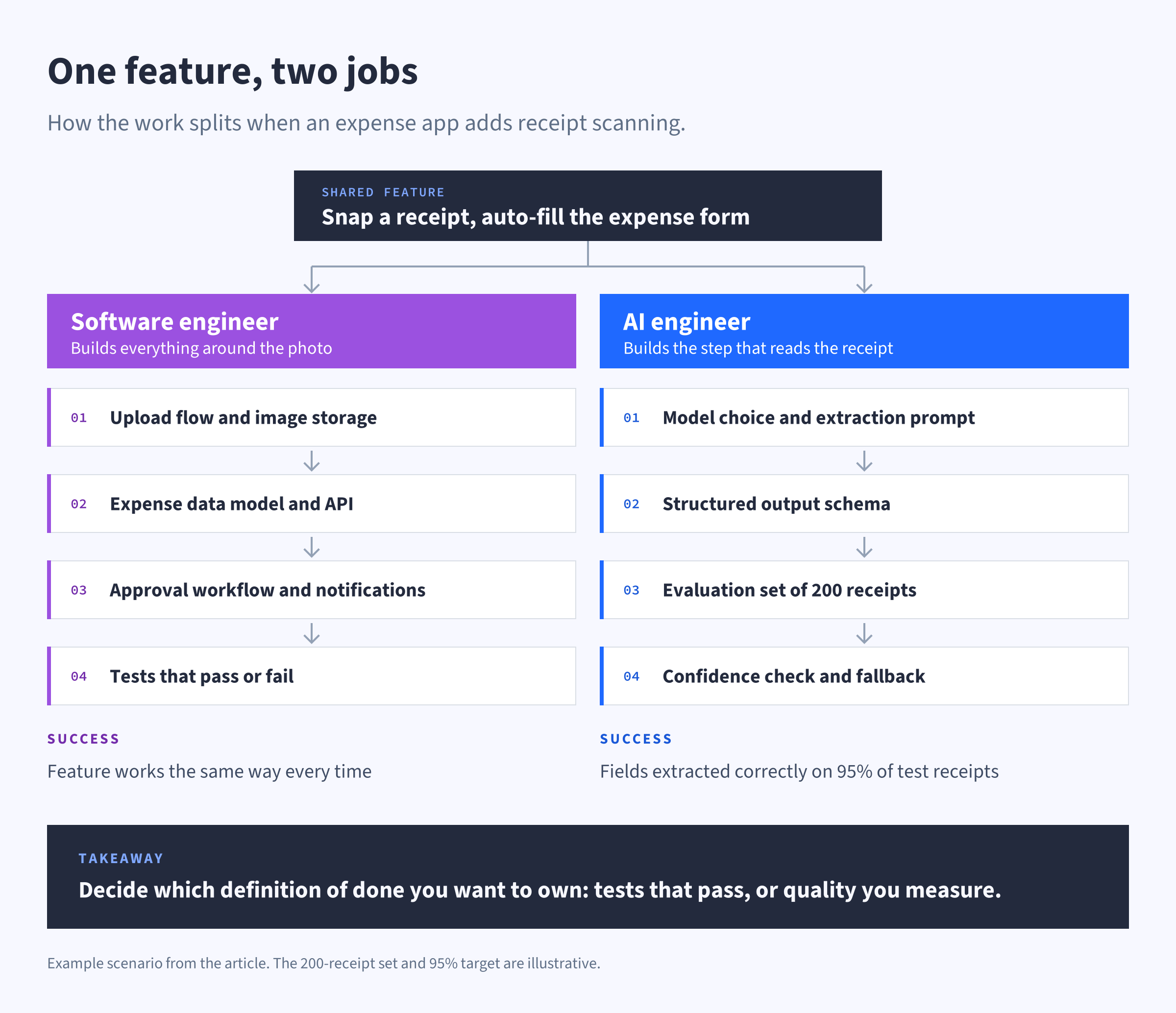
At smaller companies, one software engineer might build an entire AI feature alone. On teams that have both specialists, though, the work often splits between them. Picture an expense-reporting app whose users are tired of typing in receipts by hand. The team decides to let users snap a photo and have the form fill itself in, and here's how the responsibilities could divide between a software engineer and an AI engineer.
The Software Engineer's Part
The software engineer builds everything around the photo. That includes the upload flow, image storage, the database tables for expenses, the API the mobile app calls, and the approval workflow that routes a report to a manager.
The hard parts are design and reliability problems. Uploads fail on weak connections, two people can edit the same report at once, and the approval rules differ by department. Success means every path behaves the same way every time, and the test suite proves it.
The AI Engineer's Part
The AI engineer builds the step that reads the receipt. They send the image to a vision-capable model, ask for the merchant, date, total, and tax in a fixed structure, and validate what comes back before it reaches the form.
The hard parts are quality problems. Crumpled receipts, foreign currencies, and handwritten tips all trip up the model, and each call costs money. So the AI engineer builds a set of 200 labeled receipts, measures how often each field comes back right, and adds a fallback that asks the user to confirm when the model seems unsure. The 95% figure in the diagram is an example target, not a standard; teams set their own.
The Takeaway
The feature needs both parts, whether two specialists split them or one engineer builds both. Most of the feature is conventional software, and the model is one component inside it. The question for you is which problems you'd rather spend your days on: systems that must behave the same way every time, or model behavior you measure, tune, and keep within bounds.
AI Engineer vs Software Engineer Skills
The two skill sets share a large base. Where they split is in what sits on top: software engineers go deeper into system design and their language ecosystem, while AI engineers go deeper into working with models.
The table below shows the most-requested skills in US AI engineering postings, from Axial Search's analysis of 43,480 postings (January to September 2026).
| Skill or tool | Share of AI engineering postings |
|---|---|
| Python | 62.1% |
| Cloud platforms | 55.5% |
| Foundation models | 54.7% |
| Observability and monitoring | 40.2% |
| CI/CD (continuous integration and delivery) | 33.2% |
| Retrieval-augmented generation (RAG) | 32.2% |
| LangChain | 17.0% |
| Docker | 15.6% |
Many of these skills, including Python, cloud platforms, monitoring, CI/CD, and Docker, are widely used in software engineering. Others, like foundation models and RAG, are more specific to AI-powered applications, but software engineers building AI features use them too.
What Both Roles Need
Both roles need solid programming, Git, testing, APIs, databases, and the ability to deploy and monitor a service in the cloud. If you can build a small web service, containerize it with Docker, and explain what happens when it fails, you're building toward either career.
The Software Engineering Specialty
Software engineers spend more time on how large systems hold together. That means data structures and algorithms, system design, deep knowledge of one language ecosystem (such as Java, TypeScript, Go, or C#), frontend or backend frameworks, performance tuning, and security. Technical interviews for software roles often test data structures, algorithms, and system design directly, so this depth pays off before you're even hired.
The AI Engineering Specialty
AI engineers spend more time on the layer that talks to models. That means LLM APIs, prompt and output design, RAG pipelines, vector databases, tool calling with MCP, agent frameworks, and evaluation methods for open-ended text. Python dominates here, since most AI libraries and SDKs are Python-first.
AI engineers also need a working understanding of machine learning concepts like embeddings, overfitting, and evaluation metrics. You don't need to train large models, but you do need to know why a model fails so you can design around it.
AI Engineer vs Software Engineer Salary and Job Demand
At the same job level, the two roles pay about the same. Pave, which aggregates compensation data from more than 8,700 companies, found that US median base salaries for AI engineers and software engineers at equivalent levels are relatively close. That wasn't the case a few years ago, and Pave reads the shift as a sign that AI skills are becoming an expected part of software work. Other datasets differ slightly. Levels.fyi's 2025 data showed AI-focused software engineers earning a modest premium over their non-AI peers, about 6% at entry level and about 19% at staff level.
Why Headline Salary Comparisons Mislead
You'll find sites claiming AI engineers earn tens of thousands more than software engineers. Headline salary comparisons can be misleading when they mix experience levels, data sources, or compensation measures, such as posted salary ranges on one side and actual wages on the other.
Seniority is a common culprit. Only 12% of AI engineering postings are junior roles, according to Axial Search, so a median built from those postings leans toward mid-level and senior pay. Comparing at the same level, as Pave does, avoids that distortion.
So use level, not title, to think about pay. Since the two roles pay about the same at each level, moving up a level will usually matter more than which title you hold.
How Demand Compares
Software engineering is the much larger field, and it's still growing. The BLS counted about 1.7 million software developer jobs in 2025 and projects 10% growth from 2025 to 2035, against 3% for all occupations.
AI engineering is smaller but shows strong hiring momentum. Axial Search counts around 1,550 new US AI engineering postings a week in 2026, and AI engineer tied for first in Pave's Hot Jobs Index for Q3 2026, which scores whether each role's share of new hires and headcount is rising or falling.
The same index shows where the pressure is. Frontend engineering (−87) and web development (−82) are among the coldest roles, on a scale from −100 to +100. Those scores measure momentum, not size: these roles make up a shrinking share of hiring, which doesn't mean the jobs are disappearing.
Pave's analysis of the index adds a twist for engineers. In most departments, specialized roles are heating up while generalist ones cool, but engineering bucks that trend. Pave suggests coding agents are fueling an expectation that software engineers can work across the whole stack, and it raises the question of whether the skills for building AI products will become an expected part of the software engineering job.
Education and Experience Requirements
The two data sources in this section measure different things, so it's best to look at each role on its own terms rather than rank them.
For software developers, the category that includes software engineers, the BLS lists a bachelor's degree in computer and information technology or a related field as the typical entry requirement. For AI engineering, Axial Search looked at what job postings ask for and found that the median posting asks for 5 years of experience. Junior roles make up 12% of postings and expect about 2.
A few more details from Axial's analysis:
- Degrees: About 72% of AI engineering postings require a degree. Computer science is the most common field, appearing in 58.9% of postings.
- Certifications: They barely register for AI engineering. The most-mentioned certification appears in just 1.3% of postings.
- Portfolio: Both fields reward shipped projects. For AI engineering, Axial notes that a portfolio of working systems carries more weight than any credential.
Because the BLS describes typical entry requirements and Axial describes what postings ask for, use these figures to understand each path rather than to compare them directly.
How to Decide Between AI Engineering and Software Engineering
There's no universally right answer here. The better fit depends on the kind of problems you enjoy and how much experience you already have.
Software engineering might suit you if you:
- Enjoy designing systems and seeing every piece work exactly as intended
- Like solving complex problems involving architecture, performance, and scalability
- Want to choose from many specialties, from mobile apps to infrastructure to embedded systems
- Enjoy mastering a language ecosystem and tackling complex architectural challenges
AI engineering might suit you if you:
- Enjoy turning a capable model into a feature that solves a specific problem, such as a document search tool
- Like experimenting, measuring results, and iterating until quality is good enough to ship
- Are comfortable working with unpredictable model outputs and designing safeguards to handle failures
- Want to work in an emerging specialization with strong hiring momentum
Match the Move to Your Background
Where you're coming from often decides which move makes sense now:
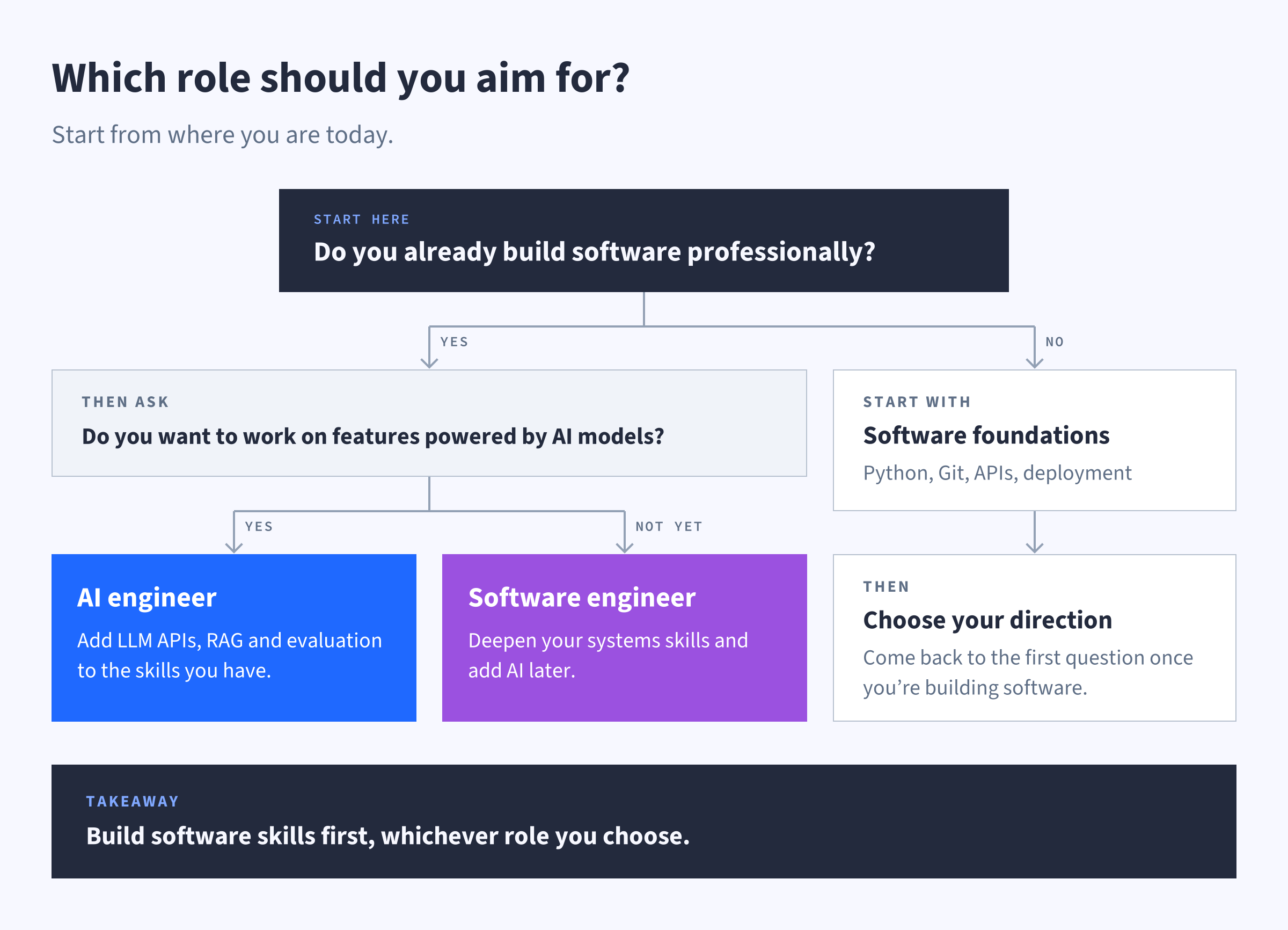
- Students choosing a degree or track: Build strong software fundamentals either way, since most AI engineering roles expect a few years of experience. Add AI projects alongside your coursework, so you're ready for either kind of role at graduation.
- Working software engineers: AI engineering is usually a short move. You already have the production skills, so the gap is LLM APIs, RAG, and evaluation. Our AI engineer roadmap estimates 3 to 5 months for this transition.
- Data scientists and ML practitioners: You already understand models and evaluation. Your gap is software engineering: testing, APIs, deployment, and monitoring.
- Data analysts: You know data and probably SQL, but both careers ask for deeper programming. Start with Python and software fundamentals, then decide which direction to specialize in.
- Career changers starting from zero: Start with software fundamentals, because both careers depend on them. Our roadmap estimates 8 to 12 months to reach AI engineering from scratch at a steady pace.
Moving Between the Two Roles
Your first choice isn't permanent. The roles share enough foundation that people move between them in both directions.
Moving From Software Engineering to AI Engineering
This is the move the AI engineer role was originally named for. Your production skills transfer directly, so the gap is the model layer. Learn to call LLM APIs with structured outputs and tool calling, build a RAG system over a set of documents, and write an evaluation suite that scores its answers.
The biggest adjustment is adding a second question to your work. You'll keep asking "does it pass?" and also ask "how often is it right, and what happens when it's wrong?" Your habits around testing, logging, and monitoring become the base for that, so they're an advantage, not baggage.
Moving From AI Engineering to Other Software Specialties
AI engineers already build production software, so this move is about switching specializations, and the size of the gap depends on where you're headed. Moving into general backend development in Python may take very little extra preparation. Targeting mobile, frontend, infrastructure, or a different language ecosystem means a larger gap, with new frameworks and tooling to learn.
Either way, your AI experience stays useful, since more product teams are adding AI features to their software.
Where to Start Learning
Whichever role you choose, the first steps are the same: learn to program well, get comfortable with Git and the command line, and build projects that run somewhere other than your laptop. After that, the paths split.
For AI engineering, start with our AI engineer roadmap to see what to learn in what order. Our AI Engineer in Python path takes you from Python basics to production AI systems in about 11 months at 5 hours a week. Across 33 courses and 21 projects, you'll work with LLM APIs, tool use and MCP, vector databases, and RAG, and work up to evaluating LLM outputs and production monitoring. If you're comparing options, our guide to the best AI engineering courses reviews 10 of them side by side.
For software engineering, the same path's early parts build fundamentals that transfer directly: Python, object-oriented programming, Git, the command line, APIs, and deploying services with FastAPI and Docker. Dataquest focuses on Python, so if you're aiming at a frontend, mobile, or Java role, you'll also want resources built for that ecosystem.
If you're a working software engineer, you can skip most of the early material. Focus on the LLM, RAG, and evaluation courses, and build one AI feature into a project you already understand.
Projects are also a good test of which side you enjoy. Build a small app with a database and an API, then add one feature that calls a model and write an evaluation for it. Whichever half held your attention longer is a useful signal.
Frequently Asked Questions
Is an AI engineer a type of software engineer?
At most companies, yes. AI engineers build production software, and most of their work involves APIs, deployment, and monitoring like any software engineer. The difference is that part of their system runs on AI models, which require additional evaluation beyond conventional software testing.
Is AI engineering a better career than software engineering?
Neither is inherently better. Software engineering offers a broader range of specialties and more established entry-level paths, while AI engineering focuses on building and evaluating AI-powered features. The roles overlap considerably, so the better choice depends on the kind of problems you enjoy and where you want to specialize.
Which pays more, AI engineer or software engineer?
At the same job level, they pay about the same. Pave's compensation data shows US median base salaries for the two roles at equivalent levels are relatively close. Headline salary comparisons can be misleading when they mix experience levels, data sources, or compensation measures.
Can a software engineer become an AI engineer?
Yes, and it's one of the shortest moves into AI engineering. You'll need to add LLM APIs, RAG, and evaluation methods to your existing skills. Our AI engineer roadmap estimates 3 to 5 months for experienced software engineers.
How can I tell whether a job posting is for AI engineering or software engineering?
Look at what the role primarily involves, not just the title. If most of the responsibilities center on model integration, evaluation, and AI-specific functionality like RAG or agents, it's an AI engineering role. If they center on conventional software work such as application features, system design, and a specific language stack, it's a software engineering role, even if it includes some AI work. Expect overlap either way, since AI engineers do plenty of conventional software engineering too.
Which role is easier to get into?
Software engineering has more established entry-level paths, with a bachelor's degree as the typical starting point. AI engineering roles more often ask for some experience. Only 12% of AI engineering postings are junior roles, and those expect about 2 years, so many people build software or data experience first.
Do AI engineers need to know machine learning?
For most AI application engineering roles, they need a working understanding, not deep expertise. You should understand concepts like embeddings, overfitting, and evaluation metrics, so you can tell why a model fails. Some AI engineering jobs involve fine-tuning or training models, and those ask for deeper ML skills.
Will AI replace software engineers?
The evidence so far points to change, not replacement. The BLS projects software developer jobs to grow 10% from 2025 to 2035, and cites software for AI as one source of that demand. What's shifting is the work itself: routine coding gets easier to automate, so depth in systems design, a domain, or AI matters more.
Is AI engineering just a bubble?
Company valuations may rise and fall, but the skills are likely to last. Building reliable systems on top of AI models draws on software fundamentals, evaluation, and data handling, all of which stay useful even if specific tools change. Learning the fundamentals, not just one framework, is the safest bet.
Do I need a degree to become an AI engineer or software engineer?
Most employers prefer one. The BLS lists a bachelor's degree as the typical entry requirement for software developers, and about 72% of AI engineering postings require a degree. Without one, you'll need strong, deployed projects to make your case.
What projects should I build?
For software engineering, build a full application with a database, an API, authentication, and tests, then deploy it. For AI engineering, build an application that uses an LLM to solve a specific problem, such as a document search assistant with RAG, and include an evaluation set and monitoring. Our Python projects and AI projects guides have ideas at every level.
