AI Engineer vs Machine Learning Engineer: Which Role Fits You?
If you're comparing AI engineer vs machine learning engineer roles, you've probably noticed that job postings use the titles in confusing ways, much as they've long blurred the line between data scientist and ML engineer. One company's "AI engineer" trains neural networks, while another's spends the day wiring an LLM into a customer support tool.
At most companies, machine learning engineers build and own models, and AI engineers build products on top of models, often ones someone else trained. Both roles ship production systems, both pay well, and both are growing. The difference is which part of the system you'd spend your days on.
In this guide, you'll see how the two roles compare on daily work, skills, salary, and job demand, using 2026 data from the same source for both so the numbers line up. We'll also walk through one realistic problem solved both ways, so you can picture which job you'd rather do.
Table of Contents
- AI Engineer vs Machine Learning Engineer at a Glance
- Why the Two Titles Get Confused
- What Each Role Actually Does
- One Problem, Two Approaches
- AI Engineer vs ML Engineer Skills
- AI Engineer vs ML Engineer Salary and Job Demand
- Education and Experience Requirements
- Which Role Should You Choose?
- Can You Switch Between the Roles Later?
- How to Get Started on Either Path
- Frequently Asked Questions
AI Engineer vs Machine Learning Engineer at a Glance
A machine learning engineer's main question is "How do we train a model that predicts this well, and keep it accurate in production?" An AI engineer's main question is "How do we turn an existing model into a reliable product people can use?" The table below shows how that difference plays out.
| AI Engineer | Machine Learning Engineer | |
|---|---|---|
| Core focus | Building applications on top of existing models | Training, deploying, and maintaining models |
| Where the model comes from | Usually a foundation model accessed through an API or open weights | Usually trained or fine-tuned by the team on its own data |
| Typical projects | Support assistants, document search with retrieval-augmented generation (RAG), AI agents, AI features in apps | Fraud detection, recommendations, demand forecasting, ranking |
| Signature tools | LLM APIs, Model Context Protocol (MCP), agent frameworks like LangChain, vector databases, FastAPI, cloud platforms | PyTorch, TensorFlow, scikit-learn, XGBoost, Spark, MLflow, cloud platforms |
| Math depth | Working knowledge; evaluation matters more than derivations | Stronger statistics, probability, and linear algebra |
| Biggest daily challenge | Output quality, cost, latency, and reliability of model responses | Data quality, model accuracy, and drift after deployment |
| Median posted salary ceiling (US, 2026) | $176,000 | $197,000 |
| US job postings (2026) | 43,480 | 13,776 |
Salary and posting figures come from Axial Search's analyses of public US job postings for AI engineering (January to September 2026) and ML engineering (January to October 2026). They reflect the top of the salary range employers post, so treat them as ceilings rather than typical offers.
Why the Two Titles Get Confused
Machine learning engineer has been a standard job title for about a decade. It grew out of the need for someone to take a data scientist's model out of a notebook and run it reliably in production.
AI engineer, in its current meaning, is much newer. In June 2023, Shawn "swyx" Wang published The Rise of the AI Engineer, arguing that work which once needed a research team could now be done by software engineers building on foundation models. At the time, he counted about 10 ML engineer jobs for every AI engineer job on Indeed and predicted the ratio would flip within five years.
By 2026, it largely has. Axial Search counts roughly three AI engineering postings for every ML engineering posting in the US, and LinkedIn named AI engineer the fastest-growing job title in the US for 2026.
The confusion comes from companies using both titles loosely. Some post "AI/ML engineer" to cover everything, and older uses of "AI engineer" (in robotics or game development, for example) still exist.
That's why the job description matters more than the title. If a posting asks for LLM APIs, RAG, and vector databases, it's an AI engineering role. If it asks for model training, feature engineering, and PyTorch, it's an ML engineering role, whatever the header says.
What Each Role Actually Does
Both roles write production code, deploy systems, and get paged when something breaks. The difference is what they're accountable for.
What a Machine Learning Engineer Does
A machine learning engineer owns the model. That means turning a business problem into a prediction task, building the training pipeline, and making sure the model stays accurate after users start sending it data.
A typical week might include:
- Framing the problem. Deciding whether "flag risky transactions" is a classification task, what counts as a positive label, and which metric reflects the business cost of a mistake.
- Building features and training models. Cleaning data, engineering features, training candidates in PyTorch or scikit-learn, and tuning them without overfitting.
- Evaluating honestly. Checking precision and recall on held-out data, and pushing back when a model looks good on accuracy but fails on the cases that matter.
- Deploying and monitoring. Serving the model behind an API, tracking prediction quality over time, and retraining when the data drifts.
Our guide to becoming a machine learning engineer covers this side of the work in more depth.
What an AI Engineer Does
An AI engineer owns the product built around a model. Most of the time, that model is a foundation model like GPT, Claude, Gemini, or an open-weight alternative, and the engineering challenge is making it useful, accurate, and affordable inside a working application.
A typical week might include:
- Designing the system. Choosing a model, writing prompts, defining structured outputs, and deciding when the model should call tools or look up information.
- Grounding the model in company data. Building RAG pipelines that pull relevant documents from a vector database so answers come from the company's own documents instead of guesswork.
- Evaluating output quality. Building test sets and LLM-as-judge checks (using a second model to grade the first one's answers) to catch wrong or made-up answers before users do.
- Shipping and operating it. Wrapping the system in an API, handling cost and latency, and defending against problems like prompt injection, where users slip instructions into their input to hijack the model's behavior.
Our AI engineer roadmap breaks these skills down phase by phase.
One Problem, Two Approaches
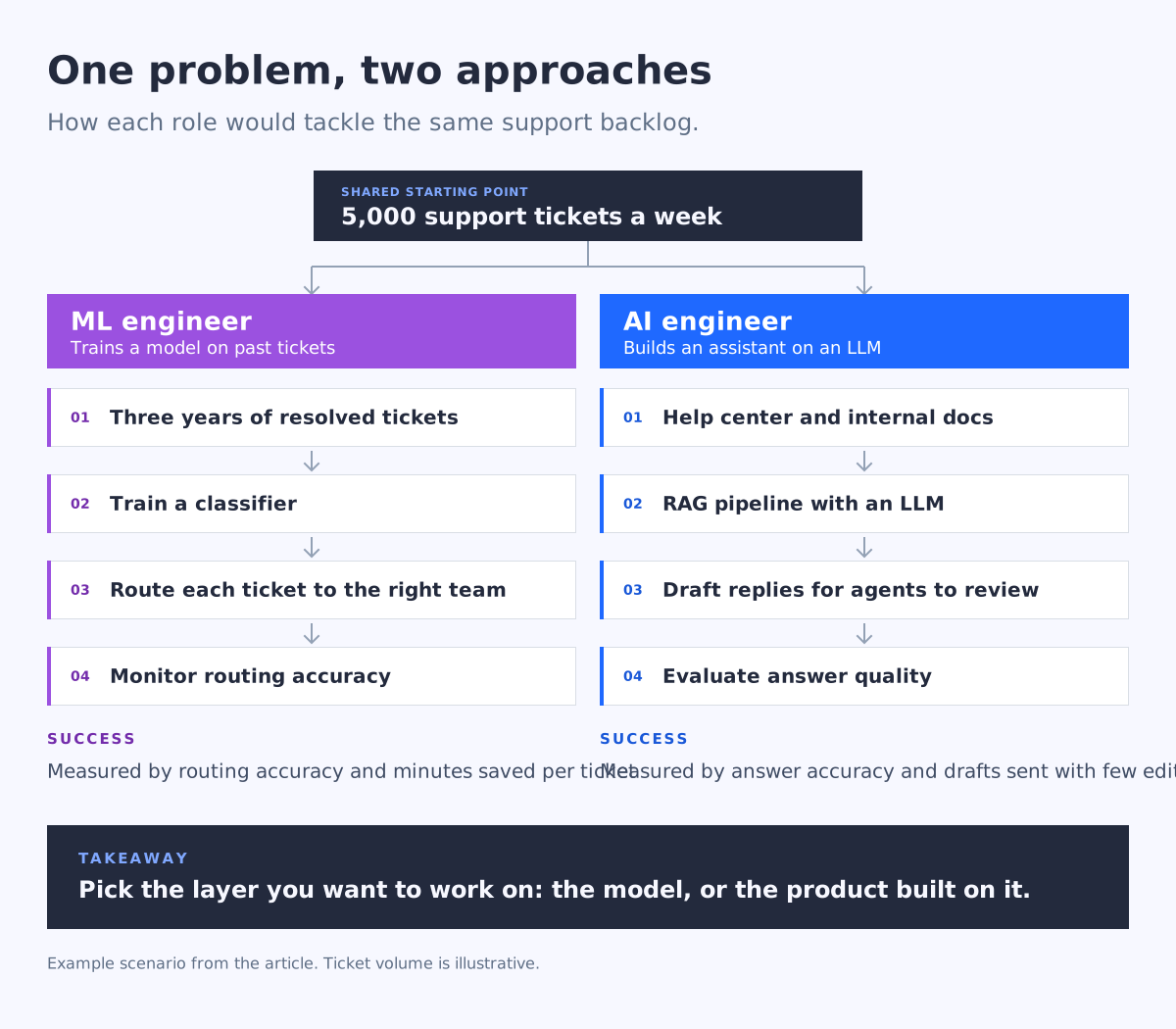
The clearest way to see the difference between AI engineer and ML engineer is to give both roles the same problem. Imagine a software company whose support team is buried under 5,000 tickets a week, and leadership wants AI to help.
The Machine Learning Engineer's Approach
The ML engineer looks at three years of resolved tickets and sees labeled training data. They build a classifier that predicts which team should handle each new ticket and how urgent it is.
The hard parts are data problems. Labels are inconsistent because agents tagged tickets differently, some categories are rare, and the model has to stay accurate as the product changes. Success is measured in routing accuracy and how many minutes it saves per ticket.
The AI Engineer's Approach
The AI engineer looks at the help center and internal docs and sees knowledge an LLM could use. They build an assistant that retrieves the relevant articles for each ticket and drafts a reply for an agent to review.
The hard parts are quality and reliability problems. The assistant must cite the right article, admit when it doesn't know, stay within budget at 5,000 tickets a week, and resist users who try to manipulate it. Success is measured in answer accuracy and how often agents send the draft with few edits.
What This Shows
Neither approach is the "real" AI work. Many companies would build both, and the two engineers would sit on the same team. The question for you is which set of hard problems you'd rather spend your days solving: data and models, or systems and product behavior.
AI Engineer vs ML Engineer Skills
The two skill sets overlap more than the job titles suggest. Both start with Python, both deploy to the cloud, and both need monitoring. Where they split is in what sits on top of that shared base.
The table below compares how often key skills appear in US job postings for each role, based on Axial Search's AI engineering and ML engineering skills analyses. It covers the skills that show up for both roles, so you can see where they lean in opposite directions.
| Skill or tool | AI engineer postings | ML engineer postings |
|---|---|---|
| Python | 62.1% | 79.3% |
| Cloud platforms | 55.5% | 42.6% |
| Foundation models | 54.7% | 38.6% |
| Observability and monitoring | 40.2% | 35.9% |
| PyTorch | 18.7% | 43.2% |
The Shared Foundation
Python, cloud platforms, and monitoring show up heavily in both roles, and that's not a coincidence. Both jobs are production engineering. If you can write clean Python, use Git, deploy a service with Docker, and track how it behaves once it's live, you're building toward either role.
Where AI Engineers Go Deeper
AI engineers spend more time on the layer above the model. That means LLM APIs, prompt and output design, RAG pipelines, vector databases, tool calling with MCP, agent frameworks like LangChain, and evaluation methods for open-ended text. RAG appears in 32.2% of AI engineering postings and LangChain in 17%, while neither ranks among the most-mentioned skills for ML engineering. Strong backend skills matter here too, since the output is usually an API or a feature inside an app.
Where ML Engineers Go Deeper
ML engineers spend more time inside the model. That means deep learning frameworks like PyTorch and TensorFlow, feature engineering, training at scale with tools like Spark, and the statistics needed to judge whether a model is genuinely good. Deep learning appears in 55.8% of ML engineering postings and TensorFlow in 34.2%, while neither ranks among AI engineering's most-mentioned skills. You don't need graduate-level theory, but you do need enough linear algebra, probability, and statistics to understand why a model behaves the way it does.
Notice that foundation models appear in 38.6% of ML engineering postings too. The roles already overlap at the edges, which makes it easier to move between them later.
AI Engineer vs ML Engineer Salary and Job Demand
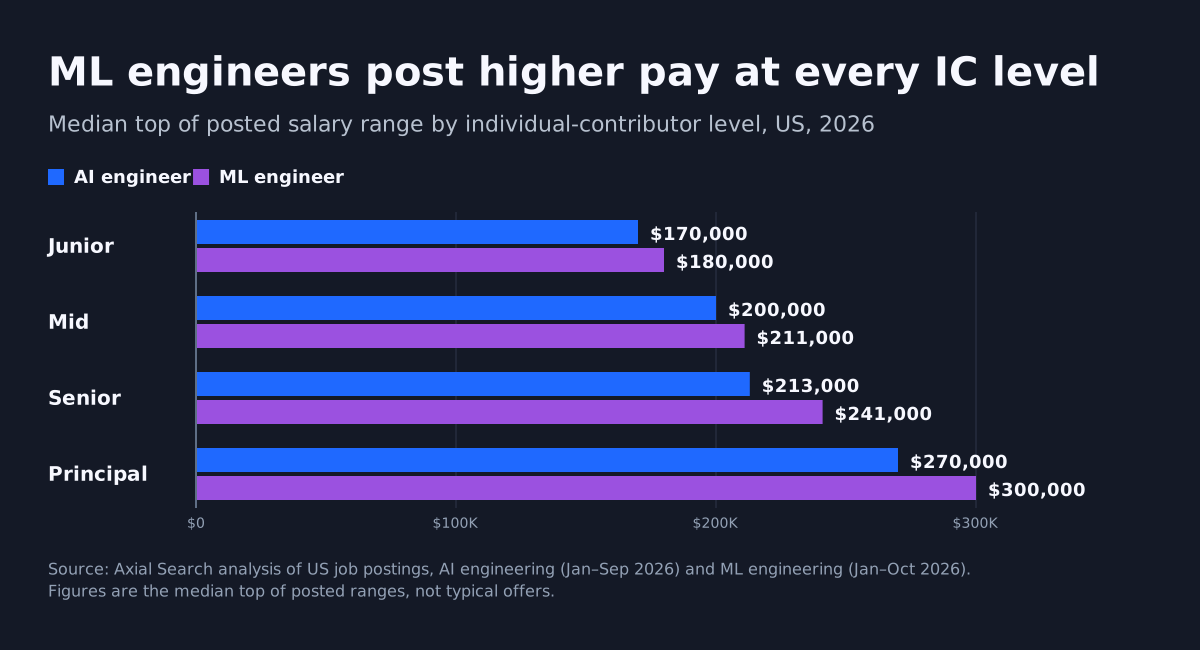
Salary comparisons for these roles are often misleading because they mix sources. One site's AI engineer number gets compared with another site's ML engineer number, and the gap says more about the methods than the jobs. To avoid that, every figure below comes from the same source and method: Axial Search's analysis of public US job postings in 2026.
One caveat before the numbers. Axial reports the top of the salary range employers post, which is the ceiling a candidate can negotiate toward, not the typical offer. Use these figures to compare the two roles with each other, not to predict your own first salary. They're also US figures, so check local salary data if you're based elsewhere.
Source: Axial Search, AI engineering (January to September 2026) and ML engineering (January to October 2026) salary reports.
What the Numbers Say
ML engineering pays more at every individual-contributor level, and the gap widens with seniority. That likely reflects how specialized the work is, since fewer people can train and operate models at scale. Location plays a part too, with California alone holding about 35% of ML engineering postings.
So the trade-off is depth versus volume. ML engineering offers a higher ceiling for individual contributors, while AI engineering, with roughly three times as many postings, offers more doors to knock on.
Either way, both are six-figure roles, and your level matters more than your title. Moving from junior to principal adds $100,000 or more to the posted ceiling in either role, while the gap between the two titles at the same level never tops $30,000.
Education and Experience Requirements
Neither role is usually a first job in tech, and the requirements look similar on paper. Both have a median ask of about five years of experience, and junior roles in both expect around two, according to Axial's AI engineering and ML engineering career reports.
The differences show up in the details:
- Degrees: About 72% of AI engineering postings require a degree, compared with about 78% of ML engineering postings.
- Fields of study: Computer science leads both (58.9% of AI engineering postings vs 64.5% of ML engineering postings), but a machine learning degree appears in 26% of ML engineering postings and only 11.5% of AI engineering ones.
- Advanced degrees: PhD requirements in ML engineering climb with seniority, reaching about a third of Principal-level postings. In AI engineering, advanced degrees mostly appear at Principal level and above.
- Certifications: Neither market screens for them. The most-mentioned certification appears in 1.3% of AI engineering postings and 0.1% of ML engineering postings.
Taken together, the bar is a bit lower for AI engineering, especially at senior levels, where ML postings start asking for PhDs. That doesn't make AI engineering easy to learn well, but software engineers can usually get there faster, while ML engineering asks for a heavier investment in statistics and modeling first.
Which Role Should You Choose?
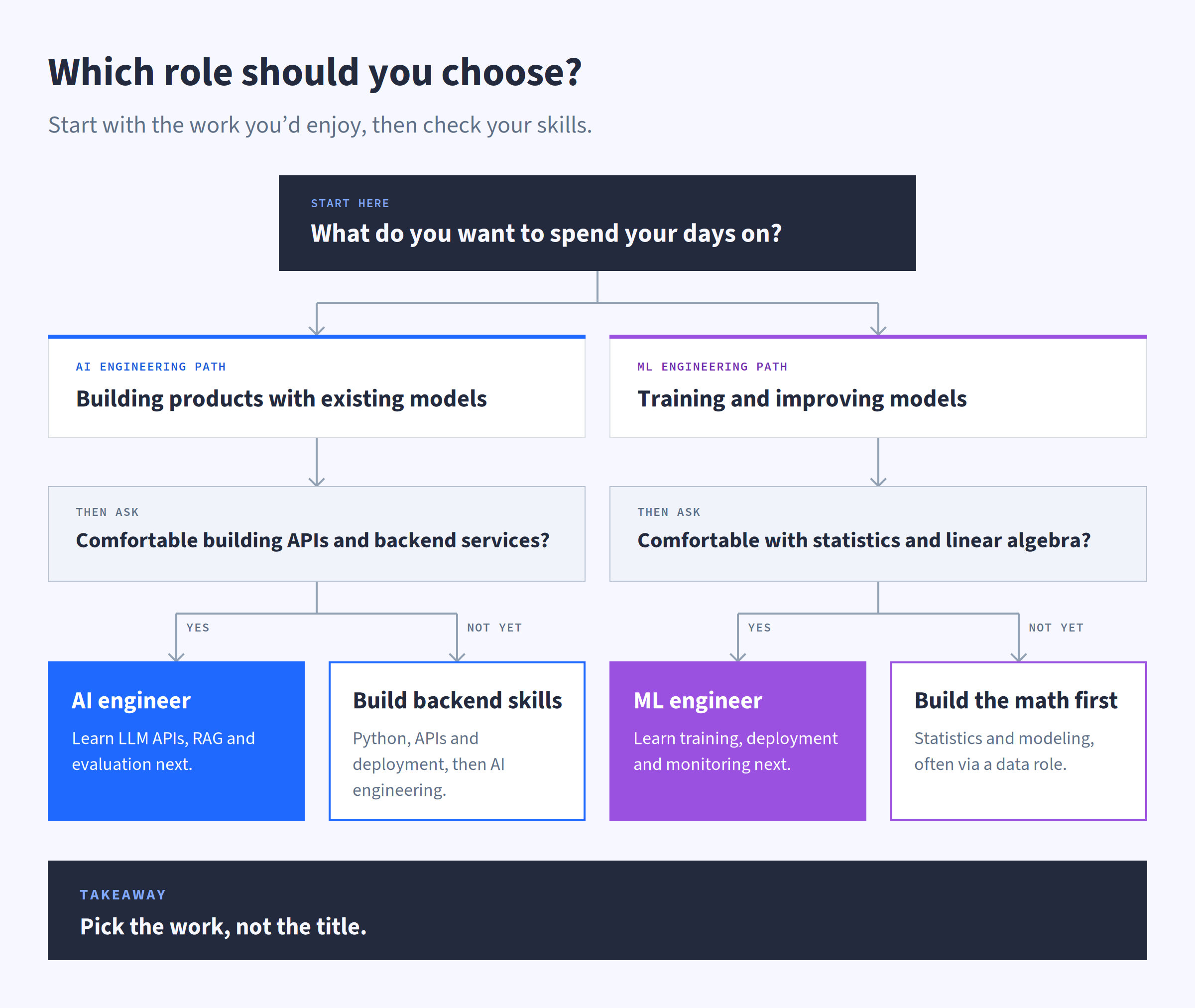
Neither role is better in the abstract. The right one matches the work you'd enjoy doing every day and the skills you already have.
Choose AI engineering if you:
- Enjoy building products and seeing people use what you made
- Like taking a capable model and turning it into a feature that solves a specific problem, such as a support assistant or a document search tool
- Enjoy software engineering: designing systems, building APIs, and making them reliable
- Like experimenting with new tools and figuring out how to make them dependable
- Want to work in the larger job market, with roughly three times as many postings
Choose ML engineering if you:
- Enjoy statistics, experiments, and figuring out why a model behaves the way it does
- Want to own models end to end, from training data to production monitoring
- Like building deep math and modeling foundations
- Are drawn to problems like fraud detection, recommendations, or forecasting
- Want the higher pay ceiling for individual contributors in a specialized field
Your Starting Point Matters Too
Where you're coming from often decides which role is closer:
- Software engineers: AI engineering is usually the shortest move. You already have the production skills, so the gap is LLM APIs, retrieval, and evaluation.
- Data scientists: ML engineering is the natural next step, since you already know the modeling side. Your gap is software engineering: testing, deployment, and monitoring.
- Data analysts: You already work with data, but ML engineering usually means adding modeling skills first, often by moving into a data scientist role along the way.
- Career changers starting from zero: Either role is a multi-step journey, so start with Python and aim for an adjacent first job. AI engineering paths can reach a working portfolio faster, while ML engineering usually needs a data role first.
Can You Switch Between the Roles Later?
Yes. The two roles already overlap in foundation models, evaluation, and monitoring, so picking one now doesn't lock you out of the other.
Moving From AI Engineering to ML Engineering
The gap is mostly modeling depth. Strengthen your statistics and linear algebra, learn to train and evaluate models with scikit-learn and PyTorch, and practice feature engineering on real datasets. Fine-tuning open models is a natural bridge, since it uses skills from both sides.
Moving From ML Engineering to AI Engineering
The gap is mostly application building. Learn to work with LLM APIs, structured outputs, and tool calling, then build a RAG system and an evaluation suite for it. Your experience with metrics and monitoring transfers directly, and AI engineering teams actively hire for it, with observability and monitoring showing up in about 40% of their postings.
How to Get Started on Either Path
Whichever role you choose, the first steps are the same: get comfortable with Python, learn Git and the command line, and build projects that run somewhere other than your laptop. After that, the paths split.
For AI engineering, start with our AI engineer roadmap to see what to learn in what order. Our AI Engineer in Python path takes you from Python basics to production AI systems in about 10 months at 5 hours a week. Across 33 courses and 21 projects, you'll work with LLM APIs, tool use and MCP, vector databases, RAG, FastAPI, and Docker, and work up to evaluating LLM outputs and production monitoring. If you're comparing options, our guide to the best AI engineering courses reviews 10 of them side by side.
For ML engineering, start with our machine learning roadmap to see what to learn in what order. The AI Engineer in Python path is a strong option here too: alongside the LLM work, it covers probability and statistics, machine learning with scikit-learn, and deep learning with PyTorch, so you can build both skill sets and choose your direction later. If you already know Python and pandas and want to focus on ML alone, the Machine Learning in Python skill path takes you straight into supervised and unsupervised learning, with 7 courses and 7 projects in about 2 months at 5 hours a week.
Either way, build things that run. Two deployed projects with monitoring will do more for your job search than a stack of finished courses.
Frequently Asked Questions
Is an AI engineer the same as a machine learning engineer?
Not quite. ML engineers mainly train, deploy, and maintain models, while AI engineers mainly build applications on top of existing models, such as LLM-powered assistants and RAG systems. Some companies use the titles interchangeably, so always read the job description.
Which is better, AI engineer or machine learning engineer?
Neither is better across the board. ML engineering has a higher pay ceiling for individual contributors and suits people who enjoy statistics and modeling. AI engineering has roughly three times as many postings and suits people who like building products on existing models. The better choice depends on the work you'd enjoy and the skills you already have.
How can I tell whether a job posting is for AI engineering or ML engineering?
Look at the responsibilities, not just the title. Roles focused on LLM APIs, RAG, AI agents, and application development typically lean toward AI engineering. Roles focused on model training, feature engineering, experimentation, and model performance typically lean toward ML engineering. Some positions combine both, so check what you'd actually be building and maintaining.
Which pays more, AI engineer or ML engineer?
ML engineering pays more at the median. Axial Search's 2026 analysis of US postings puts the median top of the posted range at $197,000 for ML engineers and $176,000 for AI engineers, and the gap holds at every individual-contributor level, from junior to principal. AI engineering has roughly three times as many openings, though.
Which role is easier to get into?
For software engineers, AI engineering is usually easier, because most of the required skills are software skills. For data scientists, ML engineering is often the more natural fit, while data analysts usually need to build modeling skills first. Most postings ask for some experience, so many people get in through an adjacent software or data role, and a strong portfolio of deployed projects helps you make the case.
Do AI engineers need to know machine learning?
For most AI application engineering roles, they need a working understanding, not deep expertise. Knowing how models are trained, why they fail, and how to evaluate them makes you a much better AI engineer. You don't need to train large models from scratch, but you should understand concepts like embeddings, overfitting, and evaluation metrics. Some AI engineering jobs do involve fine-tuning or training models, and those ask for deeper ML skills.
Do I need a degree to become an AI or ML engineer?
Most postings ask for one: about 72% for AI engineering and 78% for ML engineering. A degree isn't a hard requirement everywhere, but without one you'll need strong, deployed projects to make your case. PhDs mainly matter for senior ML engineering and research-heavy roles.
What projects should I build to become an AI engineer or ML engineer?
For AI engineering, build an application that uses an LLM to solve a specific problem, such as a document search assistant with RAG, and include evaluation, error handling, and monitoring. For ML engineering, build a predictive model, evaluate it against a baseline, and deploy it with a reproducible training pipeline. In either case, show how your project works beyond a notebook or demo. Our AI projects and machine learning projects guides have ideas at every level.
Can you switch from ML engineering to AI engineering?
Yes. The two roles already overlap in foundation models, evaluation, and monitoring. ML engineers moving into AI engineering mostly need application skills like LLM APIs, tool calling, and RAG. AI engineers moving the other way mostly need modeling depth, especially statistics, model training with scikit-learn and PyTorch, and feature engineering.
Will AI engineering replace ML engineering?
Unlikely. Foundation models still need people who train, fine-tune, and operate models, and many problems (fraud detection, forecasting, ranking) are still best solved with models trained on a company's own data. The roles are more likely to keep overlapping than to merge into one.