
How to Become a Machine Learning Engineer in 2026
Most guides on how to become a machine learning engineer leave out the part that changes your whole plan. It's rarely anyone's first job. Across 13,776 US job postings analyzed in 2026, the median role asks for around five years of experience.
That sounds like bad news. It's actually the most useful thing you can know right now, because it tells you what to aim at first.
We'll cover what ML engineers really do now that foundation models have changed the work, what postings ask for (including one skill nobody talks about), what you can skip, and three routes in depending on where you're standing today.
Table of Contents
- What Machine Learning Engineers Actually Do (In Simple Terms)
- Why This Is Rarely Anyone's First Job
- The Skills That Show Up Most in Job Postings
- The Foundations Job Postings Assume You Already Have
- Skip the Certifications, and Probably the Master's
- Your Route In Depends on Where You're Starting
- Should You Be Aiming at AI Engineer Instead?
- What the Job Pays, and Why Every Source Says Something Different
- Where to Start This Week
- Frequently Asked Questions
What Machine Learning Engineers Actually Do (In Simple Terms)
An ML engineer takes a model and makes it work in production. Training it is maybe half the job.
On a given week, that looks like:
- Frame a business problem as an ML problem. Decide whether it's classification, regression, ranking, or not an ML problem at all.
- Build or adapt the model. Feature engineering, picking an algorithm or a pretrained model, tuning it, and catching overfitting before users do.
- Evaluate it honestly. Choose metrics that match the business goal, know why raw accuracy misleads on imbalanced data, and be willing to say a model isn't good enough to ship.
- Deploy it. Wrap the model in an API, containerize it, and serve predictions at scale.
- Keep it alive. Watch accuracy drift as real data shifts, fix the pipeline that broke at 3 a.m., and decide whether to retrain or roll back.
Keeping it alive is what separates this role from data science. A data scientist can end a project with a notebook and a recommendation. An ML engineer's project isn't finished until something runs and stays accurate without them.
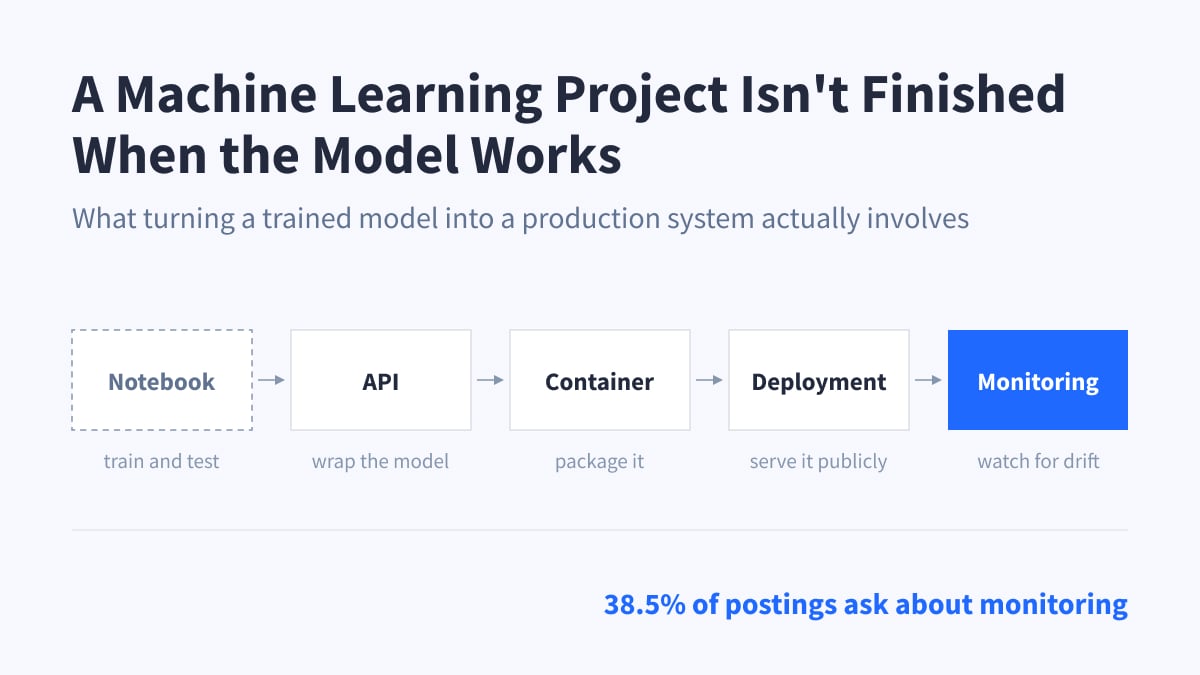
Employers screen for what you've shipped and kept alive, not what you can explain.
Why This Is Rarely Anyone's First Job
Most career guides get vague here. The numbers aren't vague at all.
Three independent sources land in the same place. Axial Search found a median requirement of about five years across 13,776 postings.
A separate analysis of 1,157 Glassdoor listings found entry-level roles made up just 3% of postings. Both of those experience figures come with a caveat, though. Only about a third of listings state a years-of-experience requirement at all.
And LinkedIn ranked AI engineer the fastest-growing job title in the US for 2026, a title plenty of employers use interchangeably with ML engineer.
The headline buries the useful part. The median person landing one of those roles brings 3.7 years of prior experience, arriving from software engineering, data science, and full-stack development.
So the field is growing fast and hiring people who already work in tech.
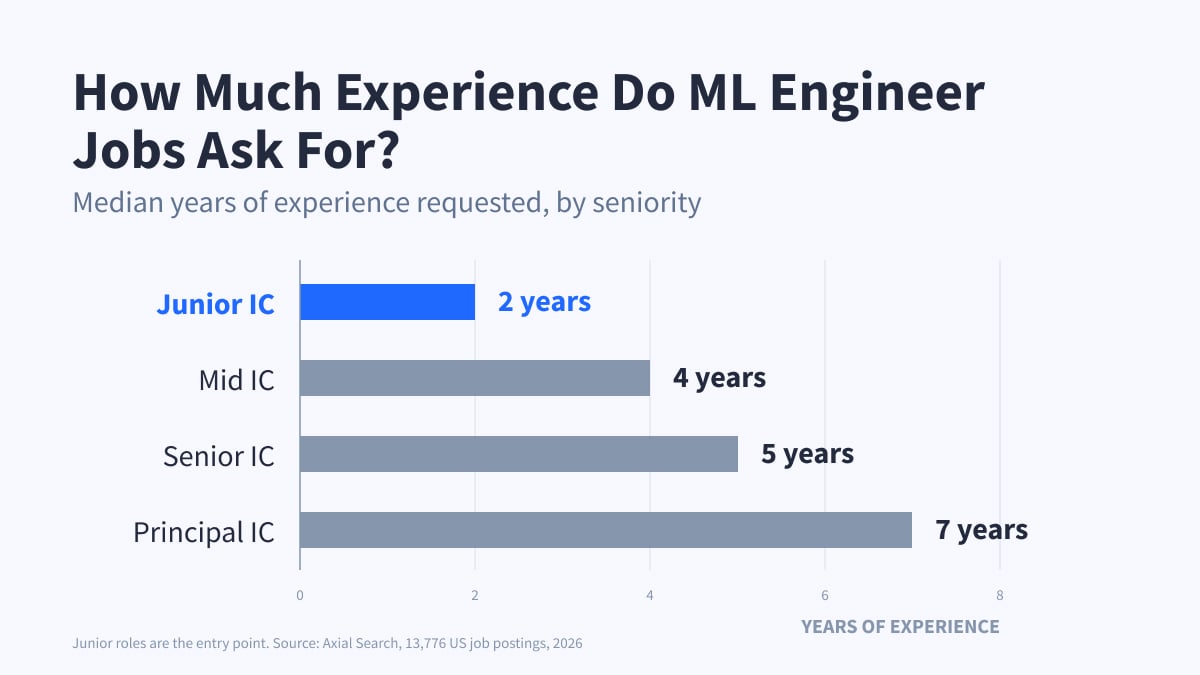
Look at the junior band, though. Junior roles exist, and they ask for about two years. That's the door.
The practical read is that ML engineering is a step you take from somewhere, not a place you land from zero. Your first goal isn't an ML engineer title. It's any job where you write production code that touches data.
The Skills That Show Up Most in Job Postings
Every other guide gives you a skills list. Almost none tell you how often each skill appears in real postings, which is the only thing that helps you decide what to learn first.
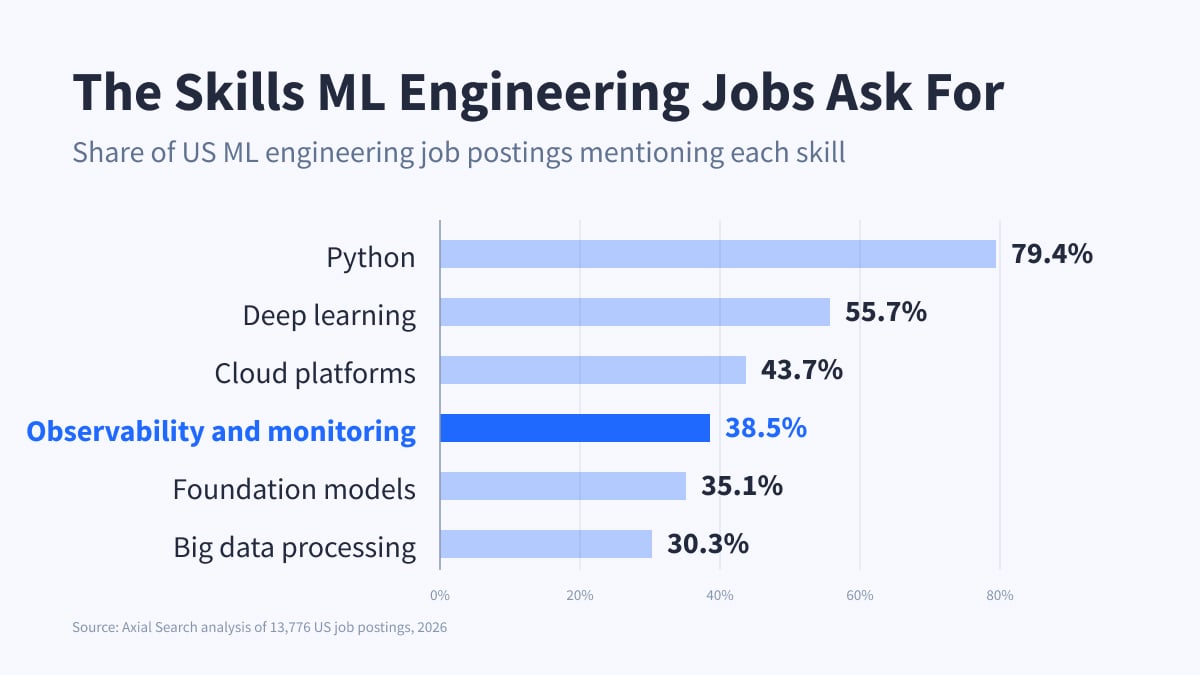
Python at 79.4% isn't a differentiator. It's the price of entry, like knowing how to type.
The one worth staring at is observability and monitoring, at 38.5%. That's well over a third of all postings, and it rarely shows up on beginner skill lists.
Observability means logging what your model predicts, tracking accuracy over time, alerting when inputs drift, and being able to explain why last Tuesday's numbers looked strange.
In practice that looks like MLflow for tracking runs and registering models, plus Evidently or Arize for catching drift once something is live.
Foundation models, at 35.1%, are a big part of why that matters. A good share of the job now involves models you didn't train and can't fully inspect.
When you didn't build the thing, judging whether its output is any good becomes the skill that separates you. Evaluation and monitoring are how that judgment gets done.
Learn it and you can answer interview questions most applicants can't. On frameworks, PyTorch appears in 45% of postings and TensorFlow in 35.5%. Pick one and go deep. Docker and Spark both sit around 17%, which is worth knowing but not worth stalling over.
Those framework numbers hold up against a second dataset. A separate analysis of 1,157 listings put PyTorch at 42% and TensorFlow at 34%, close enough to treat the ranking as real rather than an artifact of one company's sample.
The Foundations Job Postings Assume You Already Have
Most blog posts will list tools to learn. Almost none mention the two things underneath those tools. Job postings skip them too, because employers assume anyone applying already has both.
The first is math. You need enough linear algebra, probability, and statistics to understand why a model behaves the way it does, not to derive it from scratch. A working grasp is the bar. Graduate-level theory isn't. Our machine learning roadmap sequences all of it, including when to pick up each piece.
The second is data structures and algorithms, and it catches career changers off guard. The ML interview loop runs four to six rounds after the recruiter screen and opens with a coding screen.
That screen is closer to a software engineering interview than most people expect, and the bar has been climbing. Axial describes the market the same way, with volume steady and the bar rising. So you can be genuinely good at building models and still get cut in round one on a graph problem.
You might reasonably ask why any of this matters when AI can write the code for you.
The rising bar is the answer. Interviewers aren't testing whether you can produce code, because everyone can produce code now.
They're testing whether you can tell working code from plausible-looking code, and whether you can debug something you didn't write. That's why the foundations got more important rather than less.
Budget study time for math and algorithms both. The two interview rounds that decide most offers are pattern-based coding and ML system design, where you're handed a vague business problem and asked to design the whole system, monitoring included.
Skip the Certifications, and Probably the Master's
Plenty of guides will tell you to go get an AWS or TensorFlow certificate. Job postings rarely mention them.
Axial's top eight certifications for ML engineering roles each appear in 0.1% of postings or fewer. That number needs a caveat, though. A posting staying silent about certificates isn't the same as an employer not wanting one, and Axial says so in their own methodology notes.
So what the data can support is narrower. No credential is doing enough work to show up in the job ads, which makes treating one as your way in a bet against the evidence. Not everyone reads it that way, and some analysts argue certificates still signal specific skills.
We'd still skip them. They cost money and weeks you could spend shipping something instead. (We sell courses, so weigh that as you like.) If you already hold one, list it. If you don't, build a project.
Degrees are a different story. Around 79% of postings do ask for one, and computer science appears in 69% of the postings that name a field.
But the master's question has a more nuanced answer than "yes." PhDs turn up more often than you'd expect, in roughly a third of postings, and that share has been rising. That figure comes from a smaller sample of 1,157 listings, so treat it as a signal rather than a settled number.
Here's how that squares with skipping the master's. PhD requirements climb with seniority rather than sitting evenly across the market. 28% of mid-level postings ask for one, rising to 33% at Principal, and about a fifth of listings don't mention a degree at all.
So the ladder gets more academic as you climb it, while the bar for getting on it stays where it is. A bachelor's plus evidence you've shipped still clears that bar for most roles.
If you already have a technical bachelor's, more school is usually the slower path in. The academic requirements show up later in your career, which means you can meet them later too.
If your degree is in something else entirely? It won't disqualify you, but you'll need deployed work to make the case. A folder of Jupyter notebooks won't be enough on its own.
Your Route In Depends on Where You're Starting
There's no single path here. Find yourself below.
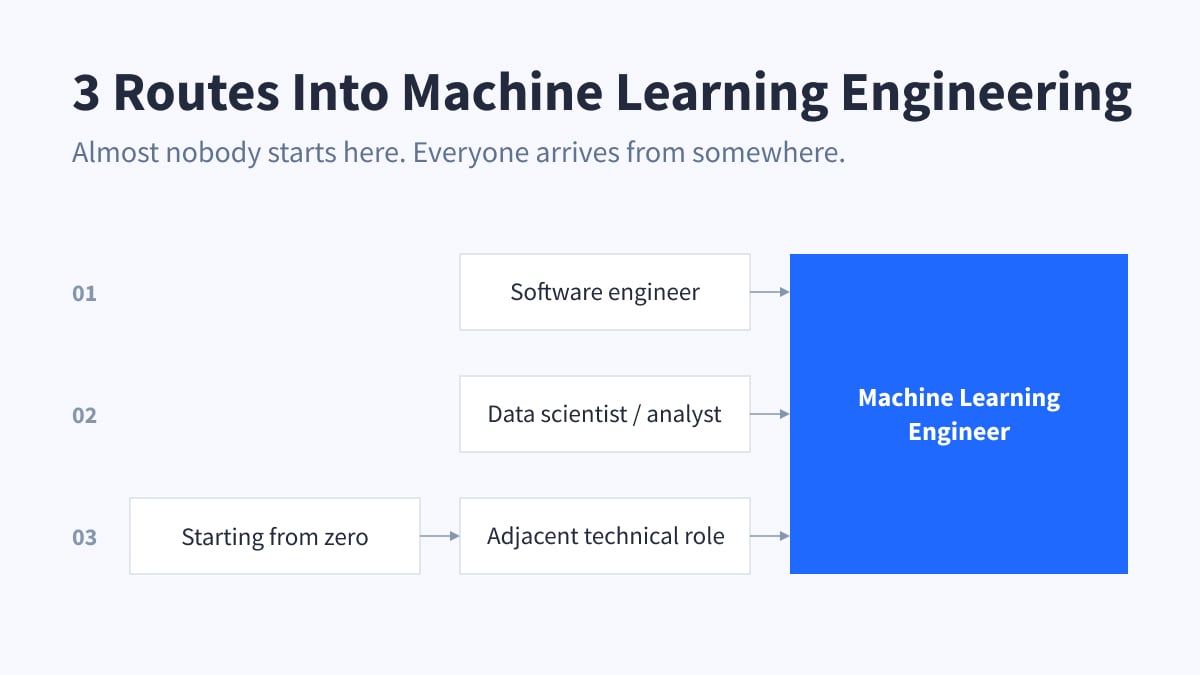
If you're already a software engineer, move sideways before you move out. This is the fastest route, and practitioners recommend it constantly. One engineer on Blind put it plainly: "Try to get a backend SWE role in a machine learning group."
Get near the ML team, take the pipeline and deployment work nobody's fighting over, then apply internally. You already have the production skills that half the applicant pool lacks.
If you're an analyst or data scientist, your gap is engineering, not math. You know the modeling. What you're missing is testing, version control, CI/CD, containers, and cloud deployment. Ask to own the deployment of your own models, even with help.
Our Machine Learning in Python path covers the modeling side if that's still shaky, but the real work here is on the software side.
If you're starting from zero, aim at the adjacent job first. Target data analyst, data engineer, or junior developer roles. Give it 8 to 12 months of consistent study to get hired somewhere, then 2 to 3 years in that seat while you build ML work into your actual job.
Our estimate for the total time to an ML engineer title from a standing start is three to five years, most of it spent working rather than studying. Anyone promising six months is selling you something.
Whatever your route, build things that run. Not a notebook. Something with an API, a container, and a monitoring dashboard, deployed where a stranger can hit it. Two deployed projects beat ten finished lessons.
If you need starting points, we've collected machine learning projects at a range of difficulty levels.
Should You Be Aiming at AI Engineer Instead?
Employers use "ML engineer" and "AI engineer" interchangeably, but the two job markets behind those titles aren't the same size.
AI engineering is the bigger market by a wide margin. Axial counted 43,480 US AI engineering postings since January 2026, running around 1,550 a week, against 13,776 ML engineering postings at roughly 490 a week. Roughly three times as many openings.
ML engineering pays more, though. The median posted band sits at $197,000 versus $176,000 for AI engineering.
The split in the work shows up in the skills. Foundation models appear in 51% of AI engineering postings but 35.1% of ML engineering ones. AI engineers spend more time building on models somebody else trained; ML engineers spend more time training and owning them.
Neither is a shortcut. Both markets are dominated by individual contributor roles that want people who have shipped systems, and the entry problem is the same in both.
If you're choosing, pick on the work rather than the title. The routes above get you to either one.
If AI engineering is the direction you want, our AI Engineer in Python path covers the LLM APIs, embeddings, RAG systems, and FastAPI deployment those postings ask for. It ends with 20 projects for your portfolio.
What the Job Pays, and Why Every Source Says Something Different
You'll see wildly different salary figures for this role, and nobody's lying. They're measuring different things.
| Source | Figure | What it's measuring |
|---|---|---|
| Axial Search (2026) | $197,000 median | Midpoint of bands employers posted |
| Glassdoor (Aug 2026) | $164,000 median | Self-reported total pay, including bonuses |
| BLS (May 2024) | $140,910 median | Computer and information research scientists |
Posted bands skew high, since employers advertise the top of what they'd pay. The BLS doesn't track machine learning engineer as its own occupation at all, so that last row is only the nearest official proxy.
Treat the range as the answer. It's a six-figure role almost everywhere, and the closest BLS category projects 20% growth through 2034.
Where to Start This Week
Pick what matches your situation and do it in the next seven days.
- Read five real ML engineer postings. Not the marketing, the requirements. Note which skills appear in all five.
- Deploy one model you've already built. Even a toy one. Wrap it in an API, containerize it, give it a public URL.
- Add monitoring to it. Log predictions, chart accuracy over time, set one alert. Now you can discuss what 38.5% of postings ask about.
- Ask your current team what ML work they'd hand off. That sideways move beats the application funnel.
Frequently Asked Questions
Can you become a machine learning engineer without a degree?
Yes, but you're working against the grain. About 79% of postings ask for a degree, so without one you need deployed, production-grade projects doing the convincing instead. The internal-transfer route is far more realistic than cold applications.
How long does it take?
From an existing software or data role, one to three years. From zero, plan on three to five, most of which is spent getting and holding an adjacent job rather than studying.
What's the difference between an ML engineer and an AI engineer?
ML engineers usually train and deploy their own models. AI engineers more often build applications on top of existing models, working with LLM APIs, RAG systems, and agents. The titles overlap and some employers use them interchangeably. We've mapped that role separately in our AI engineer roadmap.
Do you need a PhD?
Not to get in. Around a third of postings mention a PhD and the share is climbing, but the requirement concentrates higher up the ladder, at Principal level and above. For entry and mid-level roles, a bachelor's plus shipped work still clears the bar.
