
Machine Learning Roadmap: What to Learn First (2026)
Deciding what to learn first in machine learning is confusing, not because the skills are unclear, but because the order is. Python, math, and the machine learning algorithms themselves all matter. What matters more is knowing which one to focus on first, how deep to go, and when you're ready for the next step. That's what this roadmap lays out.
You'll get a clear, four-phase plan to reach a job-ready level in machine learning in 2026, whether you're starting from zero or already writing Python. No degree required, and no pretending you'll be training neural networks by next weekend.
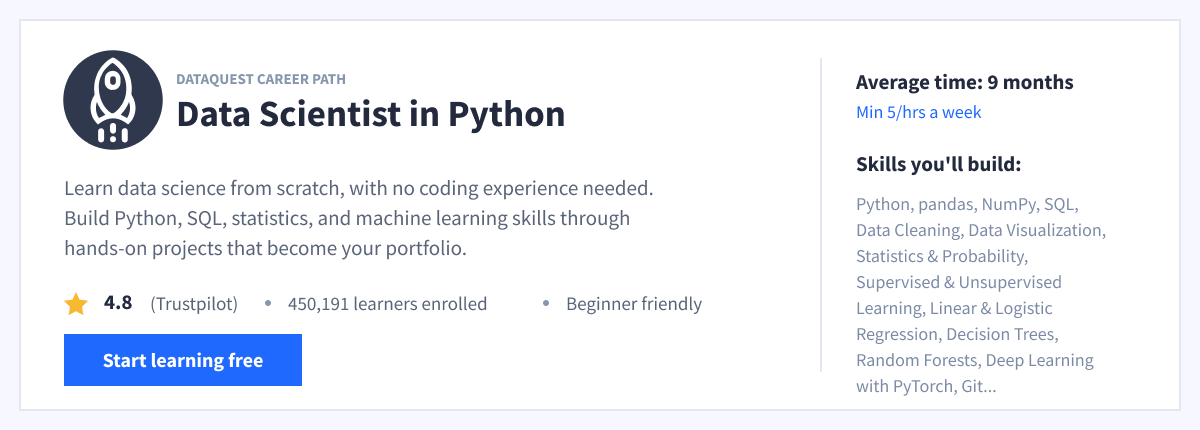
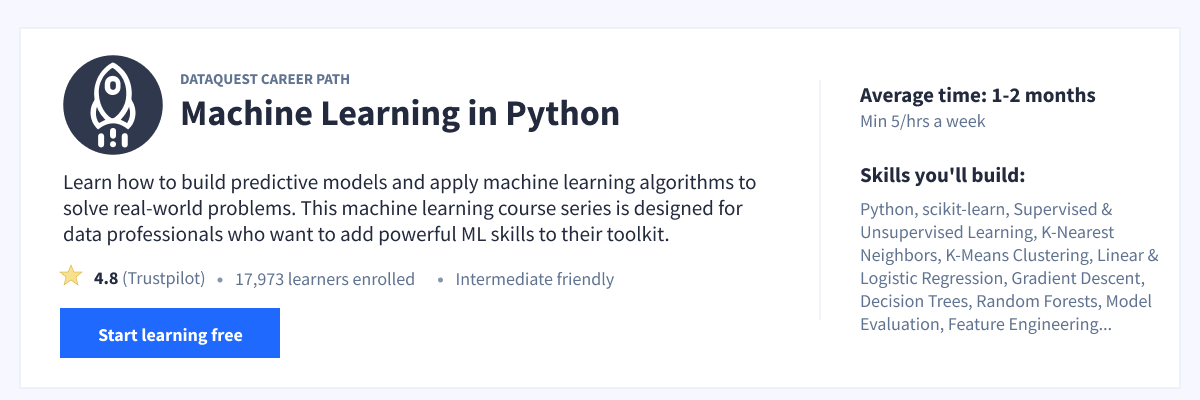
At Dataquest we teach this sequence two ways, depending on where you're starting. If you're beginning from scratch, our Data Scientist in Python path covers the whole arc, foundations through machine learning, in about nine months at five hours a week. If you already have Python and data analysis skills, the Machine Learning in Python skill path drops you straight into the modeling core. Both follow the same foundation-first order this roadmap describes, with hands-on projects rather than passive video.
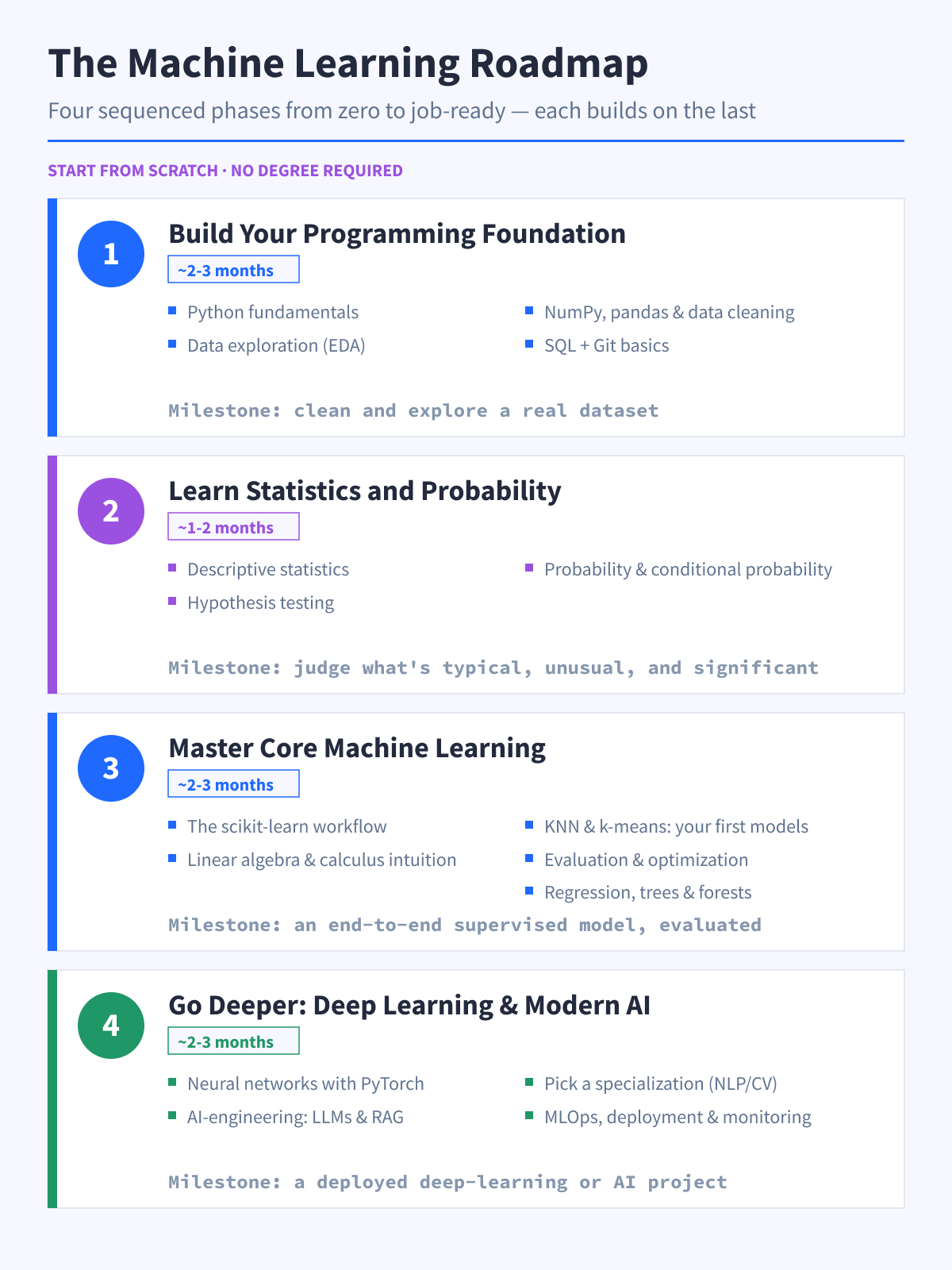
Machine Learning Roadmap at a Glance
Here is the order we recommend for learning machine learning from scratch:
- Build your programming foundation (2 to 3 months): Learn Python, NumPy, pandas, data cleaning, exploratory analysis, visualization, and the basics of SQL and Git.
- Learn statistics and probability (1 to 2 months): Distributions, sampling, variability, and the probability rules you need to evaluate a model honestly.
- Build core machine learning skills (2 to 3 months): Use scikit-learn to train and evaluate K-nearest neighbors, k-means, linear and logistic regression, decision trees, and random forests. Pick up linear algebra and calculus intuition here, where they explain what you've just built, then improve models with cross-validation, regularization, feature engineering, and hyperparameter tuning.
- Go deeper with deep learning and modern AI (2 to 3 months): Learn neural networks with PyTorch, choose a specialization, work with LLM APIs and RAG, and cover deployment basics such as Docker and model monitoring.
That is roughly nine months of steady part-time study from a standing start, and three to five months if you arrive already knowing Python and pandas.
Looking for the full step-by-step plan? Jump to the complete machine learning roadmap.
Table of Contents
- What's Changed About Learning Machine Learning in 2026
- Why Learn Machine Learning?
- What Does Machine Learning Actually Involve?
- Is Machine Learning Right for You?
- How Much Math Do You Actually Need?
- How Long Does It Take to Learn Machine Learning?
- The Complete Machine Learning Roadmap
- Where This Roadmap Can Take You
- Common Mistakes to Avoid
- Your Next Steps
- Frequently Asked Questions
What's Changed About Learning Machine Learning in 2026
The core of machine learning has been stable for years, but the environment you're entering has shifted, and a lot of the advice online hasn't caught up. Setting expectations honestly here will save you months of chasing the wrong thing.
Start with the tools. ChatGPT and Copilot can write model code or draft a pipeline in seconds, which has genuinely changed the day-to-day work. What it hasn't changed is the need to understand what a model is doing, whether its output can be trusted, or when a simple approach beats a complicated one. If anything, that raises the value of people who know the fundamentals well enough to use these tools with judgment.
The related temptation is to skip those fundamentals entirely and jump to LangChain, RAG, and agents. It's the most common trap we see in 2026, and it tends to leave people able to wire tools together but unable to tell when something is quietly broken. Practitioners keep pointing this out to beginners. In a reddit discussion about becoming an AI engineer, one commenter summed up how the work has shifted:
"In 2026, 'AI Engineer' mostly means building reliable systems AROUND models, not building models. Less PyTorch, more context management, eval frameworks, retry logic, and knowing how to catch failure modes before they hit users. The math foundation still matters but the daily work has shifted." — r/learnmachinelearning
The job titles have spread out too. "Machine learning engineer" now covers everything from training models to building the systems around them, with some roles leaning modeling-heavy and others leaning toward software and infrastructure. You don't have to choose today, but knowing the map helps, and we'll come back to it in the careers section.
Underneath all of it, the fundamentals remain the durable bet. Python, a working intuition for the math, and classical machine learning support everything else, including using AI tools well. Learn those properly and you adapt to whatever framework arrives next year instead of starting over each time the hype cycle turns.
| A few years ago | Heading into 2026 | |
|---|---|---|
| Writing model code | Write everything by hand | AI drafts it; you design, verify, and debug |
| Biggest beginner temptation | Collect more courses | Skip fundamentals and jump straight to LLMs |
| Most valued skill | Knowing an algorithm | Judgment: knowing which approach fits, and why |
| What gets you hired | Certificates alone | A portfolio of real, working projects |
Why Learn Machine Learning?
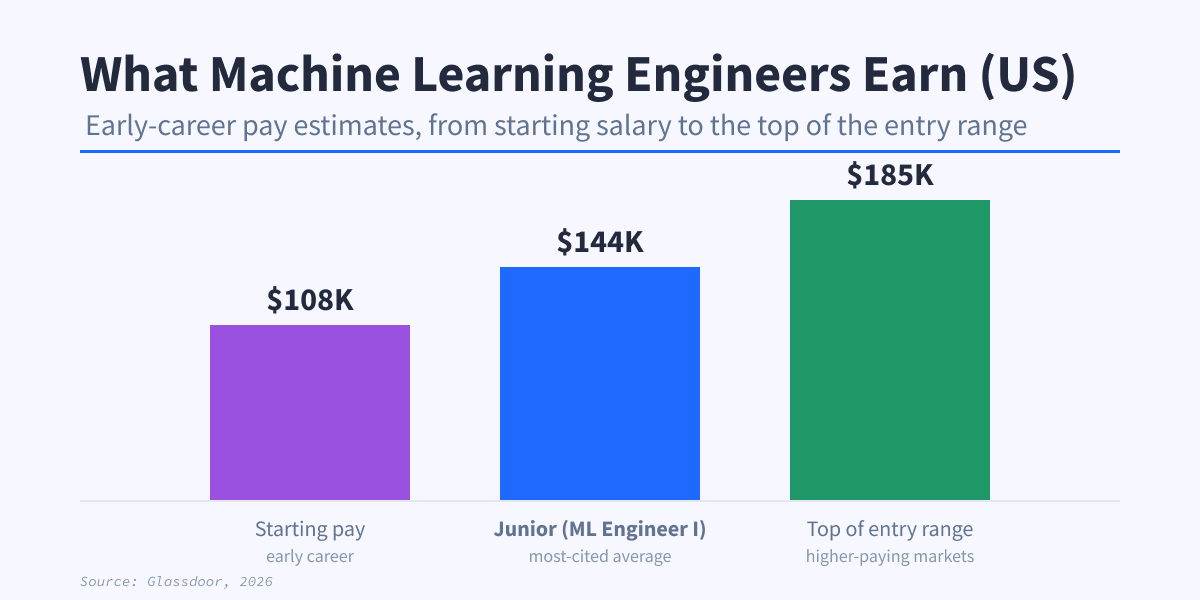
The pay is a fair place to start. Glassdoor estimates that machine learning engineer salaries in the US start around $108,000 and reach roughly $128,000 once you move past entry-level roles, against a median total pay of about $164,000 across all experience levels. Compensation varies a lot by location and company, so treat these as ballpark figures rather than promises.
Demand sits underneath some of the fastest-growing roles in tech. The US Bureau of Labor Statistics doesn't track "machine learning engineer" as its own occupation, but the closest one points clearly upward: data scientists are projected to grow 34% from 2024 to 2034, against 3% for all occupations, and machine learning skills sit at the heart of that work.
The skills also travel. Recommendation systems, fraud detection, medical risk models, demand forecasting, and search all run on machine learning, which means you can usually apply it to a field you already care about and take it with you if you change industries. And because everything newer is built on this base, the machine learning you learn here is the ground floor for deep learning, AI engineering, and MLOps. Once you understand how models learn and fail, moving into those areas is a next step rather than a fresh start.
What Does Machine Learning Actually Involve?
Machine learning has a reputation for being all abstract math and PhDs. The day-to-day is more approachable than that, and knowing what it really involves helps you decide if it's for you.
What Machine Learning Really Is
At its core, machine learning is teaching a computer to find patterns in data and make predictions, instead of you writing explicit rules for every case. You show a model many examples, it learns the relationships, then it makes predictions on data it hasn't seen. Most of the real work is preparing data, choosing and training a model, and carefully checking whether its predictions hold up.
Supervised vs. Unsupervised Learning
Almost everything you'll learn early on falls into two buckets. In supervised learning, you train on labeled examples, such as past emails marked "spam" or "not spam," so the model can label new ones. In unsupervised learning, there are no labels, and the model finds structure on its own, such as grouping customers into segments by behavior. You'll learn both, and when each one fits.
Machine Learning Engineer vs. Related Roles
These titles overlap more than job boards suggest, and the boundaries shift by company. The table below is a rough orientation rather than four clean lanes.
| Role | Primary focus | Key difference |
|---|---|---|
| Machine Learning Engineer | Modeling, plus the engineering to ship it | Pairs modeling with software engineering |
| Data Scientist | Analysis, experiments, and modeling | Same core modeling skills, more emphasis on statistics and communication |
| AI Engineer | Applications built around existing models | Builds with models more than training them |
| MLOps Engineer | Infrastructure, deployment, and monitoring | Owns the systems that keep models running |
In practice the first two blur together, and plenty of people do modeling work under either title. This roadmap builds the modeling foundation all four stand on. If the analyst route interests you first, the data analyst roadmap covers Phase 1 in far more depth, and the data scientist roadmap goes deeper on the analysis-and-experiments side. For a wider view of how these roles fit together across the whole field, see how to get into AI in 2026.
Is Machine Learning Right for You?
Machine learning isn't the right fit for everyone, and that's completely fine. Better to find out now than three months in.
You'll probably enjoy this if you:
- Like digging into a problem until the pattern finally clicks.
- Don't mind that most of the work is preparing and checking data, not just training models.
- Are comfortable being wrong often, since a lot of machine learning is trying, measuring, and adjusting.
It might frustrate you if you:
- Want fast, visual results without the setup and cleanup.
- Dislike anything mathematical, even at an intuition level.
- Prefer clear right-or-wrong answers over "this model is about 87% accurate."
How Much Math Do You Actually Need?
This is the question that stops more beginners than any other, so let's answer it directly. You need some math, but far less than the gatekeeping online suggests, and the order matters more than the volume.
Statistics and probability come first, because they're what let you tell a good model from a bad one. Linear algebra and calculus come later, after you've trained your first models, which is when they stop being abstract rather than before. You don't need to prove theorems; you need enough intuition to understand what's happening and why.
| Math area | Why it matters for ML | Depth you need | When to learn it |
|---|---|---|---|
| Statistics & probability | Evaluating models, sampling, reasoning about uncertainty | Distributions, mean and variance, basic probability | Phase 2, before the ML core |
| Linear algebra | How data and models are represented and combined | Vectors, matrices, dot products | Phase 3, after your first models |
| Calculus | How models learn through optimization | Derivatives and gradients, conceptually | Phase 3, alongside gradient descent |
That ordering is deliberate, and it's how our own paths sequence the material: statistics and probability, then the intro machine learning courses, then calculus and linear algebra, then the more advanced modeling. As one experienced engineer put it in a reddit discussion:
"You don't need to be a mathematician, but you need mathematical maturity. This means having the intuition to understand how data is transformed through layers." — r/learnmachinelearning
If your math is rusty, that's not a reason to wait. Both of our paths build the statistical foundation with real data before any modeling starts, so the concepts stick because you apply them.
How Long Does It Take to Learn Machine Learning?
Your timeline depends on where you're starting and how much time you can give it each week. These are honest guidelines, not guarantees, and they line up with how long our own paths take.
Starting From Scratch (No Coding Experience)
- 5 hrs/week: about 9 months
- 10 to 15 hrs/week: about 5 to 6 months
- 20+ hrs/week: about 3 to 4 months
Nine months at a sustainable five hours a week is the realistic figure, and it's exactly what the Data Scientist in Python path is built around. You'll build Python, data skills, statistics, and machine learning from the ground up, one phase at a time. The faster tracks are estimates scaled from that anchor, not separate measurements.
Coming From Python or Data Analysis
If you're already comfortable with Python, pandas, and working with data, you've effectively finished Phase 1. What's left is the statistics, the modeling core, and whichever depth you choose in Phase 4. The classical machine learning core alone runs about two months at five hours a week, which is the Machine Learning in Python skill path estimate. Adding statistics and some deep learning puts most people at three to five months.
Part-Time vs. Full-Time
The single biggest factor is consistency, not raw hours. A few focused hours each week, sustained, will get you further than occasional marathon sessions, because machine learning rewards the kind of repeated practice that only happens on a schedule you can actually keep.
The Complete Machine Learning Roadmap
Now let's walk through each phase in detail. Each one builds on the previous phase, taking you from your first line of Python to a portfolio of models and applications you can share with employers.
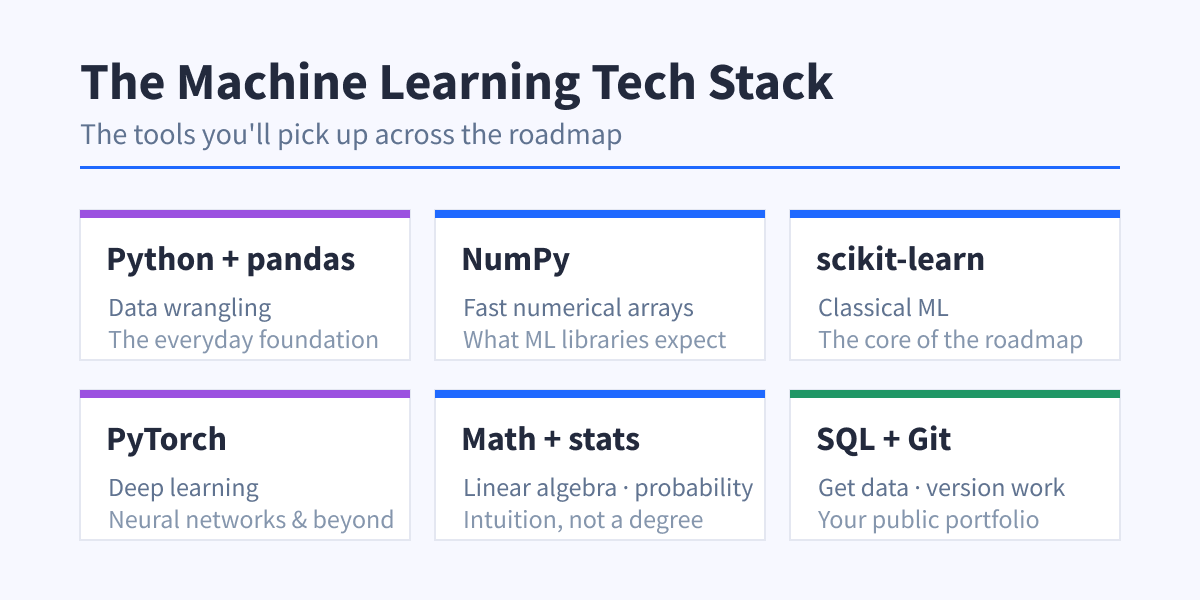
The tools below are what you'll pick up along the way. Don't worry if the names are unfamiliar, because learning them is the whole point of this guide.
Explore all four phases and estimate your own timeline with the interactive roadmap below.
Phase 1: Build Your Programming Foundation
Timeline: about 2 to 3 months

Machine learning is applied programming, so before any models, you need to be comfortable working with data in code. Don't rush this phase, because everything later builds on these habits. This is the same foundation a data analyst needs, so if you want more depth on it than this roadmap gives, the data analyst roadmap covers it step by step.
Skill: Python Programming Fundamentals
Why it matters: Python is the language of machine learning, from data cleaning to model training. Nearly every tool and lesson you'll use assumes it.
What to learn: Start with core syntax: variables, loops, conditionals, and functions. Then the data structures you'll use constantly, especially lists and dictionaries. You don't need to become a software engineer, just fluent enough to work with data confidently.
How to practice: Write small scripts that do something real, like reading a file and summarizing it.
Timeline: about 1 month
Skill: NumPy, pandas, and Data Cleaning
Why it matters: Real datasets are messy, and pandas is how you load, clean, and shape them. Cleaning data well is arguably the most valuable and most underrated skill in the entire field.
What to learn: Load data into a pandas DataFrame, select and filter rows, handle missing values, fix inconsistent formats, and create new columns. NumPy gives you the fast numerical arrays that machine learning libraries expect.
A common everyday cleaning step looks like this:
import pandas as pd

df = pd.read_csv("customers.csv")
df = df.dropna(subset=["age"])              # drop rows missing age
df["signup_date"] = pd.to_datetime(df["signup_date"])
df["is_active"] = df["last_login"].notna()   # feature from raw data
Timeline: about 1 month
Skill: Data Exploration and Visualization
Before you can model data, you need to understand it. Exploratory data analysis is how you spot trends, outliers, and relationships, and it's how you catch problems before they wreck a model. Learn summary statistics, grouping and aggregating, and enough matplotlib to see distributions and relationships at a glance.
Skill: SQL and Git
A lot of data lives in databases, so a working knowledge of SQL lets you get it yourself rather than waiting on someone else. Git lets you version your work and put projects on GitHub, where employers can actually see them. You need enough SQL to select, filter, join, and aggregate, and enough Git to commit your work and push a repository. Both are lightweight here, but both come up in interviews.
Milestone Project (Phase 1)
Take a messy public dataset, clean it in Python, and explore it with a few summary tables and charts. This becomes your first portfolio piece, and it proves you can turn raw data into something usable, which is where every machine learning project begins.
Phase 2: Learn Statistics and Probability
Timeline: about 1 to 2 months

Statistics is the math you need before you touch a model, because it's what tells you whether a model is any good. Linear algebra and calculus can wait until Phase 3, where they'll make far more sense.
Skill: Descriptive Statistics
Why it matters: Before you can judge a prediction, you need to describe your data: what's typical, how spread out it is, and what counts as unusual. These same measures reappear constantly in model evaluation.
What to learn: Sampling, frequency distributions, mean, median, variance, and standard deviation, plus z-scores for comparing values across different scales.
Skill: Probability
Why it matters: Machine learning outputs are probabilistic. A classifier doesn't say "spam," it says "87% likely spam," and interpreting that correctly is a probability skill.
What to learn: The basic probability rules, conditional probability, and independence. Bayes' theorem is worth understanding, partly because Naive Bayes classifiers are built directly on it.
Skill: Hypothesis Testing
Why it matters: Knowing whether a difference is real or noise is what keeps you from shipping a model that only looked better by chance.
What to learn: Significance testing, and enough about chi-square and permutation tests to evaluate a result honestly.
Milestone Check (Phase 2)
You can look at a dataset and say what's typical, what's unusual, and how confident you are in a difference between two groups.
Phase 3: Master Core Machine Learning
Timeline: about 2 to 3 months

This is the heart of the roadmap, and it follows the same sequence as our Machine Learning in Python skill path, with the math courses from our fuller paths folded in. You'll pick up linear algebra and calculus intuition partway through, once you've trained enough models for the math to feel like an explanation rather than a prerequisite.
Skill: The ML Workflow and scikit-learn
Why it matters: Every machine learning project follows the same loop: split your data, train a model, make predictions, evaluate. scikit-learn makes this consistent across algorithms, so learning the workflow once transfers everywhere.
What to learn: Train/test splitting, fitting a model, making predictions, and the basic scikit-learn API. Here's the shape of it:
from sklearn.model_selection import train_test_split
from sklearn.neighbors import KNeighborsClassifier
from sklearn.metrics import accuracy_score

X_train, X_test, y_train, y_test = train_test_split(
    X, y, test_size=0.2, random_state=42
)
model = KNeighborsClassifier(n_neighbors=5)
model.fit(X_train, y_train)
predictions = model.predict(X_test)
print(accuracy_score(y_test, predictions))
Skill: Your First Models, Supervised and Unsupervised
Why it matters: Starting with K-nearest neighbors and k-means gets you building immediately, because both are intuitive enough to reason about without heavy math. They also introduce the two halves of the field.
What to learn: K-nearest neighbors for classification, and k-means clustering for finding structure in unlabeled data. Implement each one from scratch once before reaching for the library version, then let scikit-learn handle it afterward.
Skill: Linear Algebra and Calculus Intuition
Why it matters: This is the natural moment for the math. You've now trained models and seen them improve, so vectors, matrices, and gradients explain mechanics you've already watched happen.
What to learn: Vectors, matrices, and dot products, so you can picture data flowing through a model. Then derivatives and gradients, which is exactly what gradient descent uses to find better parameters. Aim for intuition, not proofs.
Skill: Regression and Tree-Based Models
Why it matters: These are the workhorses of applied machine learning, and most tabular problems you'll meet in a job are solved with them rather than anything more exotic.
What to learn: Build up in this order, since each teaches something the next relies on:
| Stage | What you learn |
|---|---|
| Linear regression | Predicting continuous values; the foundation of modeling |
| Gradient descent | How models actually optimize toward better parameters |
| Logistic regression | Classification and probability outputs |
| Decision trees | Rule-based models you can interpret and explain |
| Random forests | Combining many trees for stronger predictions |
Skill: Model Evaluation and Optimization
Why it matters: A model that looks accurate can still be useless, and knowing the difference is what separates a practitioner from someone running code. Evaluation is one of the most overlooked skills in the field, so give it real attention.
What to learn: Accuracy, precision and recall, cross-validation, and the difference between overfitting and underfitting. Then the techniques that improve a model: regularization, feature engineering, and hyperparameter tuning.
Milestone Project (Phase 3)
Build an end-to-end supervised model on a dataset you care about, such as predicting a health outcome or a price, and evaluate it properly with a train/test split and clear metrics. Being able to do this well, and explain your evaluation choices, is what most working engineers would call the line between learning and employable.
Phase 4: Go Deeper with Deep Learning and Modern AI
Timeline: about 2 to 3 months
With classical machine learning solid, this phase is about depth and direction. You don't need all of it to be useful, so treat it as a menu rather than a checklist.
Choosing Your Direction
Before picking up anything new, it helps to know which of the three directions you're heading toward.
| Approach | Best when | What you build |
|---|---|---|
| Classical ML | Structured or tabular data, need interpretability | Prediction and classification models |
| Deep learning | Images, text, audio, large datasets | Neural networks for perception and language |
| AI engineering | You need a capable model fast, without training one | Reliable applications around existing LLMs |
Skill: Neural Networks and Deep Learning with PyTorch
Why it matters: Deep learning powers image recognition, language models, and most of what people mean by "AI" today. Understanding it opens the door to the highest-impact work.
What to learn: What a neural network is, how it trains, and how to build a small one in PyTorch from your own training loop before relying on prebuilt models. Regularization techniques like dropout and early stopping matter here, since deep networks overfit easily.
Skill: Pick a Specialization
Why it matters: Depth beats breadth once you have the fundamentals. Choosing an area lets you build portfolio projects that stand out.
What to learn: Pick one to start: natural language processing, computer vision, or time series. You can always add another later.
Skill: The AI-Engineering Layer
Why it matters: A growing share of jobs in 2026 is about building reliable systems around existing models rather than training your own. This is real and valuable work, and it goes better on top of the fundamentals than instead of them.
What to learn: Transformers conceptually, working with LLM APIs, embeddings and vector databases, retrieval-augmented generation, and above all evaluation, which is what separates a demo from a dependable product.
Skill: MLOps and Deployment Basics
Why it matters: A model that only runs in your notebook doesn't help anyone. Basic deployment skills turn your work into something real, and they're increasingly what employers screen for.
What to learn: Packaging a model with Docker, serving it behind a simple API, and monitoring it once it's running so you notice when its performance drifts.
Milestone Project (Phase 4)
Build a deep-learning or LLM-powered project and actually deploy it, even if the deployment is simple. A working app someone can try is worth more than ten notebooks no one sees.
If AI Engineering Is Where You're Headed
If the LLM and RAG side is what actually excites you, it's worth knowing that this is a different route rather than an extension of this one. Our AI Engineer in Python path is a full career path in its own right: about ten months from zero, and it re-covers the statistics and machine learning in Phases 2 and 3 on its way to embeddings, vector databases, and RAG systems. It also trades away SQL, which this roadmap treats as part of your foundation in Phase 1.
So if you've already worked through Phases 1 to 3, don't restart there. Take the AI-engineering skills above on top of what you have. If you're starting from zero and already know you want to build AI applications rather than train models, that path is the more direct route, and how to get into AI in 2026 compares the options in more detail.
Where This Roadmap Can Take You
The same foundation opens several doors, and as the role table earlier showed, the boundaries between them are softer than the titles suggest.
The most direct destination is machine learning engineer, with one honest caveat: this roadmap gives you the modeling half of that job. The production and infrastructure half, the pipelines, the serving, the monitoring at scale, is something most people build on the job or by moving toward MLOps work. Plenty of people are hired into ML engineering on strong modeling skills and grow the engineering side afterward.
Data scientist is the other common first title for people who come through this sequence, and it uses much the same modeling toolkit with more weight on statistics, experiments, and communicating findings. AI engineer and MLOps engineer both sit further toward software and systems work.
One thing worth knowing early is that these roles are splitting into lanes:
"The split between SWE-heavy MLE and modeling-heavy MLE is real, look at job descriptions and pick a lane." — r/learnmachinelearning
You don't need to choose now. Build the foundation first, then let the projects you enjoy most point you toward a lane.
Common Mistakes to Avoid
A few predictable mistakes slow down most beginners, and knowing them in advance saves you months.
The most common is collecting courses instead of building. Watching lesson after lesson feels productive but teaches surprisingly little, so build something small after every skill. Closely related is jumping to LLMs before the fundamentals, which is a common trap and makes the tools harder to debug than they need to be.
Then there are the portfolio mistakes. Building only notebook projects leaves your work invisible to employers, so deploy at least one, however simply, and put everything on GitHub. Skipping the math entirely is similar: you don't need a degree, but avoiding all of it leaves you unable to explain why a model behaves the way it does.
Finally, two habits that quietly cost people time. Chasing every new framework leads to burnout, since the stack changes faster than anyone can follow; anchor on fundamentals and add tools as you need them. And ignoring evaluation is the most expensive of all, because plenty of people can train a model but can't say whether it's actually good. That skill is a genuine differentiator.
"The two biggest mistakes I see: Jumping straight to LangChain/RAG without ML fundamentals. Collecting courses instead of building projects." — r/learnmachinelearning
Your Next Steps
You don't need the whole journey figured out today. You need a first move.
This week, do three things: install Python, load a dataset you find interesting into pandas, and train one simple scikit-learn model on it, even a rough one. Then create a GitHub account and commit what you did. Momentum comes from building, not planning. As practitioners often point out, the fastest way into this field isn't another certificate, it's shipping something real and putting it where people can see it.
The plan itself is simpler than the internet makes it look: foundations first, then statistics, then the core algorithms with the math that explains them, then the depth you choose. A first model trained this week is worth more than a perfect plan next month.
When you want a structured route, pick the one that matches your starting point. From scratch, the Data Scientist in Python path takes you through this whole sequence in about nine months at five hours a week. Already writing Python, the Machine Learning in Python skill path starts at the modeling core. Either way you finish with projects rather than just certificates.
Frequently Asked Questions
Can I learn machine learning without a degree?
Yes. Employers increasingly hire on demonstrated skill, and a portfolio of real, working projects can outweigh a formal credential, especially for early-career roles. A structured route gives you both the skills and the projects to show for them.
How much math do I really need for machine learning?
Less than the gatekeeping suggests, and in a different order than most people assume. Statistics and probability come first because they're what let you evaluate a model. Linear algebra and calculus are better learned after your first models, when they explain mechanics you've already seen, and intuition matters far more than the ability to prove theorems.
Should I learn classical machine learning or jump straight to LLMs in 2026?
Learn the fundamentals first. Large language models and AI engineering sit on top of machine learning understanding, and skipping the base leaves you unable to tell when things go wrong. If AI application work is your goal from the start, the AI Engineer in Python path is a separate ten-month route from zero rather than a follow-on to this roadmap, and it covers the ML fundamentals on the way.
How long does it take to learn machine learning from scratch?
For a complete beginner, plan on about nine months of steady part-time study at five hours a week to reach a job-ready level, faster if you already know Python or can study full-time. Consistency matters more than intensity, so a sustainable weekly rhythm beats occasional cramming.
Do I need to know Python before starting?
Python is Phase 1 of this roadmap, so you'll learn it as you go. You don't need to master it first, just become comfortable enough to work with data.
Is machine learning still a good field to enter in 2026 with AI?
Yes, with nuance. AI tools can now handle more routine coding tasks, which makes judgment, evaluation, and building reliable systems increasingly important. The outlook for related roles remains strong, with the BLS projecting 34% growth for data scientists through 2034, against 3% across all occupations.
What should my first machine learning project be?
Pick a dataset on a topic you care about, then train and evaluate one supervised model end to end, such as predicting a price or a category. A focused project you can explain beats an ambitious one you can't finish.