
How to Get Into AI in 2026: 5 Real Routes In
You want to get into AI, you don't know how to write a single line of code, and watching AI generate a working script in ten seconds makes you wonder whether learning to code is even worth the effort anymore.
That combination of wanting in and feeling locked out is the most common starting point there is. The top-ranked discussion on this exact question is a Reddit thread where an international relations undergrad describes it almost word for word: they think AI is bigger than the internet, they want to try their chances in the field, and they can't write a line of code. The thread has 96 replies. It contradicts itself constantly, and the single best question in it was asked twice and never answered.
This guide answers it. You'll get three lanes into AI work, five routes in depending on where you're starting, honest timelines including the part-time ones nobody publishes, and a plan for your first 90 days.
Key Takeaways
You don't need a PhD or a master's. Graduate degrees matter for frontier research roles, which are a narrow slice of AI work rather than the field itself.
You don't need to code for every AI role, but you do for most well-paid ones. Which lane you pick decides this.
A full technical route takes roughly 8–9 months at 5 hours a week, and you'll be building with real AI models in month two, not at the end. A non-technical starting point takes days.
Your existing career is an asset, not a gap. Domain knowledge is what makes AI work useful, and it's the thing you already have.
Start this week by picking your lane, then completing one small project. Not by enrolling in everything.
Table of Contents
- What "Getting Into AI" Actually Means in 2026
- Which Route Into AI Fits You?
- What You Actually Need to Get Into AI (and What You Don't)
- AI Jobs You Can Actually Target
- The Honest State of the AI Job Market in 2026
- Your Background Is an Advantage, Not a Deficit
- How to Get Into AI: A Step-by-Step Plan
- How Long Does It Take to Get Into AI?
- Five AI Projects That Get You Noticed
- Your First 90 Days
- Mistakes to Avoid on the Way Into AI
- Frequently Asked Questions
- Getting Started
What "Getting Into AI" Actually Means in 2026
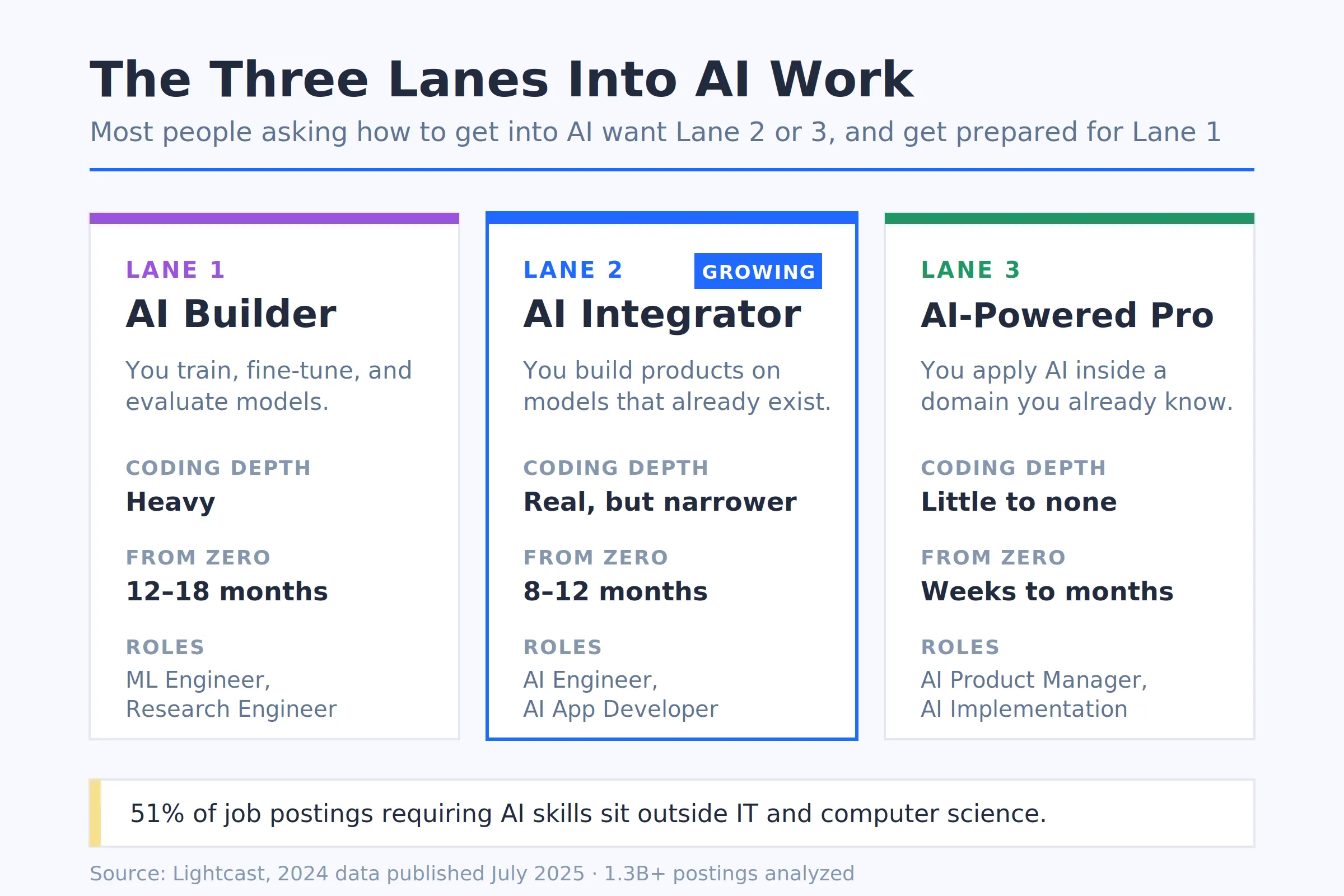
Getting into AI isn't one path. There are three distinct lanes of AI work, and they ask for very different things from you.
Almost every guide treats AI entry as a single ladder: learn Python, learn machine learning, get hired. That describes one lane, the hardest one, and probably not the one you're aiming at.
Lane 1: The AI Builder
You train, fine-tune, and evaluate models, caring about architectures, loss functions, and whether your model generalizes. The deepest technical lane, and the one that genuinely rewards graduate-level math. Titles: Machine Learning Engineer, Research Engineer, Applied Scientist.
Lane 2: The AI Integrator
You build products on top of models that already exist: LLM APIs, retrieval systems, agents, and (the part most people skip) figuring out whether the output is any good. Real engineering, real code, no training runs from scratch. Titles: AI Engineer, AI Application Developer.
This is the most realistic entry point in 2026. Most companies adopting AI aren't training models, they're wiring existing ones into their products.
Lane 3: The AI-Powered Professional
You bring AI into work you already understand: marketing, HR, operations, healthcare, legal, education, finance. Little or no code. You're the person who knows which problems are worth solving and whether the output can be trusted. For most people this shows up as advancement inside their existing career rather than a new job title, though dedicated roles do exist: AI Product Manager, AI Implementation Specialist, AI Operations, AI Evaluation Specialist.
Lane 3 is not a footnote. Lightcast's analysis of over 1.3 billion job postings found that 51% of postings demanding AI skills sit outside IT and computer science as of 2024, and that generative AI roles in non-tech industries grew 800% since 2022. The demand is real, and most of it is not in engineering teams.
Here's the mismatch that makes all the advice feel impossible: most people asking how to get into AI want Lane 2 or Lane 3, and every guide prepares them for Lane 1.
| Lane | What you actually do | Coding depth | Realistic entry timeline | Example roles | Typical pay band |
|---|---|---|---|---|---|
| 1. AI Builder | Train, fine-tune, and evaluate models | Heavy: Python, ML libraries, math fluency | 12–18 months from zero | ML Engineer, Research Engineer | Highest |
| 2. AI Integrator | Build products on existing models: APIs, RAG, agents, evaluation | Real but narrower: Python, APIs, app frameworks | 8–12 months from zero | AI Engineer, AI App Developer | High |
| 3. AI-Powered Professional | Apply AI inside a domain you already know | Little to none | Weeks to a few months | AI Product Manager, AI Implementation, AI Evaluation | Varies by domain and seniority |
For Lanes 1 and 2, the AI Engineer in Python path covers both. It takes you from zero to production AI systems, and it includes the machine learning and math foundations that the more advanced work depends on. If you only want the modeling core, our Machine Learning Using Python path is the shorter option. For Lane 3, Data Literacy and AI Fundamentals is designed for professionals who want to work with AI without writing code.
Which Route Into AI Fits You?
Knowing the three lanes tells you where you're going. Your route in depends on where you're standing right now.
Answer four questions and you'll get a specific starting point rather than a generic reading list.
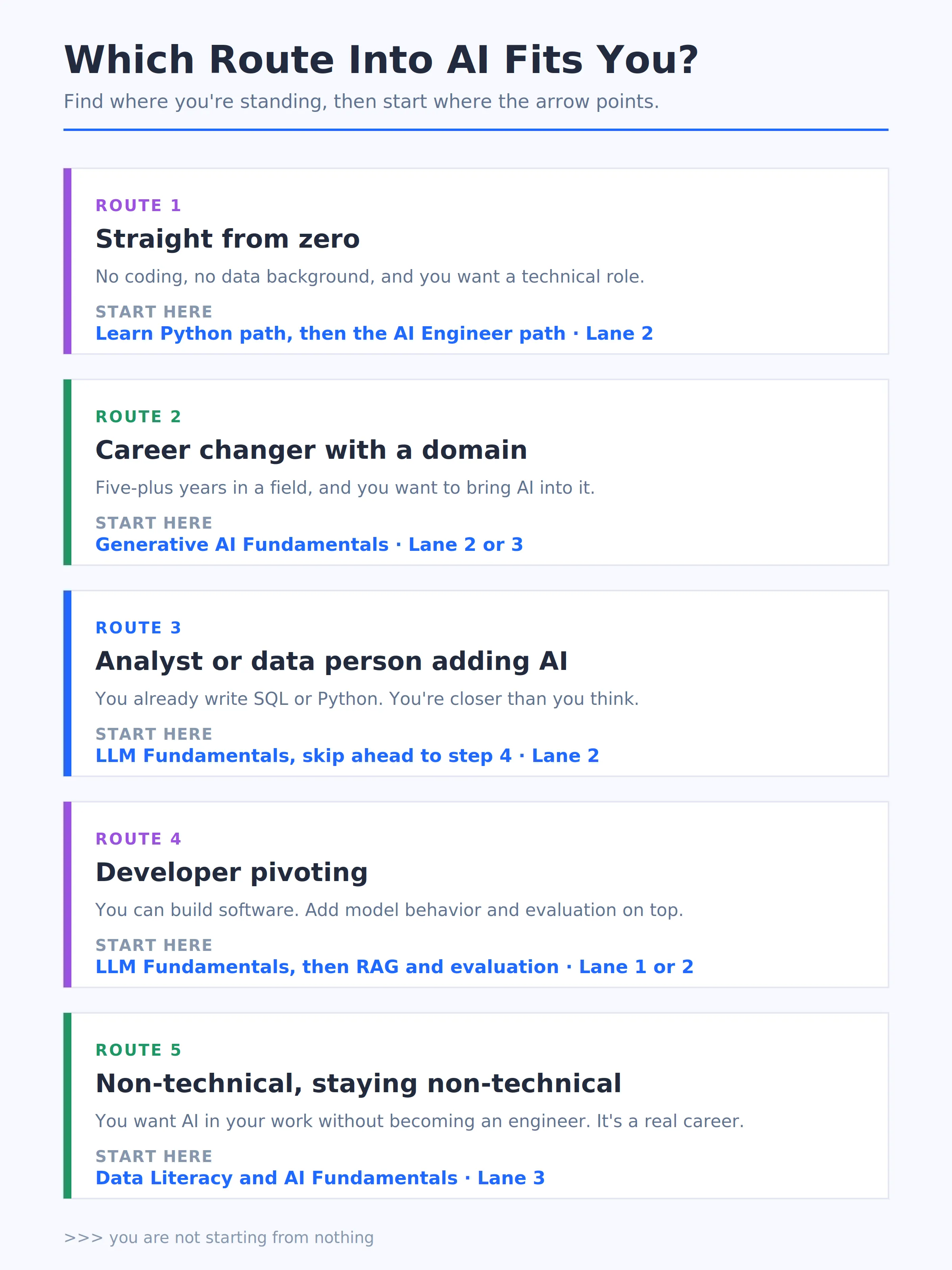
The five routes, briefly:
- Straight from zero. No coding, no data background, and you want a technical role. Longest runway, entirely doable. Start with Python.
- Career changer with a domain. You have five-plus years in a field and want to bring AI into it. Your fastest path uses the domain you already have.
- Analyst or data person adding AI. You already write SQL or Python and work with data. You're closer than you think, so jump to the LLM application layer.
- Developer adding AI. You can already build software, which means you're most of the way into Lane 2 already. What's new is model behavior, evaluation, and the AI-specific tooling. Moving further into Lane 1 is a matter of adding the ML and math parts.
- Non-technical, staying non-technical. You want AI in your work without becoming an engineer. Lane 3, and for most people it's a career accelerator rather than a job change.
Whichever route you're on, the next three sections apply to all of them.
What You Actually Need to Get Into AI (and What You Don't)
Three beliefs stop more people than any skill gap does. Let's take them in order.
Do you need to know how to code?
For Lane 1 and Lane 2, yes. For Lane 3, largely no. That's the honest answer, and it's why picking your lane comes first.
Now the harder question: if AI can generate pages of code in seconds, is learning to code still worth it?
Yes, and the reason has shifted. Typing code was never the valuable part. A model will confidently hand you code that runs and does the wrong thing, and someone has to catch that. Knowing what to build and judging whether the output is correct are the skills AI assistance makes more valuable, not less.
You don't need to become an expert programmer before you can start building with AI. You do need a solid foundation in Python, and the first 28 hours of the AI Engineer in Python path are designed to build that foundation from scratch, with no prior coding experience required.
Do you need a degree or a PhD?
No. And this deserves a direct answer, because the top-ranked page for this question contains both of these, and readers tend to find the first one:
"Bad news is that you need a masters degree in CS at minimum. They often ask for PhDs."
"While on an overlook, the AI field may look like it's full of engineers, programmers, and researchers. There are a lot of opportunities for non-technical folks like you."
— Two answers in the same Reddit thread, 2023
The first has four upvotes. The second has one, sitting near the bottom. The first insists on a master's as the floor and frames a PhD as commonly requested, and it describes research positions at frontier labs. Those roles are real, they pay extraordinarily well, and they are a narrow slice of AI employment. The US Bureau of Labor Statistics counts roughly 40,300 Computer and Information Research Scientists in 2024, projected to reach about 48,200 by 2034. Compare that to 245,900 Data Scientists heading toward roughly 328,000 over the same decade, or 1.69 million Software Developers heading toward 1.96 million.
Treating the smallest, most credentialed corner of AI as the entry requirement for the whole field is like deciding you can't work in medicine without a neurosurgery residency.
Worth noticing who tells you otherwise: four of the six top-ranking results for this question are universities or degree marketplaces. Our comparison of AI bootcamps and AI certifications covers the alternatives, and the short version is that employers in 2026 respond to demonstrable skill faster than to credentials.
How much math do you really need?
It depends on your lane, and the advice you've read is contradictory because nobody says that. Ask online and you'll be told to work through calculus I to III, that AI is mostly math anyway, and that you can skip the math entirely. Often in the same thread. A beginner comes away more confused than they arrived.
By lane:
- Lane 1 needs linear algebra, statistics and probability, and enough calculus to understand gradients. Not proofs, just intuition about what the formulas are doing.
- Lane 2 needs statistics and probability for evaluation, plus some linear algebra once you get to embeddings, vector search, and RAG. Similarity between vectors is linear algebra, and knowing why a retrieval step returned the wrong context is hard without it. That's why our path puts machine learning and linear algebra before the RAG work rather than after.
- Lane 3 needs data literacy: reading a chart honestly, understanding sampling, knowing what a confidence interval implies.
The important part is where the math sits. In the AI Engineer in Python path, calculus and linear algebra are Part 7, two hours each, taught after you've already trained models and seen why gradients matter. Statistics comes at Part 6, in code, on real data. Nothing is gated behind math you haven't met yet, and waiting until you feel mathematically ready is one of the most reliable ways to never start.
What tools should you actually learn?
| What you need | Lane 1: Builder | Lane 2: Integrator | Lane 3: AI-Powered Pro |
|---|---|---|---|
| Python | Essential | Essential | Not required |
| pandas / NumPy | Essential | Essential | Not required |
| Statistics and probability | Deep | Working knowledge | Data literacy |
| Linear algebra and calculus | Intuition required | For embeddings and RAG | No |
| scikit-learn / PyTorch | Essential | Helpful | No |
| LLM APIs and prompting in code | Helpful | Essential | No |
| RAG, embeddings, vector search | Helpful | Essential | No |
| Evaluation of AI output | Essential | Essential | Essential |
| Domain expertise | Valuable | Valuable | Essential |
| Degree or PhD | Research roles only | No | No |
Notice the one row marked essential across all three lanes. Evaluation, knowing whether an AI system is producing good output, is the least taught and most in-demand skill in the field right now.
AI Jobs You Can Actually Target
Eight roles, mapped to lanes, with current pay and an honest read on how hard each is to land as your first AI job.
| Role | Lane | What you do | Coding required | Entry difficulty | Median total pay |
|---|---|---|---|---|---|
| AI Engineer | 2 | Build applications on top of LLMs and other models | Yes | Realistic with a portfolio | ~$145K |
| Machine Learning Engineer | 1 | Train, tune, and deploy models | Yes, heavily | Stretch for a first role | ~$164K |
| Data Scientist | 1–2 | Analyze data, build models, inform decisions | Yes | Realistic | See BLS below |
| AI Product Manager | 3 | Decide what AI product gets built and why | No | Realistic if you have PM or domain depth | Varies |
| AI Implementation / Solutions Specialist | 3 | Deploy AI tools inside organizations | Rarely | Realistic | Varies |
| AI Evaluation / Quality Specialist | 2–3 | Judge whether AI output is correct and safe | Sometimes | Most accessible technical-adjacent entry | Varies |
| Data Analyst | 2–3 | Analyze and communicate data findings | Some | Strong on-ramp, not an AI title | Varies |
| AI-adjacent role in your current industry | 3 | Bring AI into work you already do | No | Easiest, you're already inside | Your current band, often higher |
On the pay figures: Glassdoor estimates median total pay for an AI Engineer in the US at around $145,000 a year, with a range of roughly $116,000 to $183,000. For a Machine Learning Engineer it estimates around $164,000, ranging from about $132,000 to $207,000. Both accessed August 2026. These come from user-submitted data rather than employer payroll reporting, so treat them as directional.
For job growth we use the Bureau of Labor Statistics, and there's something you should know about it: BLS has no occupation code for "AI engineer." Any growth percentage you see attached to that title comes from a private job-postings vendor, not government data. The closest official occupations project 34% growth for Data Scientists between 2024 and 2034, with a median wage of $112,590 as of May 2024, and 20% growth for Computer and Information Research Scientists at a median of $140,910. Both are classed as growing much faster than average.
If Lane 2 is where you're headed, our complete AI engineer roadmap goes role-deep on that specific path. For the modeling side, machine learning jobs in demand and the data scientist roadmap cover the adjacent forks.
The Honest State of the AI Job Market in 2026
AI skills are a genuine differentiator right now, and the market you'd be entering is otherwise soft. Both halves of that sentence are true, and no other guide on this topic will tell you the second one.
It's tighter at entry level
The New York Fed's tracking of recent college graduates put underemployment at roughly 41.5% in the first quarter of 2026, with unemployment around 5.7%. Two in five recent graduates are working jobs that don't require their degree.
If you've been sending applications into apparent silence, that's the context. It isn't you.
AI skills are where the growth is
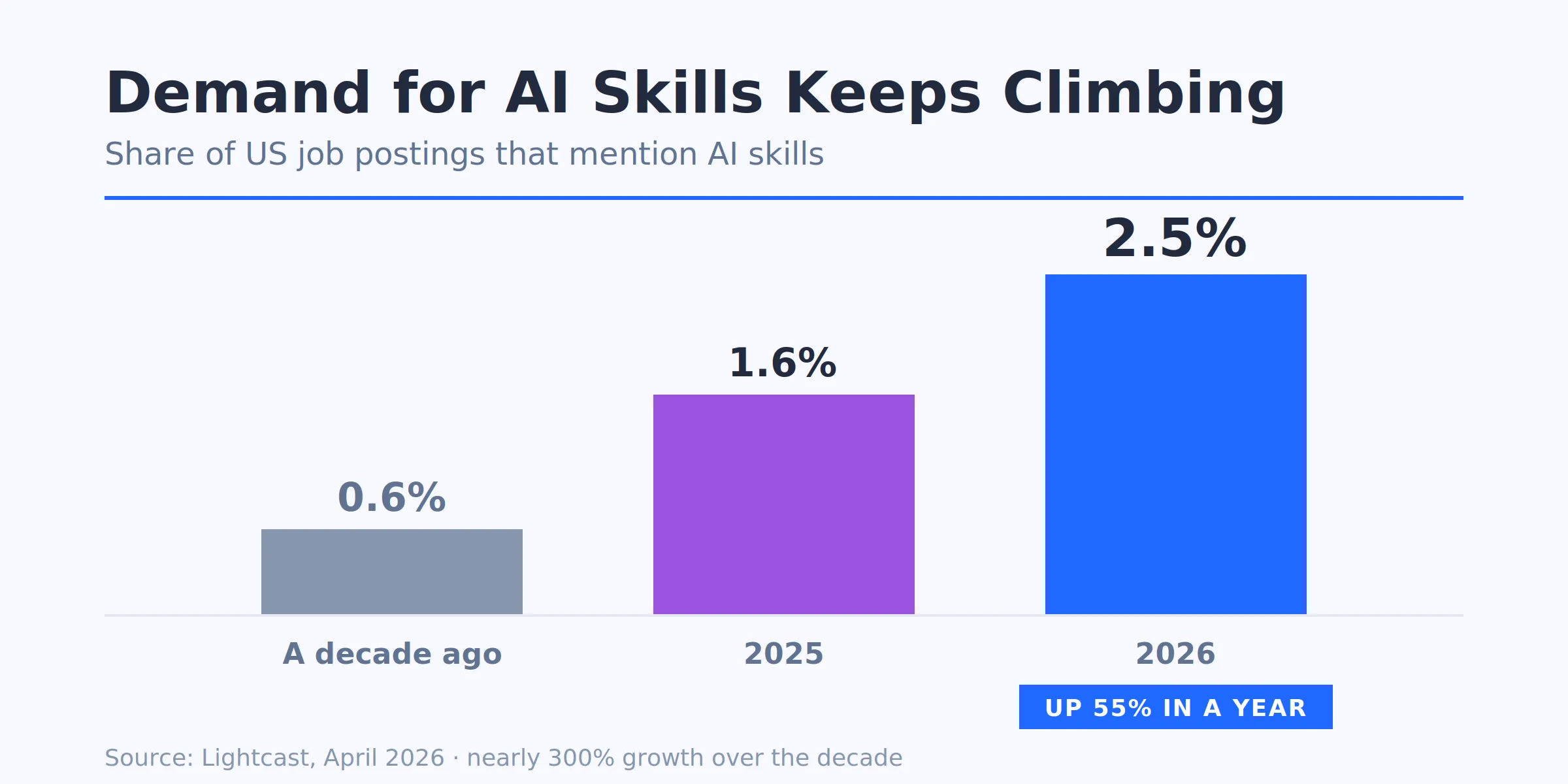
Against that flat backdrop, demand for AI skills is moving in the opposite direction. Lightcast's April 2026 analysis found AI skills appeared in 2.5% of US job postings, up 55% from the previous year.
The pay signal is just as clear. Lightcast's review of more than 1.3 billion postings found that roles requiring AI skills pay 28% more than comparable roles that don't, nearly $18,000 a year.
The World Economic Forum's Future of Jobs Report 2025 named AI and big data the single fastest-growing skill through 2030, ahead of cybersecurity and general technological literacy.
What that means for you
AI skills are a differentiator rather than a guarantee. In a soft market, employers get pickier, and what cuts through is evidence rather than assertion. Someone who can point at three working things they built has an easier conversation than someone with a longer list of completed courses.
That's the whole argument for the projects section below. It isn't padding, in this market it's the part that does the work.
Your Background Is an Advantage, Not a Deficit
The thing you're treating as your disqualification is closer to your edge.
AI systems fail in ways that require domain knowledge to notice. A model that summarizes clinical notes needs someone who knows what a dangerous omission looks like. A recommendation system needs someone who understands what a bad recommendation costs the business. An AI grading tool needs a teacher who can tell confident nonsense from a correct answer. In every case, the scarce skill isn't building the system. It's knowing whether it's working.
Brian Evergreen makes this argument from an unusual vantage point. He ran global Autonomous AI Co-Innovation at Microsoft Research, wrote Autonomous Transformation, and was named to the Thinkers50 Radar Class of 2025, a cohort of 30 emerging management thinkers. He also built and taught a course called How to get into AI, and when he selected instructors for it, one of his stated criteria was that they had taken a non-traditional route in.
Every instructor he picked came from outside computer science. Finance. Neuroscience. Chemistry. Education. That pattern was deliberate, not incidental.
His framing of AI strategy applies equally to careers: "Instead of being AI first, you need to be value first." The scarce ability is connecting what AI can do to something worth doing. Judgment, not syntax.
| If you come from | You already understand | A first project that proves it |
|---|---|---|
| Healthcare | Clinical workflow, what an unsafe error looks like | An AI tool that summarizes patient intake notes, with an accuracy check |
| Marketing | Brand voice, what converts, what a bad recommendation costs | A campaign-copy generator evaluated against your own past performance data |
| Finance | Risk, compliance, why explainability matters | A document Q&A tool over regulatory filings |
| Teaching | How people learn, spotting confident wrong answers | An AI tutor with a rubric that scores its own responses |
| Operations | Where the manual bottlenecks actually are | An AI workflow that automates one real recurring task |
| Customer support | What customers actually ask and how they phrase it | A support-ticket triage classifier trained on real ticket categories |
If you want to start from inside your current role, Data Literacy and AI Fundamentals is built for that. When you're ready to add code to your domain knowledge, Generative AI Fundamentals in Python is the shorter on-ramp.
How to Get Into AI: A Step-by-Step Plan
Eleven parts, grouped into four stages. This is the sequence our AI Engineer in Python path follows, and the ordering is deliberate: you'll be building with real AI models by Part 3, long before you reach the heavier math.
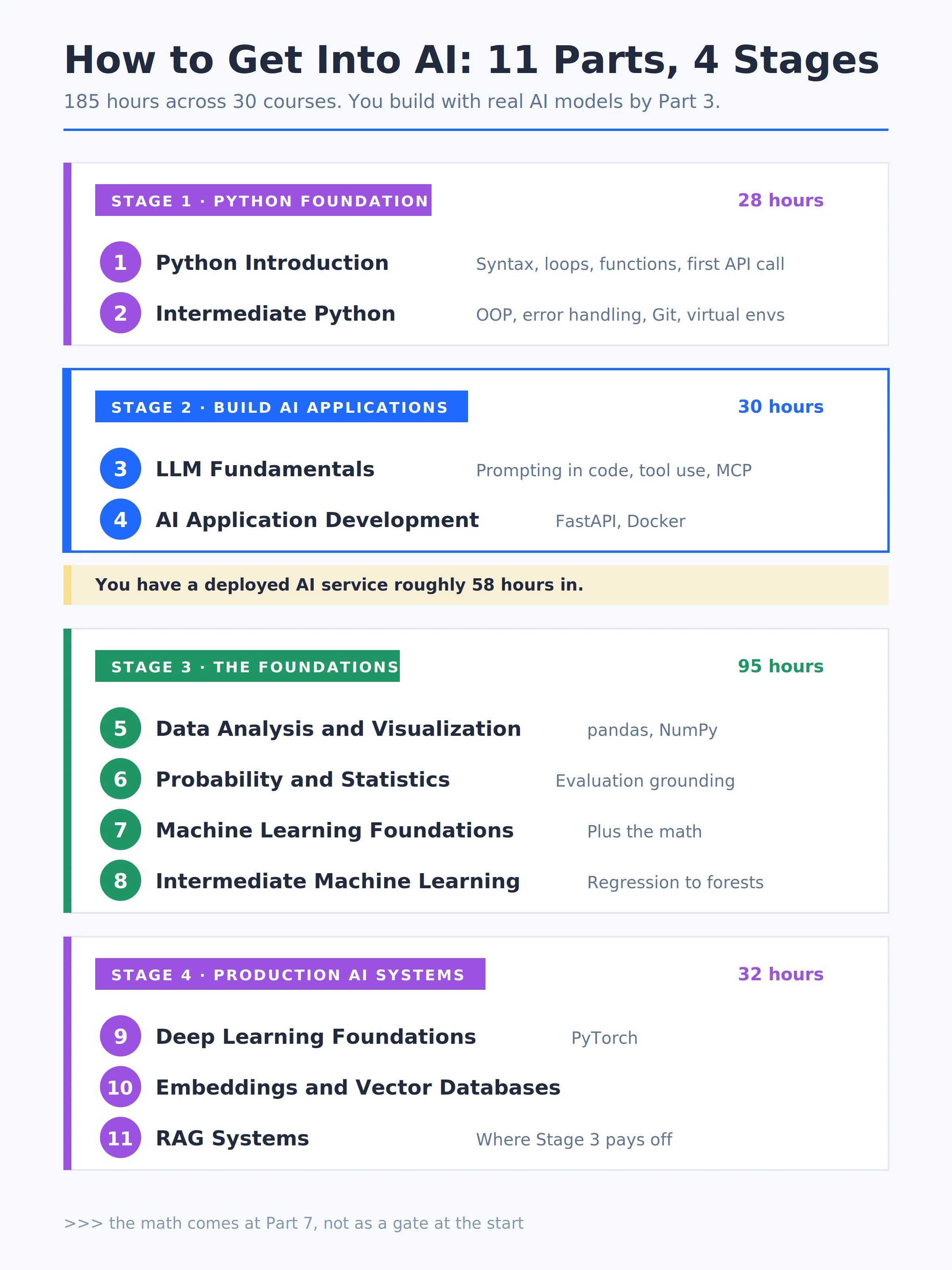
Stage 1: Build your Python foundation (Parts 1–2, 28 hours)

Part 1, Python Introduction. Variables, data types, lists, loops, conditionals, then dictionaries, functions, and your first API call. You'll finish by building a food ordering app, which is proof you can make something work end to end.
Part 2, Intermediate Python. Object-oriented programming, decorators, regular expressions, list comprehensions, and error handling, then the tooling engineers use daily: command line, virtual environments, Git, and an IDE.
Most self-taught learners skip that tooling and pay for it later. Git and virtual environments are the difference between code that runs on your laptop and code a team can work with.
You'll know you're ready to move on when: you can write a class, handle an error deliberately, and push a project to GitHub without looking up the commands.
Stage 2: Build real AI applications (Parts 3–4, 30 hours)

This is where it gets fun, and it arrives earlier than almost any other curriculum puts it.
Part 3, LLM Fundamentals. What AI chatbots can and can't do, then working with models in code: the Chat Completions API, conversation context, token budgets, structured outputs, function calling, agentic loops, and the Model Context Protocol.
Part 4, AI Application Development. API authentication, rate limits, and pagination, then building and deploying an LLM-powered API with FastAPI, Docker, and Docker Compose.
By the end of Part 4 you have something most people learning AI never get: a deployed, containerized AI service with your name on it, roughly 58 hours in.
You'll know you're ready to move on when: you've deployed an LLM-powered API that someone else can call.
Stage 3: Build the foundations underneath (Parts 5–8, 95 hours)

You can build AI applications without this stage. You can't debug them well, evaluate them honestly, or work on the more advanced AI systems without it.
Part 5, Data Analysis and Visualization. pandas and NumPy, plotting, and the unglamorous work of cleaning messy data. Python for data is a different dialect from Python for LLM applications, so this stage deepens your Python as much as it teaches analysis.
Part 6, Probability and Statistics. Sampling, distributions, variability, probability rules, conditional probability (where you build a Naive Bayes spam filter), and hypothesis testing. This is what lets you answer "is this output actually good?" with evidence rather than a feeling.
Part 7, Machine Learning Foundations. The ML workflow, supervised and unsupervised techniques, then the math: calculus and linear algebra, two hours each. Notice where it sits. Not at the start as a gate, but here, once you know what a model does and why gradients matter.
Part 8, Intermediate Machine Learning. Linear regression, gradient descent, logistic regression, decision trees and random forests, then cross-validation, regularization, and feature engineering.
You'll know you're ready to move on when: you can explain why a model's accuracy score might be misleading, and fix it.
Stage 4: Ship production AI systems (Parts 9–11, 32 hours)

Part 9, Deep Learning Foundations. Tensors, autograd, and neural networks in PyTorch, across sequence models, NLP, and computer vision.
Part 10, Embeddings and Vector Databases. How meaning becomes vectors and how similarity is measured, then production vector search: ChromaDB with HNSW indexing, chunking strategies, hybrid search, and semantic caching.
Part 11, RAG Systems. Pipeline architecture, query expansion, reranking, grounded generation with source attribution, and diagnosing the failure modes that break RAG in production.
This is where the ML stage pays off. Retrieval, embeddings, and evaluation rest on ideas from Parts 6 through 8, which is why they come first. Systems that retrieve the wrong context or confidently answer from nothing are the normal failure mode, and recognizing why takes the statistical grounding you built earlier.
You'll know you're done when: you've built a RAG system you can defend in an interview, including where it fails and what you did about it.
Two things the path doesn't cover, and you shouldn't skip
The curriculum takes you from no code to production AI systems. These two are on you.
Ship three things in public. Three finished projects with real write-ups beat a longer list of completed courses. The path gives you guided projects at every stage: a food ordering app, a spam filter, an IPO predictor, a deployed knowledge base. Put them on GitHub with a README that explains the problem properly and walks through what you did.
Get visible. Brian Evergreen's point is that skills nobody knows about don't convert. Write up what you build, join a community where AI work gets discussed, and have one conversation a week with someone doing the job you want.
How Long Does It Take to Get Into AI?
Between a few weeks and about 18 months, depending entirely on your lane and starting point. Lane 3 is measured in weeks, Lane 2 in months, and Lane 1 from zero is the 12 to 18 month end of that range. Here's the arithmetic rather than a guess.
Our AI Engineer in Python path is 185 hours across 30 courses in 11 parts. At 5 hours a week that's 37 weeks, or about 8–9 months. At 10 hours a week it's roughly 18 weeks, about 4–5 months.
Worth knowing how those hours are distributed, because it changes what the wait feels like. You reach real AI application work at hour 28 and have a deployed LLM-powered API by hour 58. You aren't waiting eight months to touch AI. You're building with it in month two and spending the rest of the path learning why it works.
For Lane 3, Data Literacy and AI Fundamentals is 12 hours, a couple of focused weekends. For a Lane 2 quick start, Generative AI Fundamentals in Python is 33–37 hours, roughly 7–8 weeks at 5 hours a week.
One caveat that matters more than any of these numbers: these are learning hours, not time to hired. Job searching adds months and depends on your market, your network, and luck. Anyone quoting you a guaranteed time to employment is guessing.
Consistency beats intensity. Five hours a week for eight months finishes. Twenty hours a week for three weeks, then nothing, doesn't.
Five AI Projects That Get You Noticed
Every guide tells you to build a portfolio. Almost none names a project you could actually finish. Here are five, with what each one proves.
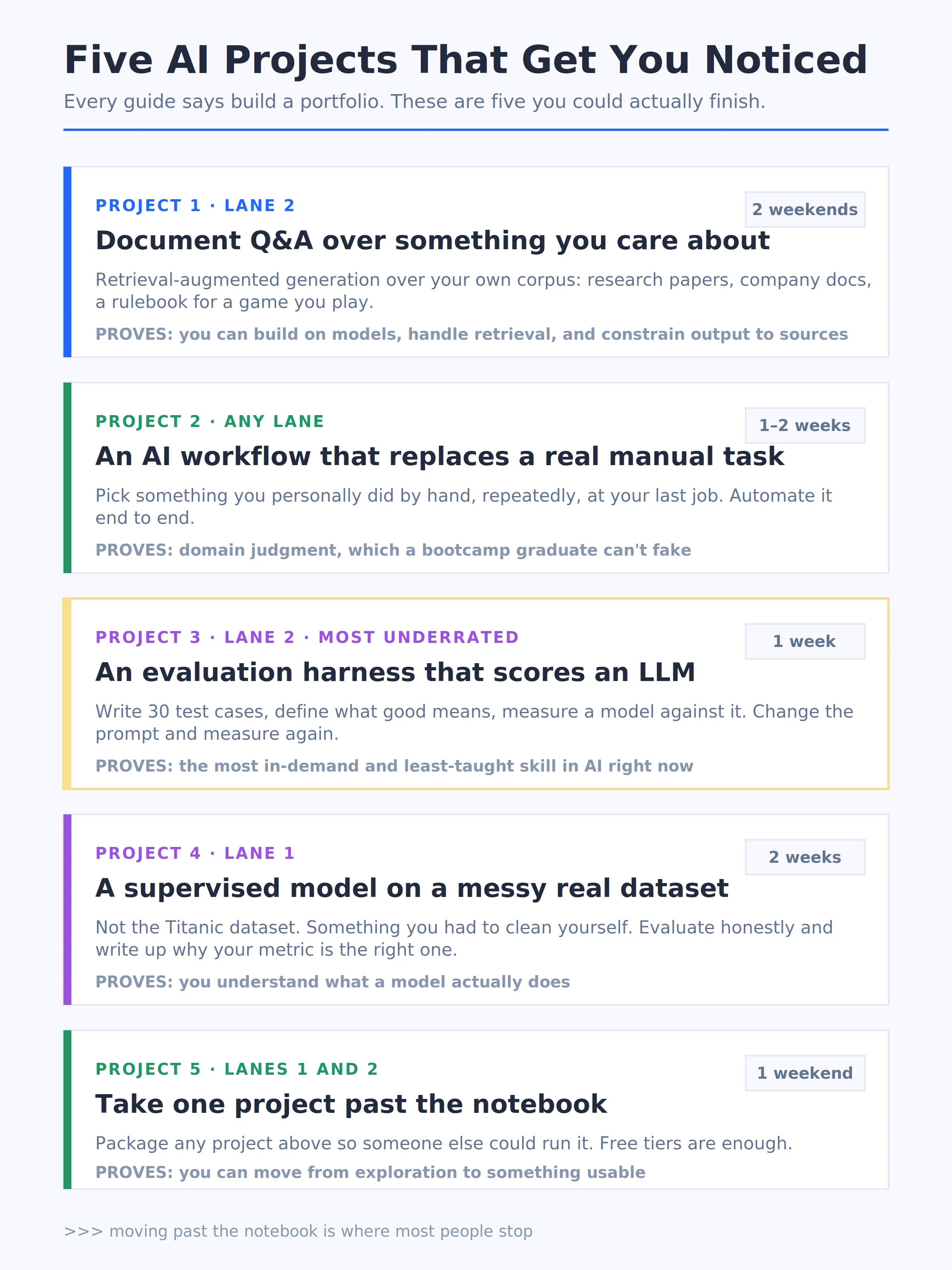
1. A document Q&A tool over something you actually care about. Retrieval-augmented generation over your own corpus: research papers in your field, your company's docs, a rulebook for a game you play. Proves you can build on models, handle retrieval, and constrain output to sources. Two weekends. Lane 2.
2. An AI workflow that replaces a real manual task from your last job. Pick something you personally did by hand and repeatedly. Automate it end to end. Proves domain judgment, which is the thing a bootcamp graduate can't fake. One to two weeks. Any lane.
3. An evaluation harness that scores an LLM's output on a task you define. Write 30 test cases, define what "good" means, and measure a model against it. Then change the prompt and measure again. Proves the most in-demand and least-taught skill in AI right now, and it's the project that will surprise an interviewer. One week. Lane 2.
4. A supervised model on a messy real dataset, properly evaluated. Not the Titanic dataset. Something you had to clean yourself. Train, evaluate honestly, and write up why your metric is the right one. Proves you understand what a model actually does. Two weeks. Lane 1.
5. Practice taking one project past the notebook. Take any project above and package it so someone else could run it: a simple interface, clear setup instructions, dependencies pinned. Free tiers are enough to practice on. Proves you can move from exploration to something usable. A weekend once the thing works. Lanes 1 and 2.
That last one carries more weight than people expect, because moving a project past the notebook is where most people stop. For more options once you've got the basics, our machine learning projects for beginners to advanced has graded ideas, and the best generative AI courses roundup covers where to build the underlying skills.
Your First 90 Days
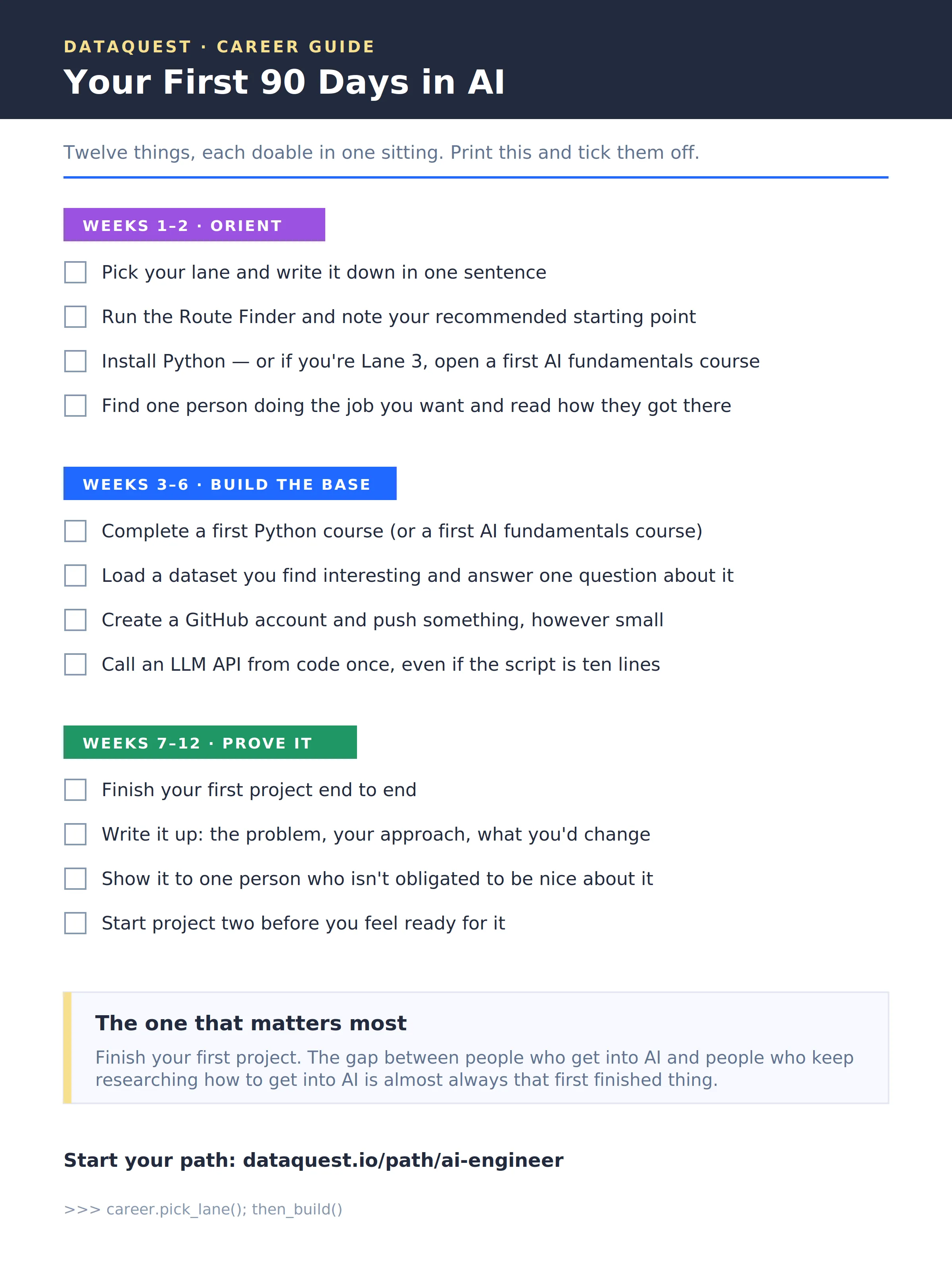
Whichever lane you picked, there's a path built for it: AI Engineer in Python for the full technical route, Generative AI Fundamentals in Python for a faster Lane 2 start, and Data Literacy and AI Fundamentals if you're staying non-technical.
Mistakes to Avoid on the Way Into AI
Chasing the newest layer instead of building a base
In 2023, one popular piece of advice was to skip the fundamentals and just learn prompt engineering, which sounded reasonable at the time. Three years later, prompt technique is a skill inside roles rather than a career of its own. Advice pinned to whichever layer is newest dates fast. The base of Python, data handling, evaluation, and judgment has held through every shift so far.
Collecting courses instead of shipping
Enrolling feels like progress and costs nothing emotionally. Finishing something and showing it to someone is uncomfortable, which is exactly why it's the signal employers read. Pick one structured path from our AI courses and finish it rather than starting five.
Waiting until you feel ready to build
You won't feel ready. The people who make it start projects they're underqualified for and figure it out mid-build. Our project list exists so you can start one this week.
Assuming you need the PhD
Covered above, and worth repeating because it's the single most common reason people don't start.
Skipping evaluation
You can build an impressive-looking AI feature without ever checking whether it works. Plenty of companies did exactly that and quietly rolled it back. Being the person who measures is career insurance.
Building only notebook projects
Notebook projects can demonstrate strong technical work, but they don't show the full picture. Adding at least one project you've taken further shows that you can move something beyond exploration and turn it into a usable application.
Learning entirely in private
Six months of solid work nobody knows about converts to nothing. Publish as you go.
Frequently Asked Questions
Can you get into AI with no experience at all?
Yes, though "no experience" usually undersells what you have. If you've worked anywhere, you have domain knowledge, and that's half of what AI work needs. The most open doors for people starting cold are AI evaluation and quality work, data annotation, and AI-adjacent roles in the industry you already know. Data Literacy and AI Fundamentals is a 12-hour starting point that assumes nothing.
Is it too late to get into AI in 2026?
Not at all. Demand for AI skills is still growing. Lightcast's 2026 analysis found that AI skills appeared in 2.5% of US job postings, up 55% from the previous year and nearly 300% from a decade ago. The field is more established and competitive than it was a few years ago, but employers are still increasing their demand for people with AI skills.
Is AI hard to learn?
The concepts are more approachable than the reputation suggests. The hard parts are elsewhere: tolerating the stretch where nothing makes sense yet, and showing up consistently for months. Most people who don't make it didn't hit a concept they couldn't grasp. They stopped during a stretch where progress felt invisible.
What's the difference between AI, machine learning, and generative AI?
AI is the broad field of building systems that perform tasks requiring intelligence. Machine learning is the subset where systems learn patterns from data rather than following written rules. Generative AI is a subset of machine learning that produces new content (text, images, code) and is what most people now mean when they say "AI." Our Machine Learning Using Python path covers the middle layer.
How do you get AI experience before you have an AI job?
Four routes that work. Solve an AI problem inside your current job, even unofficially, which is the fastest because you already have the context and the data. Contribute to an open-source AI project. Take on one small freelance scope. Or build the projects listed above and write them up properly. Our project ideas are a starting point.
Do AI certifications actually help you get hired?
They help with two things: giving your learning structure, and getting past automated screening that looks for keywords. They don't substitute for evidence you can do the work. A certificate plus three shipped projects is strong. A certificate alone is weak. We compare the options in best AI certifications.
Should you do a bootcamp, a degree, or self-teach?
Self-teaching costs the least and demands the most discipline. A bootcamp buys structure and a cohort for a few thousand dollars and a few months. A degree makes sense if you're targeting research roles or need the credential for visa or institutional reasons, and it costs years and considerably more. Most people entering Lane 2 or Lane 3 don't need one. Our AI bootcamps comparison covers the middle option.
What does the hiring process for an AI role actually look like?
Typically five stages: a resume screen, a technical assessment or take-home, an initial conversation with a recruiter or hiring manager, one or more technical interviews, and a final round that's often as much about judgment as code. For Lane 2 roles, expect to be asked how you'd evaluate a system, not just how you'd build it. For Lane 3, expect scenario questions about deciding what's worth building. Have your projects ready to walk through in detail, because that's where most of these conversations actually go.
Do you need to be good at math to work in AI?
For most AI roles, "good at math" means reading a formula and understanding what it's doing, not deriving it. The arithmetic is done by libraries. What you need is intuition: why dividing by a small number makes things unstable, why an accuracy score can be high and useless, what a distribution implies about your data. That's learnable alongside the code, which is how our Introduction to Statistics in Python course teaches it.
Will AI take the entry-level AI jobs before you get there?
It's changing what entry level means rather than removing it. The boilerplate parts of junior work are increasingly automated. What's left, and growing, is judgment: deciding what to build, checking whether output is correct, catching the confident mistake. The World Economic Forum's Future of Jobs Report 2025 found employers expect 39% of workers' core skills to change by 2030, with AI and big data the fastest-growing skill of all.
How do you stay current in AI without burning out?
Pick three sources and ignore the rest. The field produces more daily than anyone can read, and most of it won't matter in six months. A useful filter: if something is important, you'll encounter it three separate times without looking for it. Chasing every release is a reliable way to feel permanently behind while learning nothing deeply.
How do you know when you're ready to start applying?
Earlier than you think. If you have two or three finished projects you can talk through (what the problem was, why it mattered, and how you approached it) you're ready to be in conversations. Applying is also information: interviews tell you what's actually being asked for far more accurately than any curriculum will. Apply while you're still learning. Waiting until you feel finished means waiting indefinitely.
Getting Started
Getting into AI is more tractable than the loudest advice suggests, and it starts with a decision rather than a course. Pick your lane. Builder if you want to make models work. Integrator if you want to build things people use. AI-powered professional if you want to bring AI into work you already know and care about.
Then do one small thing this week. Not the whole plan, one thing. The gap between people who get into AI and people who keep researching how to get into AI is almost always that first finished project.
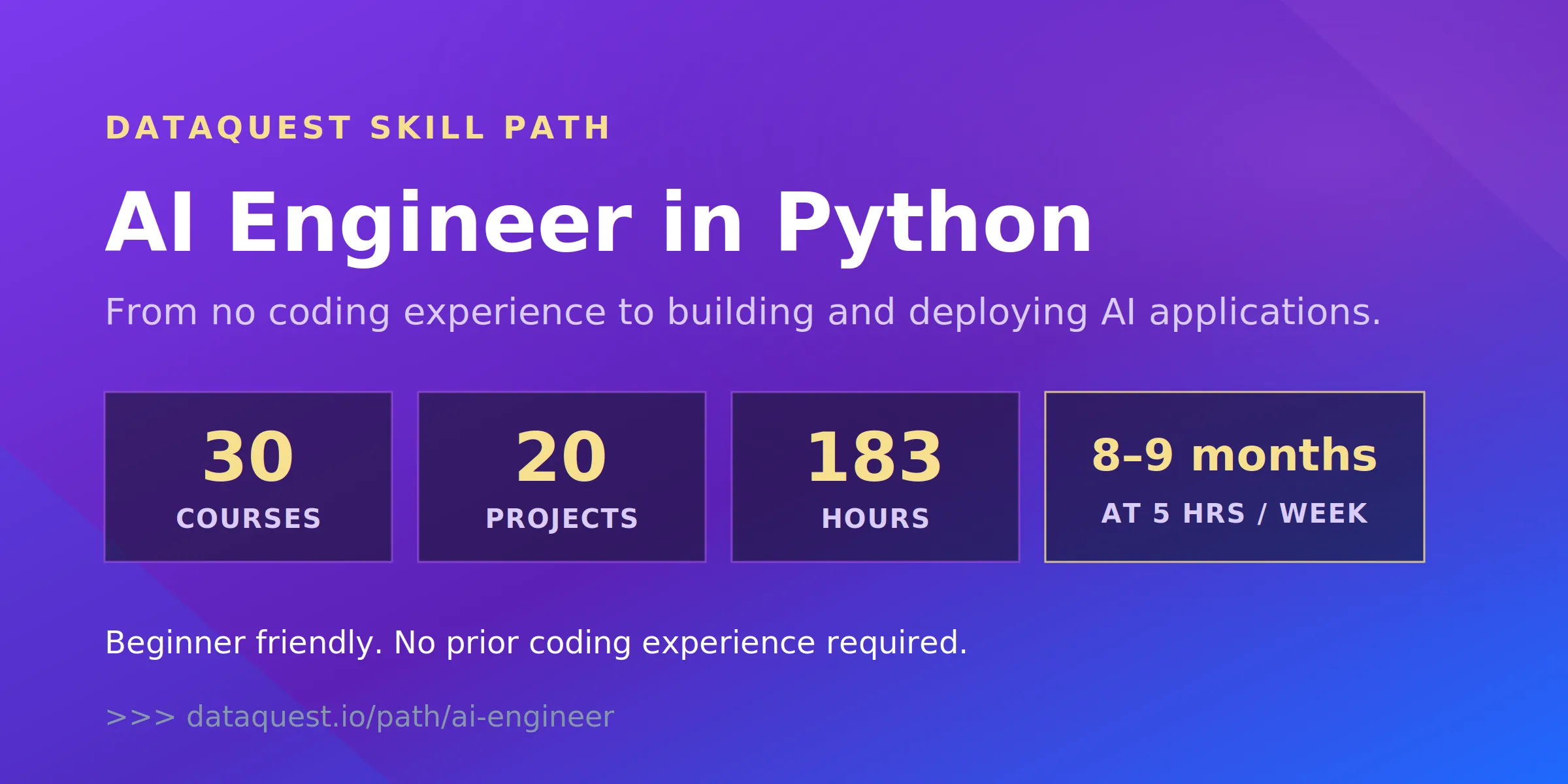
The AI Engineer in Python path was built for exactly the person reading this, someone who wants to build AI skills and hasn't been given a straight answer about how. It starts with a print() statement and ends with you deploying production RAG systems, across 30 courses and 11 parts. No degree, no prior coding, no prerequisites beyond showing up.
You don't have to believe you're the kind of person who can do this yet. You do have to start Part 1. The path handles the sequence, the projects, and the feedback; your job is the hours. The people who finish kept going through the week where nothing made sense, which is most of what separates them from the people who don't.
If you want a faster first win before committing, Generative AI Fundamentals in Python gets you building with LLMs in about two months. And if you're staying non-technical, Data Literacy and AI Fundamentals is 12 hours well spent.