
Machine Learning Algorithms You Should Learn First
Machine learning algorithms power everything from the recommendations in your streaming apps to fraud detection at your bank. Whether you’re building a spam filter, predicting housing prices, or teaching a robot to walk, the algorithm you choose shapes how a model learns from data.
If you are new to data science or machine learning, this guide provides a practical map of the most important algorithms, what each does, and when to use them.
To start learning them hands-on, our Machine Learning in Python skill path is a good place to start.
In this guide:
- Types of Machine Learning
- Supervised Learning Algorithms
- Unsupervised Learning Algorithms
- Reinforcement Learning Algorithms
- Neural Networks and Deep Learning
- Quick Reference: Choosing the Right Algorithm
Types of Machine Learning
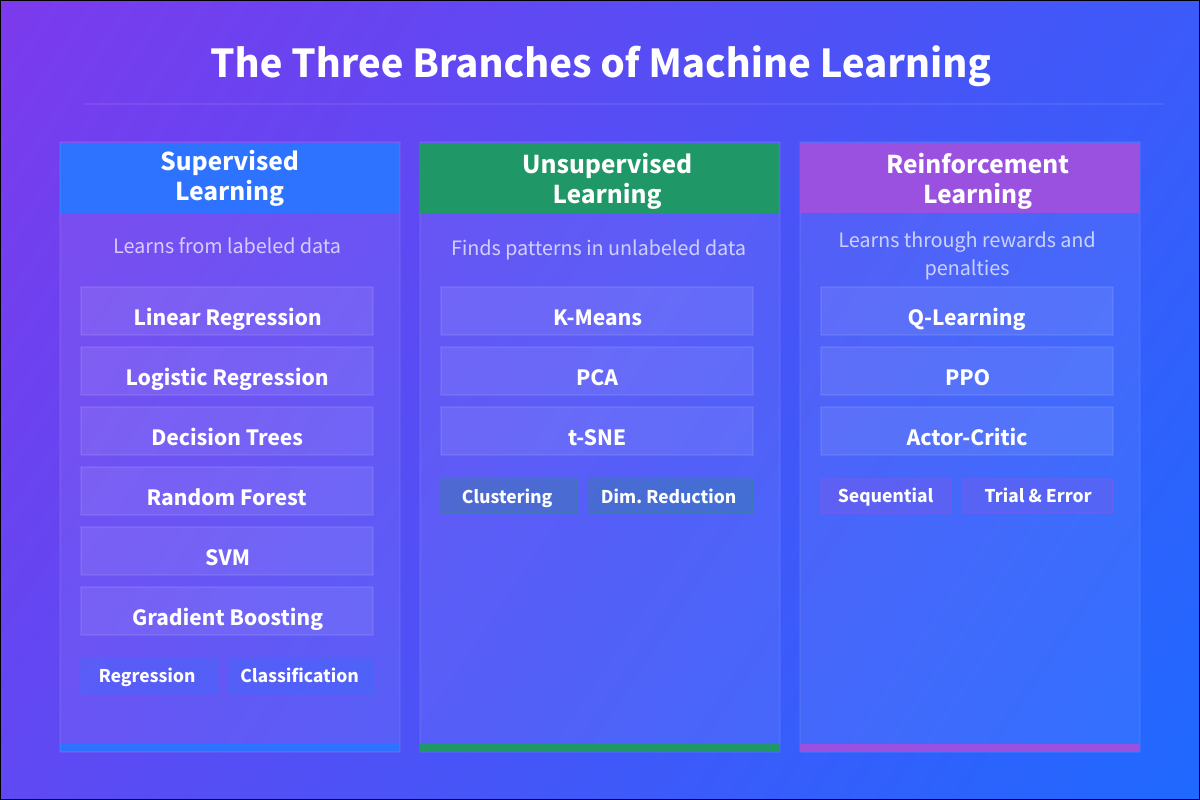
In traditional programming, you write explicit rules that tell the computer what to do with an input to produce an output. Machine learning flips this. Instead of writing the rules yourself, you give the algorithm examples of inputs and their corresponding outputs, and the algorithm figures out the rules on its own. That's what makes it a machine learning algorithm. The diagram above shows the three main ways that learning can happen.
Supervised Learning Algorithms
If you have labeled data and a target you want to predict, these are the algorithms you'll reach for most often.
Linear Regression
Linear regression is often the first machine learning algorithm programmers learn. It is simple, easy to interpret, and one of the most widely used algorithms in practice.
A linear regression model predicts a continuous outcome by fitting a straight line through the training data:
$$
Y = \beta_0 + \beta_1 X + \epsilon
$$
The idea is one you’re probably already familiar with. If you’ve ever thought, "The more I study, the better my grades should be," then you have used the mental model behind linear regression. For every unit increase in $X$, you get a proportional change in $Y$.
Common use cases include:
- Predicting insurance costs from patient data
- Estimating sales revenue from advertising spend
- Forecasting energy consumption based on weather
The algorithm finds the best-fitting line by minimizing the squared differences between predicted and actual values. Linear regression is also the foundation for many more advanced machine learning algorithms.
Use it when: You want to predict a continuous number, and the relationship between your input and output variables is roughly linear.
Logistic Regression
Logistic regression looks similar to linear regression, but it solves a different problem. Instead of predicting a number, logistic regression predicts the probability that a data point belongs to a particular category.
It works by passing the linear combination of inputs through a sigmoid function, which squashes the output to a value between 0 and 1. If the predicted probability (output) is above 0.5, the model assigns one class. Below 0.5, it assigns the other.
Despite the word "regression" in its name, logistic regression is a classification algorithm. Common uses include:
- Predicting disease status from lab results
- Detecting fraudulent transactions
- Determining whether a customer will churn
Use it when: You need to classify data into two categories (binary classification), and you want a simple, interpretable model.
Decision Trees
A decision tree is one of the most interpretable machine learning algorithms. It makes predictions by splitting data into branches based on feature values. The result is a tree-like structure you can visualize and explain to someone with no technical background.
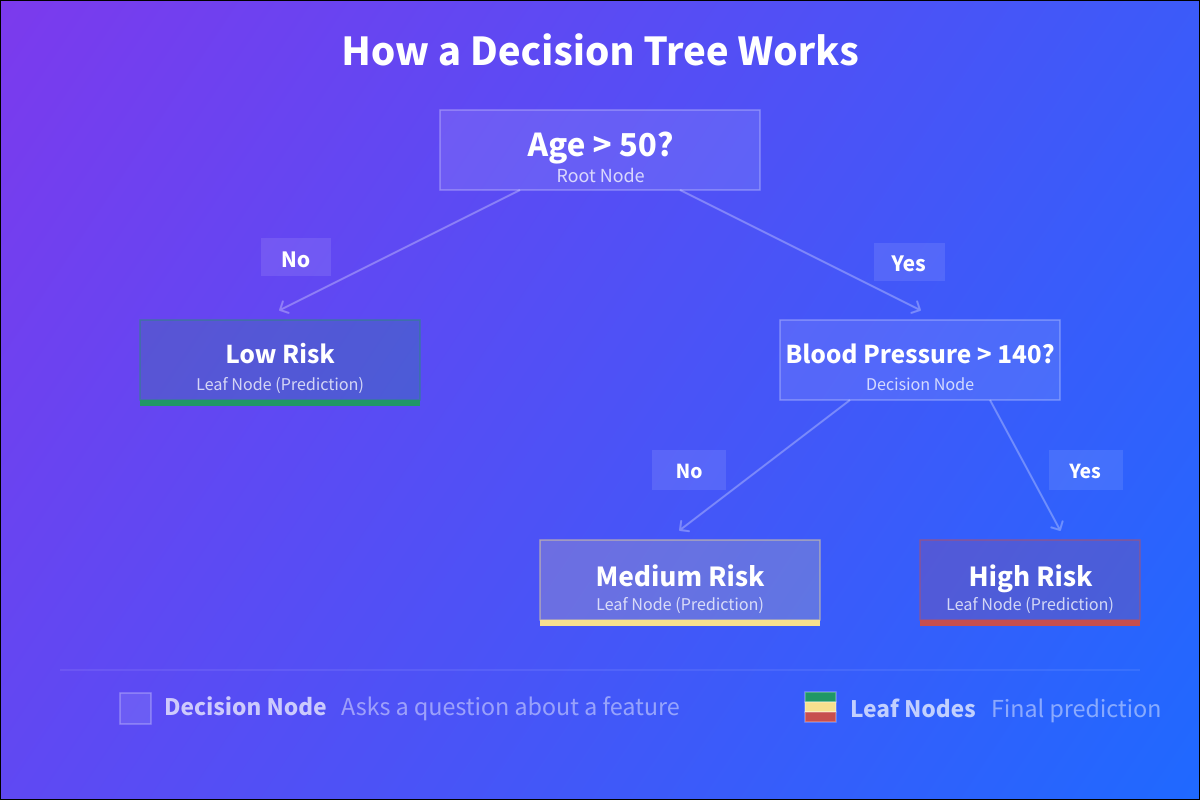
Each internal node asks a question about a feature. Based on the answer, the data flows down one branch or another until it reaches a leaf node with a final prediction. A decision tree might first ask if a patient's age is above 50, then check their blood pressure, and arrive at a disease risk prediction.
Decision trees work for both classification and regression. They handle mixed data types well and need minimal data preprocessing.
The tradeoff is that a single decision tree can overfit the data. It may learn the training data too precisely, including its noise, and then perform poorly on new data. That is why decision trees are often used as building blocks for more powerful ensemble methods like random forests and gradient boosting.
Dataquest's Decision Tree and Random Forest course covers how to build, visualize, and optimize trees, with a guided project on predicting employee productivity.
Use it when: You need an interpretable model, your data has mixed types, or you want a building block for ensemble methods.
Naive Bayes
Naive Bayes classifiers are based on Bayes' Theorem. They assume that all features are independent of each other. That assumption is almost never true in real-world data (which is why the algorithm is called "naive"), but it works surprisingly well in practice.
The algorithm calculates the probability that a data point belongs to each possible class, given the values of its features. It then picks the class with the highest probability.
Naive Bayes is especially popular for text classification. Spam filters, sentiment analysis, and document categorization all use it because it handles high-dimensional data well and works even with small training datasets.
If you want to understand the probability theory behind Naive Bayes, Dataquest's Introduction to Conditional Probability course walks you through Bayes' Theorem and has you build a spam filter from scratch.
Use it when: You are working with text classification or high-dimensional data and need a fast, lightweight classifier.
K-Nearest Neighbors (KNN)
K-Nearest Neighbors is one of the simplest machine learning algorithms to understand. To classify a new data point, KNN looks at the $k$ most similar data points in your training data. It assigns the new point to the class that appears most often among its neighbors.
The intuition is simple. If you want to know something about a person, look at the people most similar to them. KNN applies that logic using a distance metric (usually Euclidean distance) to measure how close data points are in the feature space.
KNN handles both classification and regression:
- For classification, it takes a majority vote of the neighbors.
- For regression, it averages their values.
The choice of $k$ matters. A small $k$ (like 1 or 3) makes the model sensitive to noise. A larger $k$ smooths things out but can blur class boundaries.
A few things to watch out for:
- Speed on large data. KNN calculates distances to every existing data point at prediction time, so it slows down as your dataset grows.
- Feature scaling. Features need to be on similar scales. A feature ranging from 0 to 1,000 will dominate the distance calculation over one that ranges from 0 to 1, even if the second feature is more useful. Normalization is essential.
Dataquest's Introduction to Supervised Machine Learning course covers KNN in detail, including how to tune $k$ and evaluate your model with cross-validation.
Use it when: You have a small to medium dataset, you want a simple baseline model, or you need a quick prototype before trying more complex algorithms.
Support Vector Machines (SVMs)
Support Vector Machines classify data by finding the boundary that best separates different classes. An SVM draws a hyperplane that maximizes the gap (margin) between the classes. The data points closest to the boundary are called "support vectors."
SVMs can also handle non-linear relationships through kernel functions, which transform data into a higher-dimensional space where a linear separator works.
A few things to keep in mind:
- Training speed. SVMs can be slow to train on very large datasets. They work best with small to medium-sized data.
- Kernel choice. Picking the right kernel (linear, polynomial, RBF) requires experimentation. The wrong choice can lead to poor results.
- Feature scaling. Like KNN, SVMs are sensitive to feature scales, so normalization is important.
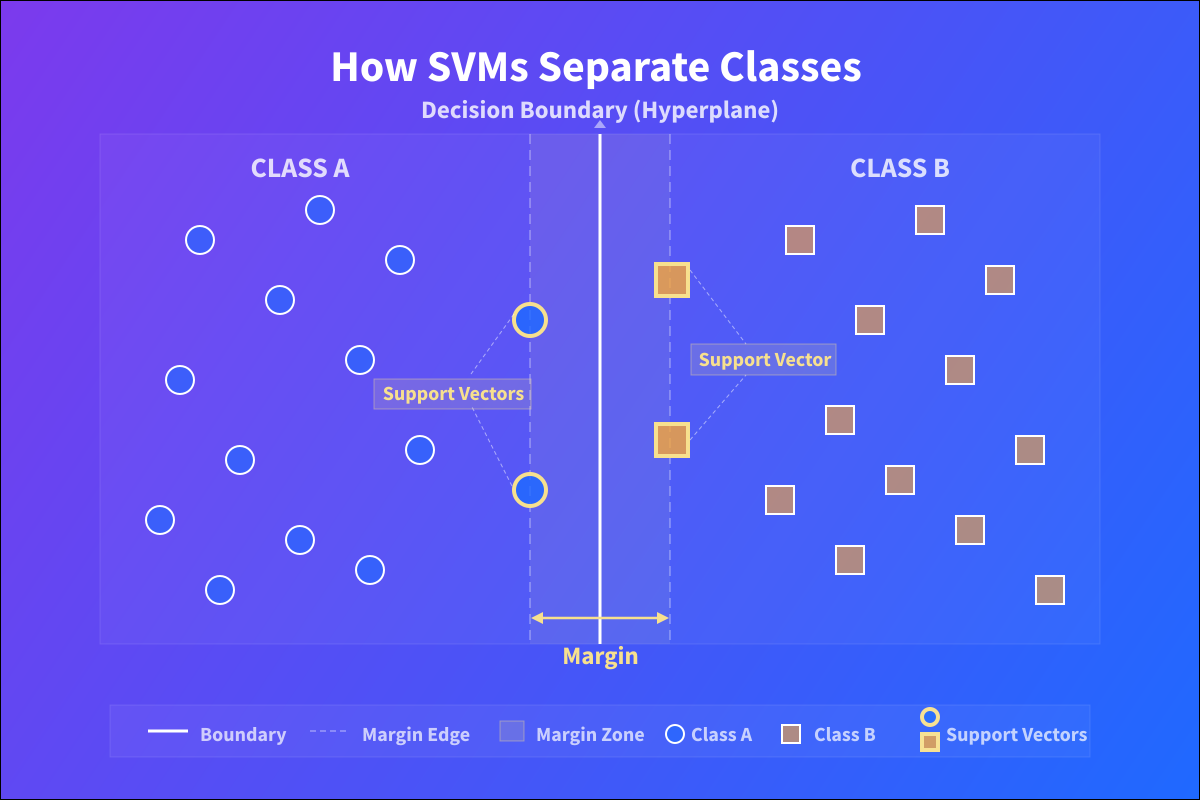
Use it when: You have a clear margin of separation between classes, you are working with high-dimensional data, or when simpler classifiers are not performing well enough.
Random Forests
A random forest is a collection of decision trees that work together. This is an example of ensemble learning, where multiple models combine for better accuracy and stability.
How it works:
- Train many decision trees, each on a random subset of the training data and features.
- When making a prediction, each tree "votes."
- The random forest takes the majority vote (for classification) or averages the results (for regression).
This approach greatly reduces the overfitting problem that plagues individual decision trees. By combining many diverse trees, the random forest smooths out noise. Random forests are accurate, versatile, and easy to use, which is why they remain one of the most popular machine learning algorithms in practice.
Use it when: You want strong out-of-the-box performance with minimal tuning, or you need a reliable baseline for classification or regression problems.
Gradient Boosting
Gradient boosting is another ensemble learning method, but it builds trees sequentially rather than in parallel.
How it works:
- Start with a simple, weak model (often a shallow decision tree).
- Train a new tree to predict the errors the previous model made.
- Add the new tree's predictions to the ensemble.
- Repeat until accuracy stops improving.
Over many rounds, this sequential correction produces a highly accurate model. The difference from random forests is that gradient boosting builds dependent trees, where each one learns from the errors of the ensemble so far.
Three popular implementations have made gradient boosting a very common choice among practitioners:
- XGBoost (Extreme Gradient Boosting) adds regularization and parallel processing for speed. It is one of the most widely used machine learning libraries.
- LightGBM uses a histogram-based approach for faster training on large datasets.
- CatBoost handles categorical features natively, reducing the need for manual encoding.
If you take a look at data science competitions or production prediction tasks, you’ll likely see these libraries dominating the leaderboards.
Use it when: You want strong predictive performance on structured or tabular data and are willing to tune the model.
Regularized Models (LASSO and Ridge)
Overfitting happens when a model learns the training data too well and fails on new data. Regularized models fight this by adding a penalty that constrains how large the model's parameters can grow.
LASSO is a regularized version of linear regression that can reduce unimportant feature coefficients all the way to zero, effectively performing feature selection.
Ridge regression uses a similar penalty but cannot eliminate features entirely. Both become especially useful with high-dimensional data where the number of features approaches or exceeds the number of observations.
Use it when: You have many features (especially more than observations), you suspect some are irrelevant, or you want to prevent overfitting in a linear model.
Unsupervised Learning Algorithms
When you don't have labels in your data, or when you want to find structure you didn't know was there, these algorithms do the exploring for you.
K-Means Clustering
K-Means is one of the most widely used unsupervised learning algorithms. Given a dataset of unlabeled data and a number of clusters ($k$), K-Means groups each data point into the cluster whose center it is closest to.
The algorithm works in a loop:
- Place $k$ initial cluster centers (centroids) at random positions.
- Assign each data point to the nearest centroid.
- Recalculate each centroid as the mean of all points assigned to it.
- Repeat steps 2 and 3 until the centroids stop moving.
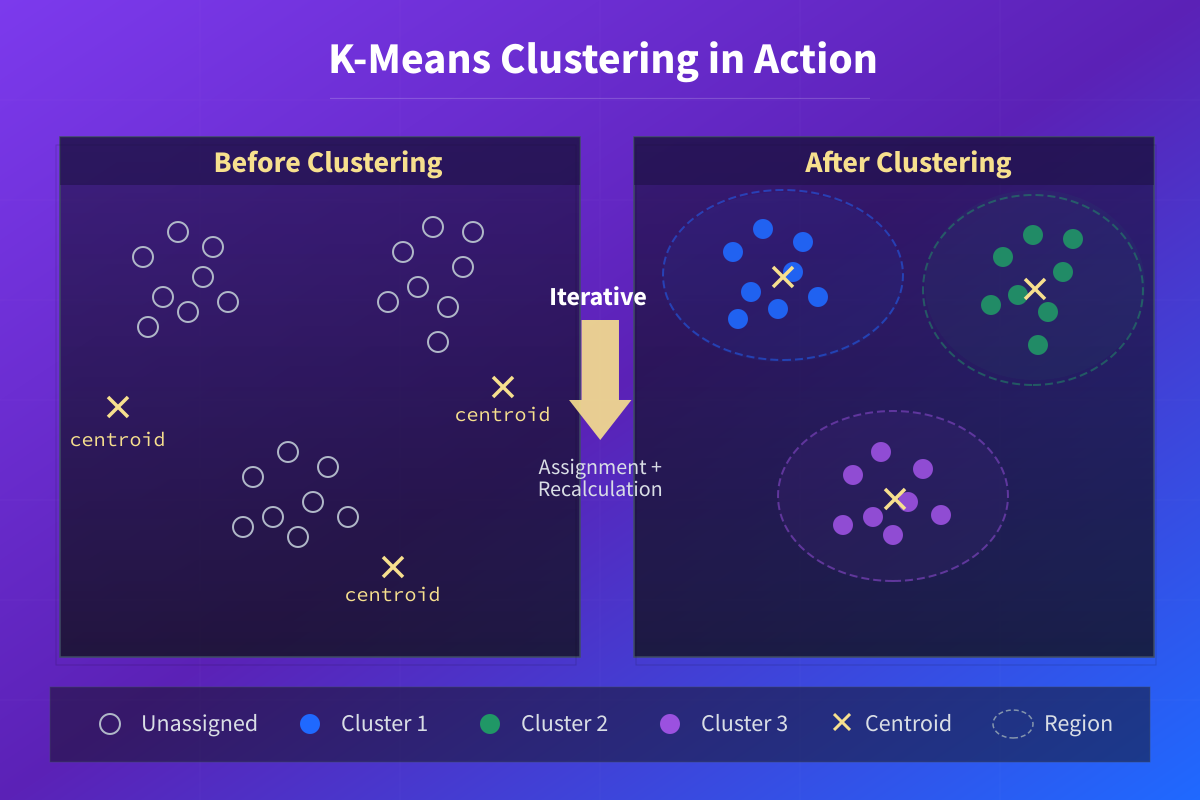
K-Means is popular for customer segmentation, image compression, and any task where you need to discover natural groupings. The concept that similar data points should be close together comes up repeatedly in machine learning.
Dataquest founder Vik Paruchuri has an in-depth video on implementing K-Means in Python that walks through the algorithm step by step.
Use it when: You want to segment data into a known number of groups, the clusters are roughly spherical, and you need a fast, scalable solution.
Dimensionality Reduction
Real-world datasets often have dozens or hundreds of features. Many of those features may be redundant or noisy. Dimensionality reduction algorithms simplify these datasets by reducing the number of features while keeping the most important information.
These techniques work on both labeled and unlabeled data, though they are most commonly associated with unsupervised learning.
Two widely used methods serve different purposes:
- PCA (Principal Component Analysis) is a preprocessing technique that compresses your features into a smaller set of uncorrelated "principal components" that capture the maximum variance. If you have 50 features but most of the variation can be explained by 5 components, PCA lets you work with 5 instead. Use PCA when you want to reduce noise, speed up training, or handle redundant features.
- t-SNE (t-distributed Stochastic Neighbor Embedding) is a visualization technique that maps high-dimensional data to 2 or 3 dimensions while preserving local relationships between data points. Use t-SNE when you want to visually explore clusters or patterns in complex data.
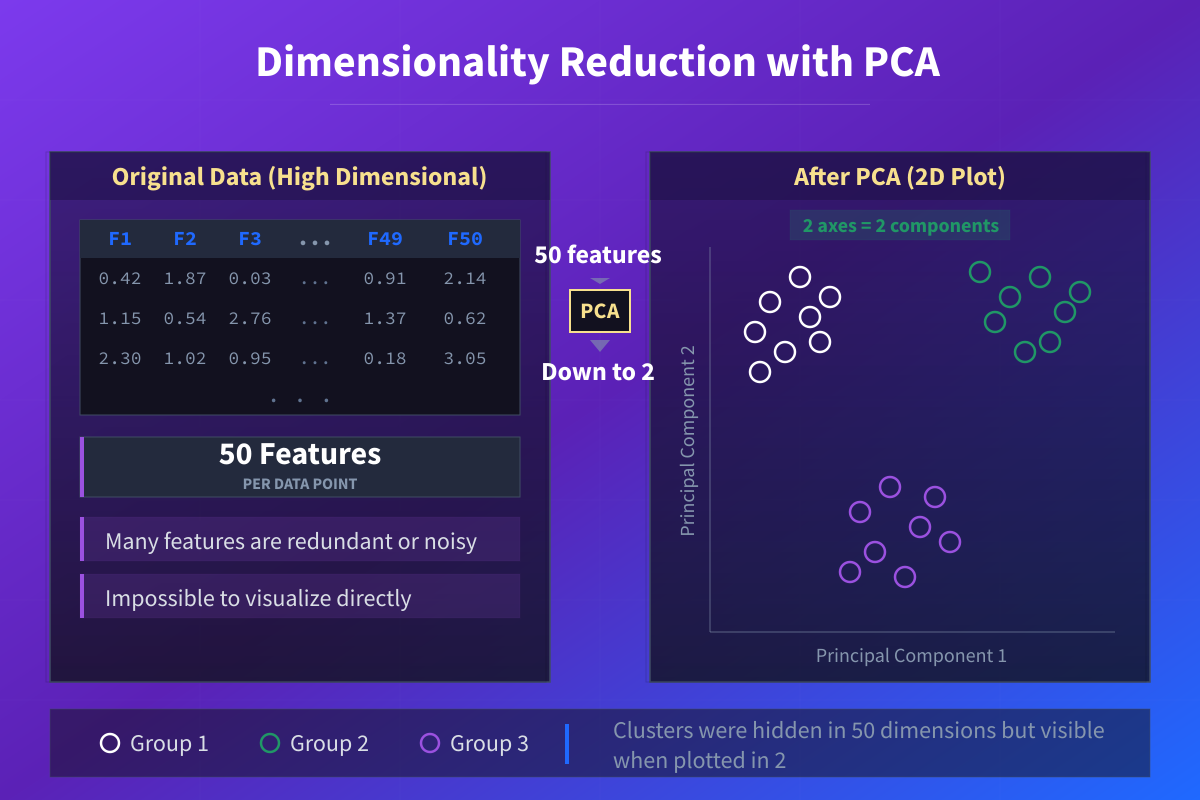
Use it when: You have many features and suspect redundancy, you want to visualize high-dimensional data, or you need to reduce noise before training a model.
Reinforcement Learning Algorithms
Reinforcement learning works differently from supervised and unsupervised approaches. Instead of learning from a static dataset, a reinforcement learning algorithm learns by interacting with an environment. An agent observes its state, takes an action, receives a reward (or penalty), and gradually learns a policy that maximizes total reward.
The main approaches are:
- Value-based methods like Q-Learning estimate how valuable each state or action is, then pick the highest-value option
- Policy-based methods like PPO (Proximal Policy Optimization) directly learn which action to take. PPO powers reinforcement learning from human feedback (RLHF), one of several techniques used to align large language models and other generative AI systems with human preferences
- Hybrid methods like Actor-Critic combine both ideas for faster, more stable learning
Use it when: Your problem involves sequential decisions, feedback comes as rewards rather than labels, or you are working on robotics, game AI, or model fine-tuning.
Neural Networks and Deep Learning
Neural networks are among the most powerful machine learning algorithms. They can learn complex, non-linear patterns that simpler algorithms miss. A neural network has interconnected layers of units (neurons), where each unit performs a mathematical operation on its inputs and passes the result forward.
A basic dense neural network has three sections:
- An input layer that receives your data
- One or more hidden layers that learn intermediate patterns
- An output layer that produces the final prediction
Each unit in a hidden layer computes a weighted combination of the previous layer's outputs, then applies a non-linear activation function. This non-linearity is what lets neural networks model complex relationships.
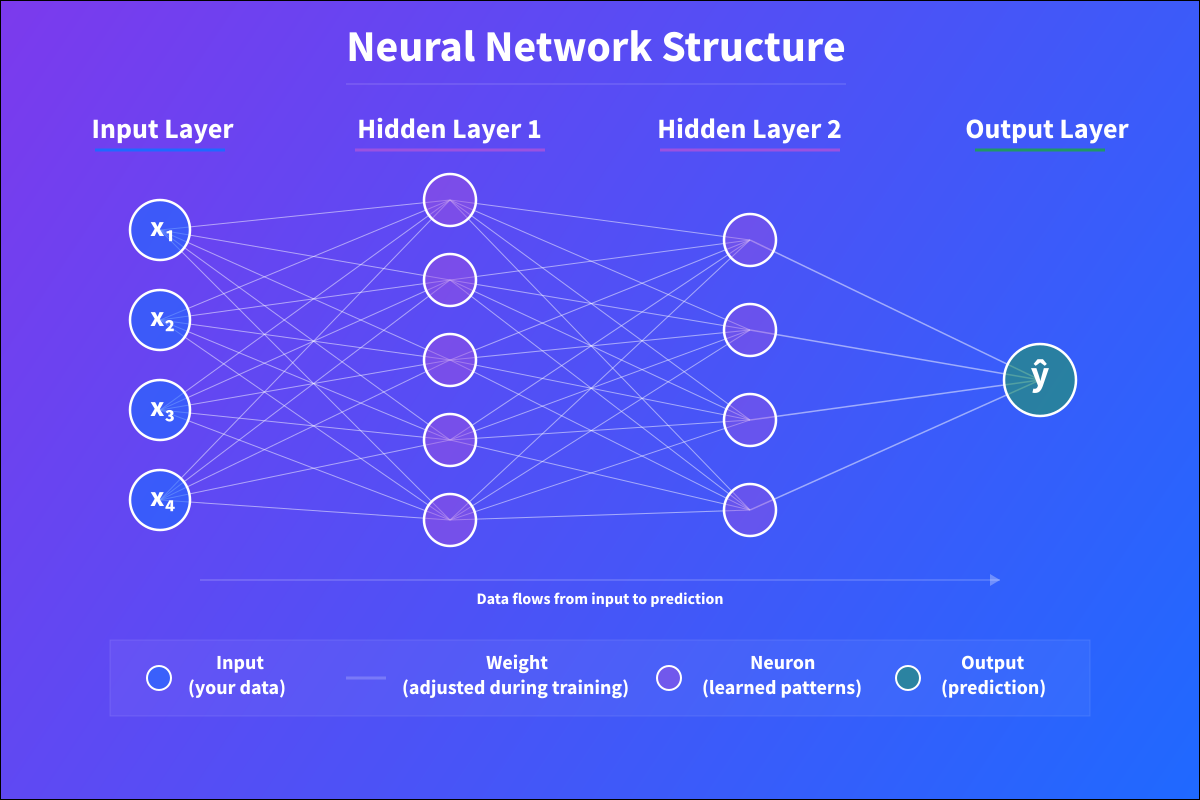
Stacking many layers is where the term "deep learning" comes from. Early layers detect simple patterns like edges in an image. Deeper layers combine those into complex features like faces or objects.
- Deep learning has driven most major advances in artificial intelligence over the past decade.** It powers image recognition, speech-to-text, natural language processing, and generative AI. Specialized architectures handle different data types:
- Convolutional neural networks (CNNs) for images and computer vision
- Recurrent neural networks (RNNs) and LSTMs for sequential data like text and time series
- Transformer models for natural language processing and generative AI (large language models like GPT and Claude are built on transformers)
You do not need to master every architecture from the start. Understanding the basic structure is what matters. This post on deep learning vs. machine learning covers how these fields relate.
Use it when: You have a large dataset, your problem involves complex patterns (images, text, audio), and simpler algorithms are just not cutting it.
Quick Reference: Choosing the Right Algorithm
The table below gives you a starting point for matching problems to algorithms. Mind you, these are not hard rules. In practice, you will often try several approaches and compare results to find the algorithm that matches your particular situation.
| Algorithm | Problem Type | Best For | Watch Out For |
|---|---|---|---|
| Linear Regression | Regression | Predicting continuous values with linear relationships | Assumes linearity; sensitive to outliers |
| Logistic Regression | Classification | Binary classification with interpretable output | Struggles with non-linear boundaries |
| Decision Trees | Both | Interpretable models; mixed data types | Prone to overfitting on their own |
| Naive Bayes | Classification | Text classification; high-dimensional data | Assumes feature independence |
| KNN | Both | Small datasets; quick prototyping | Slow on large data; needs feature scaling |
| SVMs | Classification | High-dimensional data; clear class margins | Slow to train on very large datasets |
| Random Forest | Both | Strong default performance; minimal tuning | Less interpretable than a single tree |
| Gradient Boosting | Both | Strong performance on structured/tabular data | Easier to overfit; more tuning needed |
| LASSO / Ridge | Regression | High-dimensional data; feature selection | Only handles linear relationships |
| K-Means | Clustering | Customer segmentation; grouping unlabeled data | Must specify number of clusters in advance |
| PCA | Dim. Reduction | Noise reduction; preprocessing; removing redundant features | Assumes linear relationships between features |
| t-SNE | Visualization | Exploring clusters and patterns in high-dimensional data | Not suitable for preprocessing; slow on very large data |
| Q-Learning / PPO | Reinforcement | Sequential decisions; game AI; aligning LLMs via RLHF | Needs lots of interaction data |
| Neural Networks | Both | Complex patterns; images; text; audio | Needs large data and compute; less interpretable |
Keep Building Your Skills
The best way to lock in this knowledge is through practice. Apply these algorithms to real datasets, interpret the results, and iterate.
Dataquest's Machine Learning in Python skill path covers the core algorithms from this guide with hands-on coding from the first lesson. The path includes seven courses and seven guided projects, including predicting heart disease risk, segmenting customers, and forecasting employee productivity.
For project inspiration, explore these data science projects for beginners to advanced learners. You can also follow along with video tutorials on predicting the stock market or the weather.
Dataquest students have gone on to work at companies like Accenture and SpaceX. If you are exploring machine learning jobs, a strong portfolio of projects is one of the best ways to stand out. Connect with other learners in the Dataquest Community to share your work and see what others are building.