
From automating nonprofit reporting to machine learning classes at Carnegie Mellon, Avery Trinidad learned Python by writing it himself. Now that's how he checks, and fixes, the code AI writes for him.
Why did he start learning Python?
In early 2024, Avery was a data analyst at a nonprofit, doing program evaluation: working out whether its programs did what they set out to do. The person before him had run that work in Excel, and he could have kept it there. The trouble was the input. Every cycle started with what he calls "hyper-manual Salesforce output," and the volume kept climbing. He was fairly sure most of the cleanup could be automated, so he got approval to install VS Code on his work laptop. He knew some SQL and was at home with tabular data, but he had never written a line of Python.
"I guess I'm going to learn how to do Hello World in Python and figure this out," he remembers thinking.
Why did he pick Dataquest?
His employer gave staff a yearly learning stipend, and Dataquest was on its list of recognized resources. Because the stipend paid, he could choose on fit rather than price. He had tried DataCamp and found the pacing frustrating. Dataquest came up when he searched for Python courses. He tried the free lessons and checked Reddit to see how other learners had done.
What kept him was the format: a short written explanation, then code he had to write and run before the platform would mark the step complete, with no 15-minute video to sit through first.
He enrolled in the Data Scientist path and took it out of order. Python basics, data cleaning and SQL came first, because that was what the reporting work needed that month.
"I do remember going through the course in a nonlinear manner," he says.
The rest waited until he had time and felt settled in the basics. The command line part was the first time the Unix commands he had been copying from Stack Overflow made sense to him. By the later lessons of Intermediate Python for Data Science he had made up his mind ("Okay, this product is working for me") and upgraded to a lifetime account. All of it fit around a full-time job.
How did Dataquest help him get into Carnegie Mellon?
By the end of 2024, he felt ready to do two things at once: apply for jobs that listed Python as a requirement, and apply to graduate school, which he had always planned to go back to.
Dataquest became part of the story he told in both. "Working with Dataquest was actually a sign that I was self-sufficient," he says. It showed admissions readers and hiring managers that he could learn a technical skill on his own without dropping his day job.
He is now in the second year of a master's program at Carnegie Mellon University. In his first semester he kept going back to Dataquest to review concepts as they came up in class, and he was not doing it to catch up. "My professor was actively worried that the pace of the class was too slow for me, given the foundation I had been given through Dataquest."
This year he is taking machine learning classes in CMU's School of Computer Science, and the small habits are what he notices most. He doesn't have to look up how to import a package, format a query or write the Git command for a pull request.
"I think the sort of muscle memory of those actions is something that Dataquest felt particularly good in reinforcing."
He has also used Dataquest lessons to show classmates and colleagues who know the theory how a task is done in practice.
What did the projects teach him?
Avery appreciated having a structured environment for learning, but also being expected to work through problems independently.
The Dataquest projects were useful for the same reason.
They helped him decide how he picked his own. "What I do remember from them is the constant reminder that there's supposed to be a fundamental business question behind it all."
His independent projects were messier, with far more ambiguity about how to attack the problem, but each one started from a question that mattered to him, the way the guided projects had taught him to start.
That experience also highlighted something Avery believes data education could do better.
Learning a technical concept is only part of the work. Learners also need to understand how it relates to their goals and how to explain their decisions to colleagues, managers, and AI tools.
How does he work with AI now?
Last summer Avery was a product management analytics intern at Capital One. Two messages ran side by side there. If you needed to brush up on SQL, Dataquest was the recommended self-learning tool. Meanwhile, AI was arriving everywhere: an enterprise chat assistant, coding agents rolled out to more and more roles, an agentic tool that started popping up inside VS Code.
He doesn't see those as competing. The job expects people to produce at the pace AI makes possible, but "resources like Dataquest are still fundamental in terms of, okay, do you understand what this thing is doing, or is this becoming a bit of a black box effect?"
He has seen what the black box looks like. Someone leans on AI, rushes, and the team ends up looking at a code block whose generated comments are vague, with nobody able to say what it does.
In his view, a lot of "so-called vibecoding" has the same problem. Having built this kind of code by hand puts him on the other side: "I'm able to not only interpret what all this AI output is, I'm able to actually debug it because sometimes it is deeply overengineered."
So he works the way he has seen experienced developers work. He decides what he wants, which tools will get him there and what the steps are, and then hands over the boilerplate he has no reason to type himself.
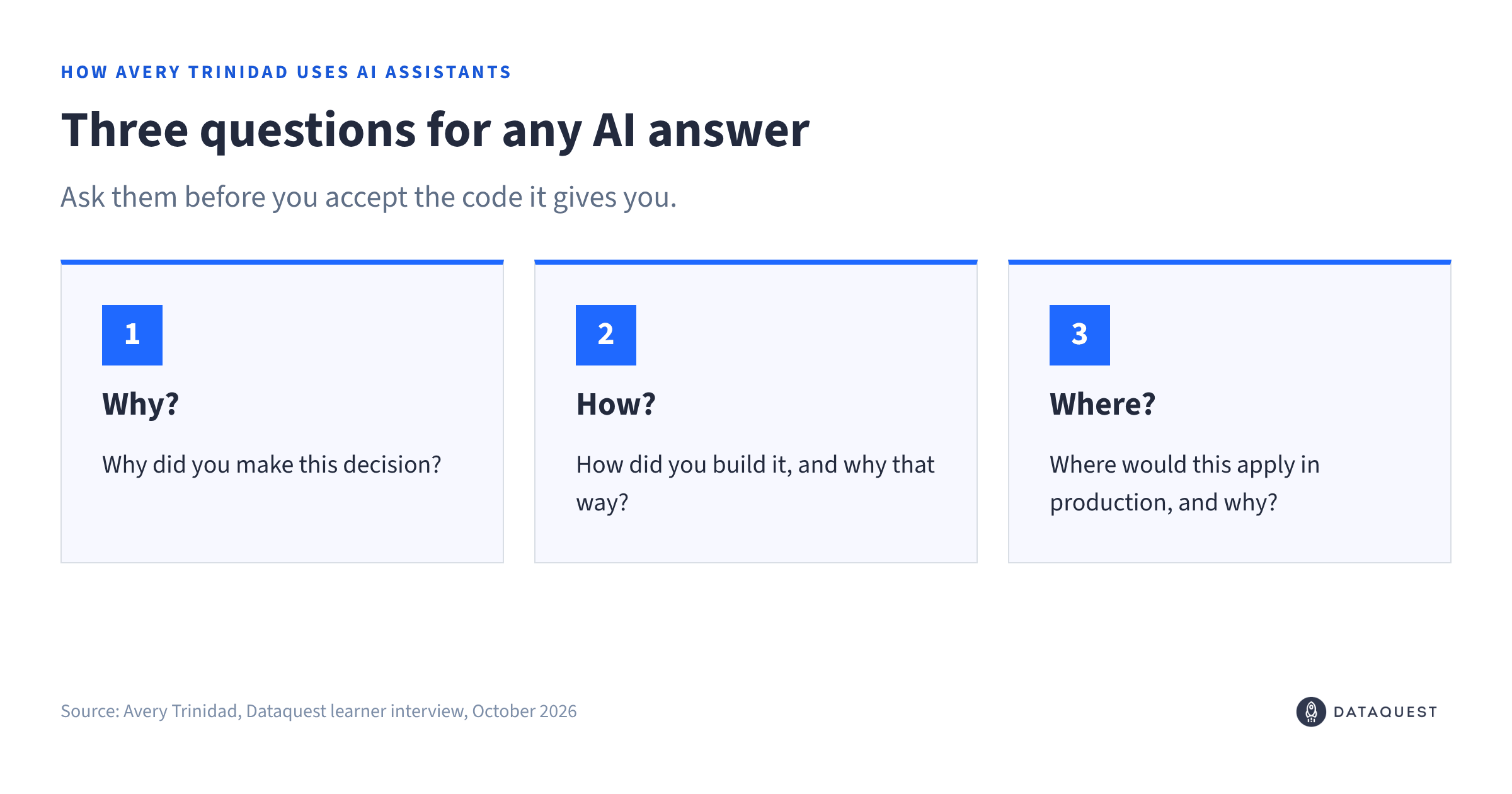
When he is learning something hard, he questions the assistant instead of taking its first answer: why it made a decision, how it is implementing it and why, and where the approach would be used in production or what business case it serves.
What's next for Avery?
He feels confident across the whole Data Scientist path except deep learning, and he plans to go back to that part because it lines up with a class he is taking next semester. To decide what to learn after that, he looks at people further along in his job family, and at whatever is stopping him from taking on more responsibility in a project.
He describes Dataquest to people starting a degree or a new research program the same way every time: "It will guide you, but it doesn't hold your hand." The part he is still working on comes after the skills. Once you know how to do the work, "how do you begin explaining that to an LLM and how do you structure those explanations and how do you have the other person in the loop, whether that be another developer or that be a manager that needs something?"
Learn Python by writing real code. Start the Data Scientist path for free and build the foundation that lets you understand, check and fix the code you work with.