
How to Become a Data Engineer in 2026
The short version of how to become a data engineer goes like this. Get strong at SQL and Python. Build a few pipelines that actually run. Then plan on getting in through a job that isn't called "data engineer."
Getting in sideways is what most career guides leave out, and it decides whether the first two steps pay off.
Below, we'll cover what the work really looks like, why the front door is mostly closed right now, the four routes people take instead, and what's worth learning first. We're assuming you're starting from zero.
Table of Contents
- What Data Engineers Actually Do All Day
- Data Engineering Is Rarely Anyone's First Job
- Four Routes In, Depending on Where You're Starting
- You Probably Don't Need a Degree, but You Do Need Proof
- The Skills Worth Learning First
- How Do You Know When You've Done Enough?
- What It Pays, and What the Outlook Really Says
- What to Do This Week
- Frequently Asked Questions
What Data Engineers Actually Do All Day
The best description we've seen came from a joke on r/dataengineering, where someone summed up the whole job as taking the data and pushing it "somewhere else."
It's funnier than it is wrong.
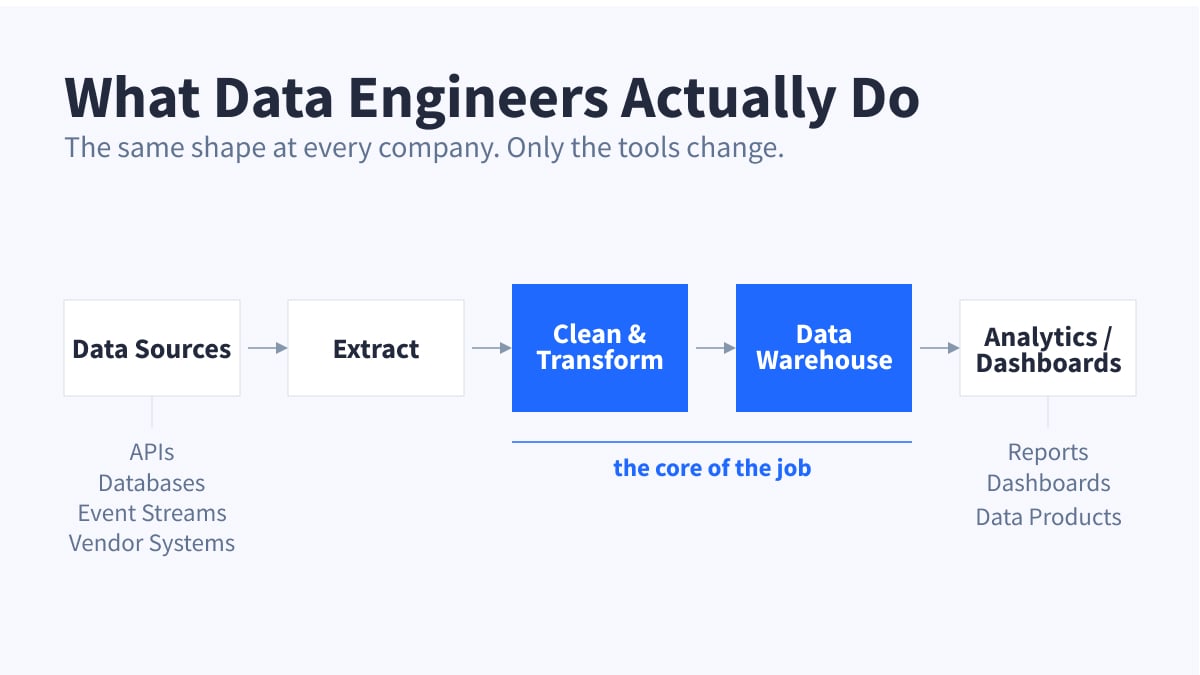
You pull data out of the places it's born, which means APIs, application databases, event streams, and vendor systems. You reshape it into tables people can actually query, load it into a warehouse, then schedule the whole thing to run again tomorrow without you.
Across 6,877 active postings on one large job board, pipelines show up in 74% of listings. Companies differ mostly on tooling. The underlying job stays the same.
Now the part the job ads skip.
Your inputs belong to other people. A product team ships a schema change on Tuesday and your pipeline breaks Tuesday night. A vendor alters an API response and nobody tells you. When it breaks at 3 a.m., you're the one who gets paged.
You'll inherit code, too. Every data team has a pile of SQL and shell scripts written by someone who left in 2021, and it still runs payroll reporting. (Nobody knows how it works. It is load-bearing.)
If that sounds like a headache, it's worth knowing now. If it sounds like a puzzle, keep reading.
Data Engineering Is Rarely Anyone's First Job
So you learn the skills, build a portfolio, and start applying to junior data engineer roles, right?
That's where most people hit a wall.
In that same set of 6,877 postings, only 219 carry a junior or entry-level title. That's 3.2% of postings worldwide, against 8% for data analyst roles.
One caveat almost nobody reports. Most listings put no seniority word in the title at all, so the real share open to a beginner runs higher than 3.2%. Not high enough to change your plan.
The field isn't shrinking, though. Those 6,877 openings are real jobs at real companies, and 45% of them explicitly ask for someone senior or above. Most of that hiring is aimed at people who have already done the work.
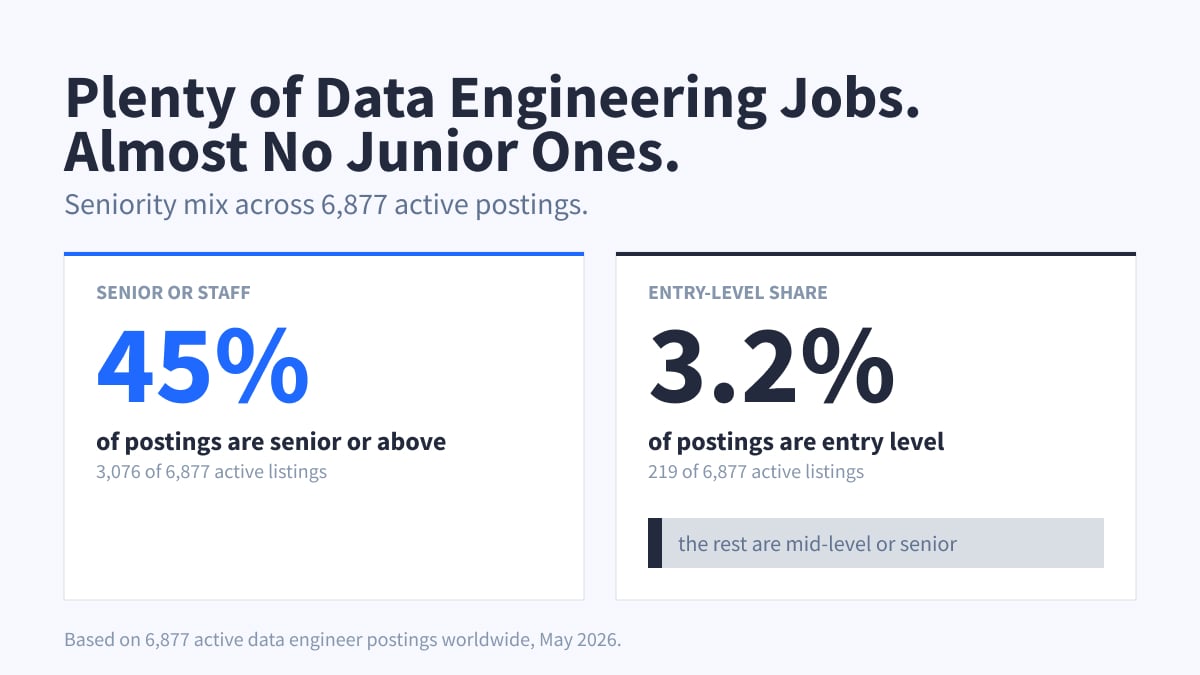
The ladder is there. Someone took the first rung off. If you've been applying to junior roles and hearing nothing back, that's the tier you've been aiming at.
AI is a big part of why that rung disappeared, and the effect cuts two ways. The work juniors used to be hired for, wiring source A to warehouse B with tool C, is exactly the work AI is best at.
What's left is the judgment. You decide whether the output is right, which schema will survive contact with the business, and why a number on a dashboard moved.
Which is why the foundations got more valuable, not less. SQL and Python aren't the skills getting automated. They're the skills you need to check the automation.
So the plan has to change. "Study for eight months, then apply for junior roles" has a low hit rate. There's a better way in, and it depends on where you're starting from.
Four Routes In, Depending on Where You're Starting
The useful question is which adjacent job sits closest to where you're standing.
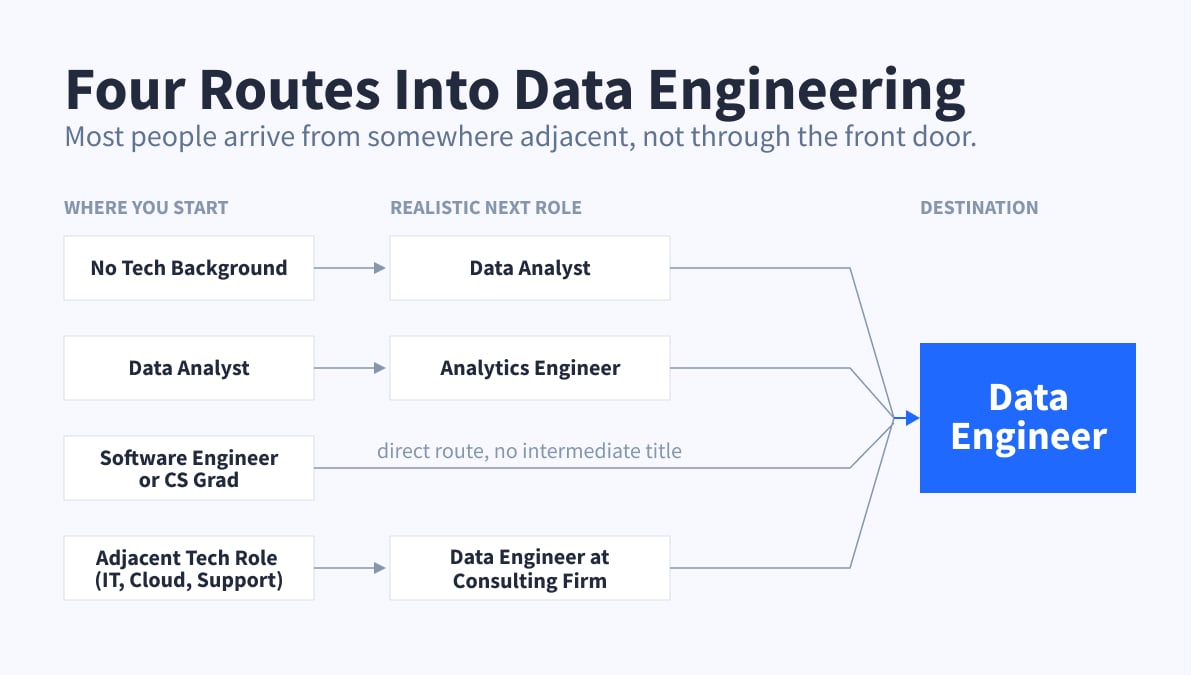
The table adds what the diagram can't: what to study, and how long it tends to take.
| Where you're starting | Realistic next title | What to close the gap on | Rough time |
|---|---|---|---|
| No tech background | Data analyst, BI analyst | SQL first, then Python | 12–18 months |
| Data analyst | Analytics engineer, BI developer | Python, Git, orchestration | 6–12 months |
| Software engineer or CS grad | Data engineer directly | SQL depth, warehousing, data modeling | 3–6 months |
| Adjacent tech role (IT, cloud, support) | Data engineer at a consulting firm | SQL, Python, pipeline basics | 6–12 months |
Analytics engineer sits between analyst and engineer. You build the data models reporting runs on, using SQL and dbt more than infrastructure. People in that Reddit thread call it data engineering with the hard infrastructure parts stripped out, and it's the most direct feeder into a data engineering title.
BI developer gets you paid to do a diluted version of the job. Part dashboards, part building the pipelines behind them. The technical ceiling is lower, but it's real pipeline work with real stakeholders, and that's experience.
The consulting route surprises people. Consulting and services firms dominate the top of that board's employer list, with Accenture alone posting 452 open roles. You trade salary for faster placement. Early on, that trade is usually worth making.
Notice what isn't in that table. A lot of guides name an internship as the way in, and that advice deserves pushback.
If you're working full time with a family to support, you can't take an unpaid one, and advice that assumes you can is useless to you. A paid analyst job where you volunteer to automate the reporting will teach you more anyway.
You Probably Don't Need a Degree, but You Do Need Proof
University career pages tend to answer this question in a way that happens to suit universities. (We sell courses, so apply the same suspicion here.) Let's use the postings instead.
An analysis of 943 US data engineer listings found 42% asked for a bachelor's specifically, 28% for a master's, and fewer than 5% for a PhD.
Be careful with that 42%, though. It's the share requiring only a bachelor's; count every posting that treats one as the baseline and you get 74%. A degree is plainly the default expectation.
Your opening is the 26% that never mention education, up from 23% the year before.
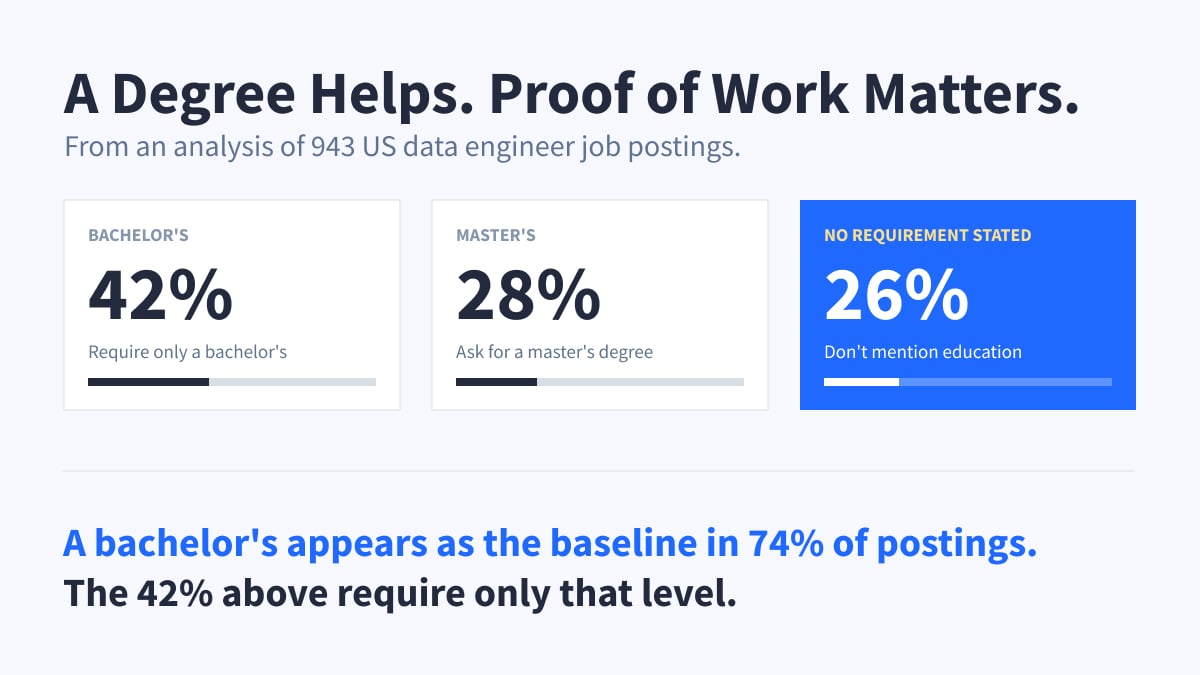
A degree helps, especially at large companies with rigid HR filters. It isn't a gate. What replaces it is evidence, meaning work someone can look at and run.
The Skills Worth Learning First
Start with SQL. Then Python. Everything else can wait much longer than the job ads suggest.
That's not a simplification for beginners. Those are the two skills in 71% of postings.
The rest of the stack matters after that. AWS appears in 44% of listings, Spark and Snowflake in about a third each, Airflow and Databricks in 29%, dbt in 24%. Pick one cloud and one orchestrator instead of sampling all of them.
If you'd rather not assemble that yourself, our Data Engineer path runs the full sequence across 30 courses and 14 projects, ending with an Airflow pipeline that pulls from an API, transforms the data, and deploys to AWS or GCP.
It's built for about five hours a week over five months. What it won't do is the part this post is mostly about, which is choosing your route in and getting someone to interview you.
For the sequence and timelines on their own, our data engineering roadmap breaks it into phases, and our data engineering skills guide ranks the fifteen that matter most.
How Do You Know When You've Done Enough?
One hiring data engineer on that same Reddit thread gave the clearest answer. Pull data from an API or a database. Land it in a cloud database. Write SQL to build a few useful tables from it. Put a simple visualization on top. That, they said, is entry-level data engineering.
The posting data adds one requirement. Production quality means testable code, handled errors, and a pipeline that survives being rerun, with idempotency and observability baked in.
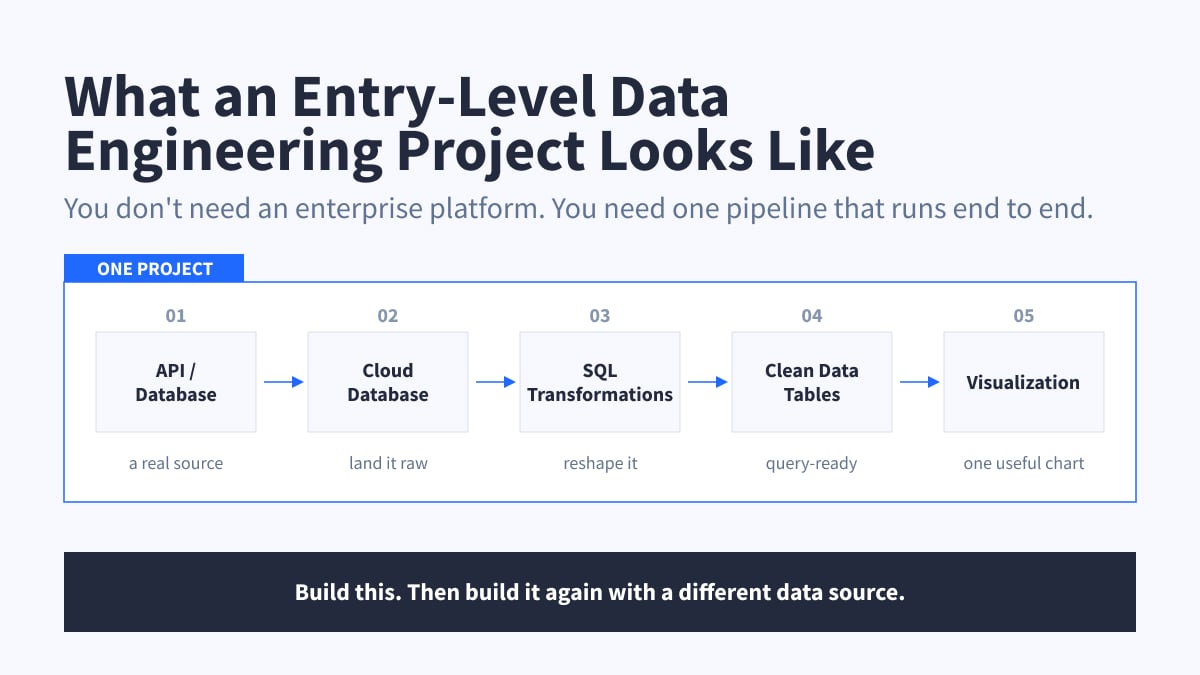
Build that. Then build it again with a different source.
One thing changed in 2026, though. You can generate a working pipeline with AI in an afternoon, so the pipeline alone proves less than it used to. What you can't fake is knowing whether it's correct.
So when you build, practice the checking. Where does this pipeline silently drop rows? What happens when the source sends a null it never sent before? Why this schema and not the other one?
Checking your own work is half of it. The other half is saying out loud what you checked and why, and that shift shows up in what employers now ask for.
In one analyst's sample of 101 data science postings, communication rose 11 points year over year and stakeholder management 13, while the vague phrase "problem solving" fell 22.
Nobody wants you to have critical thinking. They want you to explain, out loud, why you chose this design and what could break it.
What It Pays, and What the Outlook Really Says
Data engineers do well. How well depends on who's counting…
Levels.fyi puts median total compensation at $160,000, but that's self-reported and skewed toward large tech employers paying at the top of the market.
Postings tell a steadier story. Median advertised base pay across 1,183 US listings is $128,300, and 365 Data Science's average lands near $130,000. Levels.fyi counts total compensation. The postings count base pay.
Job outlook is messier. The Bureau of Labor Statistics doesn't track data engineers as an occupation at all, so guides borrow a nearby category. That's where the confident numbers come from, and where they fall apart.
The two closest fits point in opposite directions. Data scientists sit at 34% growth through 2034. Database administrators and architects sit at 4%.
A tidy "8% by 2032" also circulates, attributed to BLS for data engineers. BLS has no such occupation to project.
Pick whichever supports your argument and you can make this career look like a rocket or a dead end. The posting data is more useful, and it says the work is plentiful while the entry tier stays tight.
What to Do This Week
- Pick SQL and start today. Skip the course roundups and the roadmap videos for now. Write queries against a dataset you find interesting and keep going until joins and window functions feel boring.
- Choose your realistic next title, not your dream title. Match yourself to a starting point in the table above, then read ten real job ads for the title it points to and note what repeats.
- Build the pipeline. API to cloud database to a few clean tables to one chart. Put it on GitHub with a README that explains your schema decisions.
- Break your own pipeline on purpose. Feed it a null, a duplicate, a malformed date. Fix what breaks and write down what you learned, because that's your interview answer.
- Apply before you feel ready. Most postings don't put a seniority level in the title, which means nobody has ruled you out yet except you. Match most of the stack and let them decide the rest.
Frequently Asked Questions
Can I get a data engineering job with no experience?
Directly, it's tough. Only about 3% of data engineer postings carry a junior title.
Most people get there through an analyst, BI, or software role first, then move across once they've done pipeline work on the job. That detour is usually faster than waiting for one of the 3% to answer.
Should I become a data analyst first?
Often, yes, especially with no technical background. Analyst roles are far more open at entry level, and the SQL you'll write daily is the same SQL data engineers use. Volunteer for the automation work nobody else wants and you're building the case for your next move.
Is AI making data engineering harder to break into?
At the entry level, yes. The routine wiring work that used to justify a junior hire is what AI does well, and that tier thinned as a result.
Above it, the effect reverses. Someone still has to decide whether the output is correct, and that judgment is what employers now pay for.
How long does it realistically take?
From software engineering, 3 to 6 months. From analytics, 6 to 12. From scratch, 12 to 18 months to a first data job, then more to reach the title. Where you land in each range depends less on study hours than on whether you're building things someone could run.
