
How to Become a Data Analyst in 2026
While searching for how to become a data analyst, you've probably already noticed that the answers range from "just learn Excel" to "you need a master's degree." Like most things, the truth is somewhere in the middle.
Data analysts are the people who turn raw numbers into decisions. They answer questions like: Why did sales drop in Q3? Which customers are most likely to churn? What's driving our support ticket volume? Every company that collects data (which is nearly all of them) needs someone who can make sense of it.
If you're coming from a non-technical background and wondering whether it is realistic for you to become a data analyst, the short answer is yes, but it takes focused effort and the right approach. This guide gives you the data-backed roadmap: what skills to learn, in what order, how long it actually takes, what the job market looks like right now, and how to get hired without experience.
At Dataquest, we've helped thousands of learners break into data careers through our Data Analyst in Python path and everything in this guide reflects what actually works.
What’s inside
- What Does a Data Analyst Actually Do?
- Is Data Analytics Right for You?
- Do You Need a Degree to Become a Data Analyst?
- Data Analyst Salary: What Can You Earn?
- Skills and Tools You'll Need
- How Long Does It Take to Become a Data Analyst?
- How to Become a Data Analyst: Step-by-Step
- Free Resources to Accelerate Your Learning
- Conclusion
- Frequently Asked Questions
What Does a Data Analyst Actually Do?
Data analysts collect, clean, and interpret data to help organizations make better decisions. In practice, that means a lot of SQL queries, a lot of spreadsheets, and a lot of conversations with people who don't speak "data."
A typical week might include pulling sales data from a database, building a dashboard for the marketing team, investigating why a key metric dropped, and presenting findings to a director who wants the bottom line—not the methodology.
The role sits between the raw data and the people who need to act on it. That makes communication just as important as technical skill. If you can find insights but can't explain them clearly, you'll struggle. If you can explain things clearly but can't find the insights, same problem.
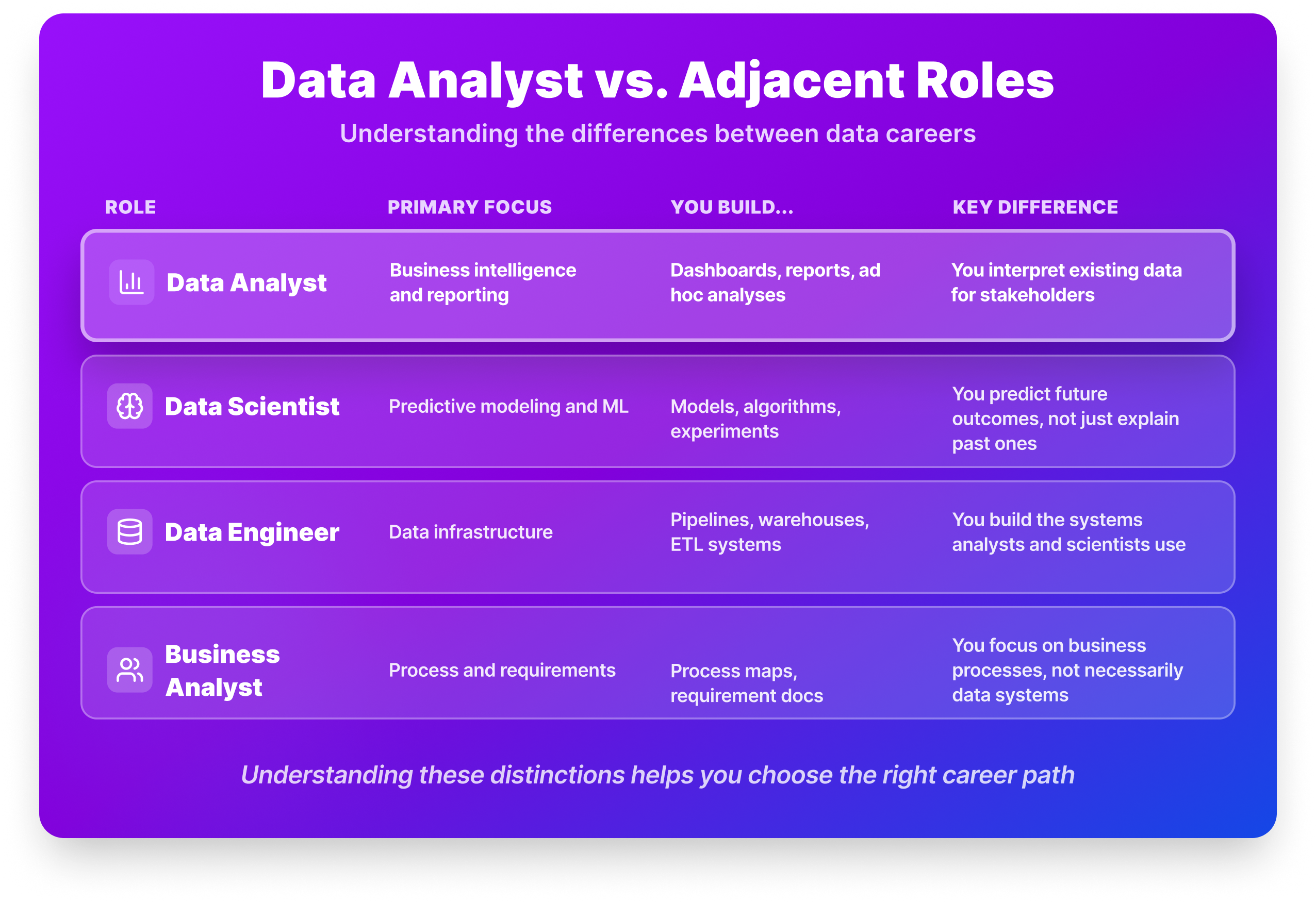
Here's how the data analyst role compares to adjacent roles you'll hear about:
Is Data Analytics Right for You?
Before you invest months of your time, it's worth asking whether the day-to-day reality matches what you're looking for. Data analytics is a good fit if you genuinely enjoy digging into problems, you're comfortable sitting with ambiguity, and you find satisfaction in making something messy into something clear.
You don't need to be a math genius or a programmer. Most working analysts spend more time cleaning data and building dashboards than doing anything resembling advanced statistics. What matters more is curiosity, attention to detail, and the ability to communicate what you found to someone who wasn't in the weeds with you.
If you're coming from a non-technical background like teaching, finance, healthcare, retail, the arts—that's not a liability. Domain knowledge is genuinely valuable. A former nurse who understands clinical workflows will ask better healthcare questions than a developer who just learned SQL. A teacher who knows how to explain complex things simply is already ahead on the communication side.
The question to ask yourself: Do I like solving puzzles with imperfect information, and am I okay with the answer sometimes being "we don't have enough data to know"?
Do You Need a Degree to Become a Data Analyst?
Most data analyst job postings list a bachelor's degree as a requirement, and the but when it comes right down to it: a degree helps, but it's not a hard requirement if you can demonstrate skills another way.
Most working data analysts do hold a degree, often in fields like statistics, economics, computer science, or business. But the field has shifted meaningfully in the last few years. Employers increasingly care about what you can do, not just what your diploma says.
The non-degree path requires more deliberate proof-of-skill: a strong portfolio, a GitHub profile with documented projects, and ideally some domain expertise that makes you a compelling candidate in a specific industry. A resume that says "Google Data Analytics Certificate + 3 portfolio projects + 5 years in healthcare administration" can be genuinely competitive.
What won't get you hired on its own is a certificate with no projects to back it up. Certifications show that you completed a course. A portfolio proves you can actually do the work. You need both.
Data Analyst Salary: What Can You Earn?
Data analytics pays well relative to the learning investment. According to Glassdoor data from February 2026, the average data analyst in the United States earns around $92,900 per year in total compensation.
Entry-level positions typically fall between $50,000 and $81,000. Mid-level analysts with a few years of experience commonly earn in the $72,000–$121,000 range. In higher-paying industries like finance or tech, or in high-cost cities like San Francisco and New York, compensation runs higher. The Robert Half 2026 Salary Guide puts the tech sector midpoint for data analysts at $117,250.
Salary also varies significantly by tool specialization, industry, and company size. Analysts who work with cloud platforms, Python, or advanced SQL tend to command more than those who work primarily in Excel. The skill investment pays off in compensation fairly directly.
Skills and Tools You'll Need
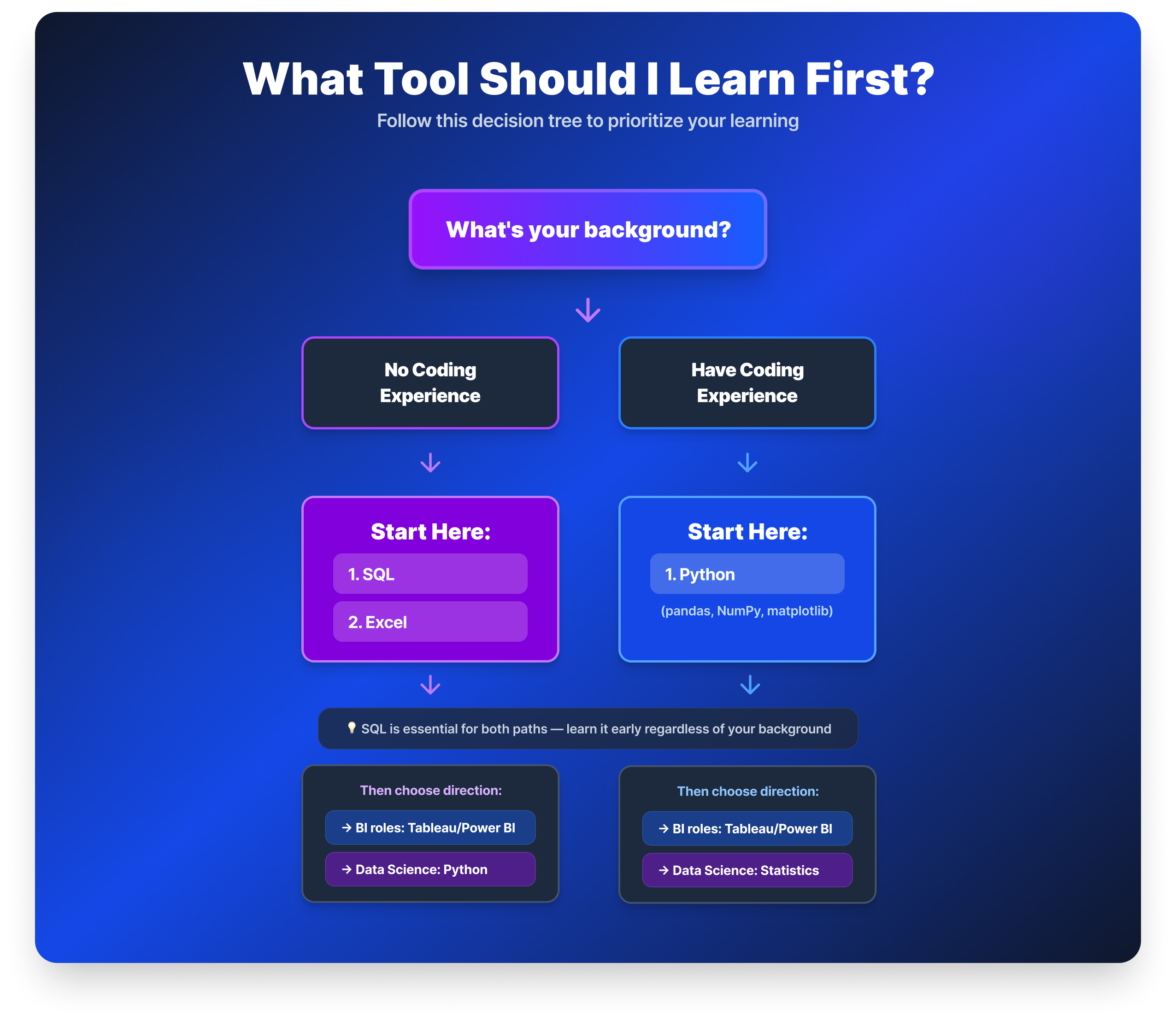
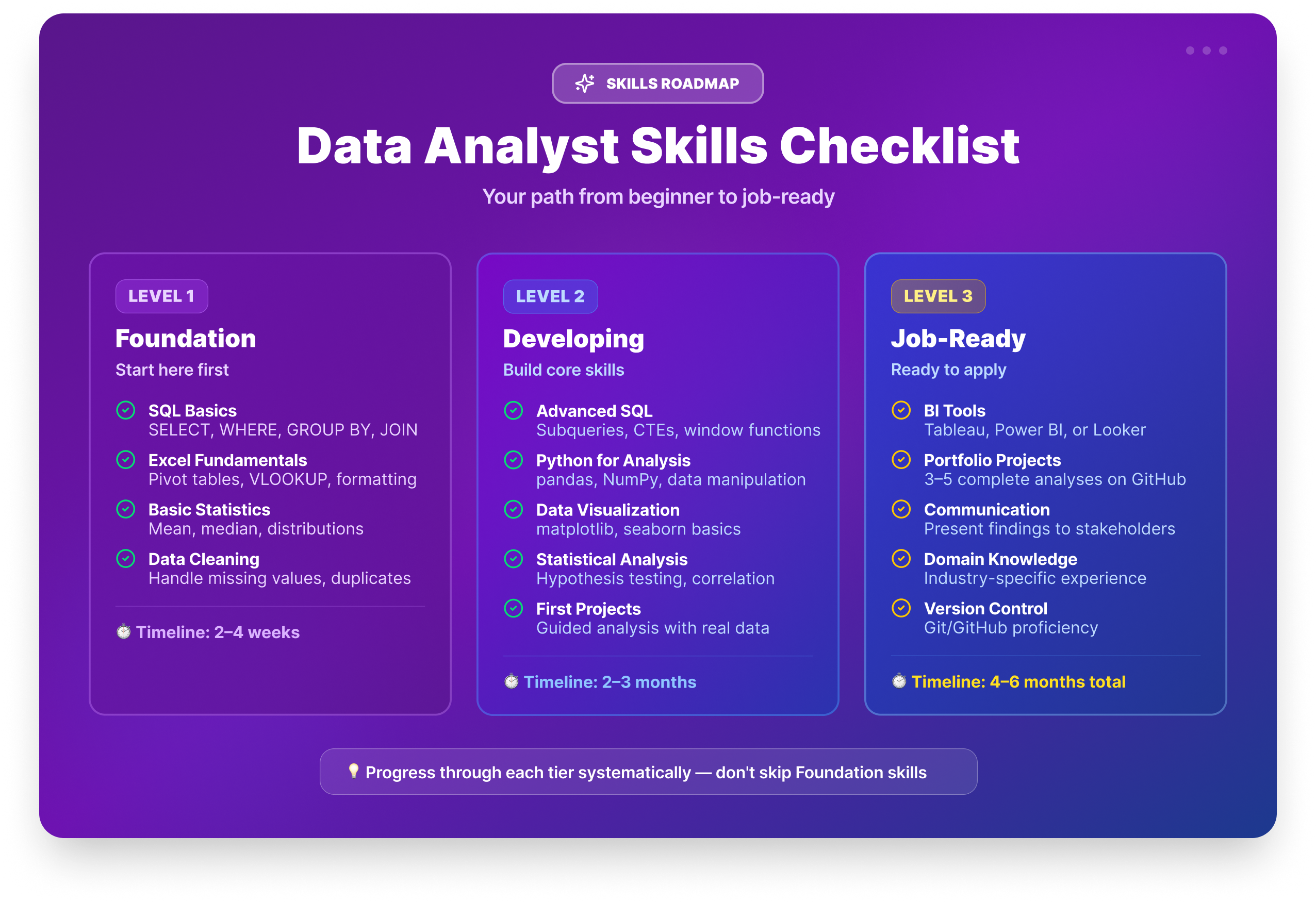
The data analyst skill stack isn't complicated, but there's a right order to learn it. If you're self-directing your learning, many practitioners recommend getting comfortable with SQL before tackling Python—you'll use it more often day-to-day, and the logic transfers well. That said, structured paths like Dataquest's build Python and SQL together in a sequence designed for beginners, which works well if you're starting from scratch.
Here's the recommended sequence:
Foundation first:
- Excel: Still used daily in most analyst roles. Pivot tables, VLOOKUP, basic charting. It's not glamorous, but skipping it costs you in practice.
- SQL: The most important technical skill for data analysts. You'll use it to pull, filter, and aggregate data from databases. Start here before Python.
Build from there:
- Python: The primary programming language for data analysis. Focus on pandas and NumPy for data manipulation, matplotlib or seaborn for visualization. Python is the dominant choice for most analyst roles in 2026; R remains strong in academia and biostatistics, but it isn't the recommended place to start.
- Tableau or Power BI: Pick one visualization tool and learn it well. Tableau Public lets you build and publish dashboards for free, which is useful for your portfolio. Power BI is widely used in corporate environments and offers free learning materials through Microsoft.
Round it out:
- Basic statistics: Mean, median, distributions, correlation, and hypothesis testing at a conceptual level. You don't need a statistics degree, but you need enough to know when a pattern is meaningful versus noise.
- Data storytelling: The ability to structure and present findings for a non-technical audience. This is what separates analysts who get promoted from those who don't.
How Long Does It Take to Become a Data Analyst?
It depends on where you're starting from and how much time you can dedicate to learning each week. Here are realistic ranges:
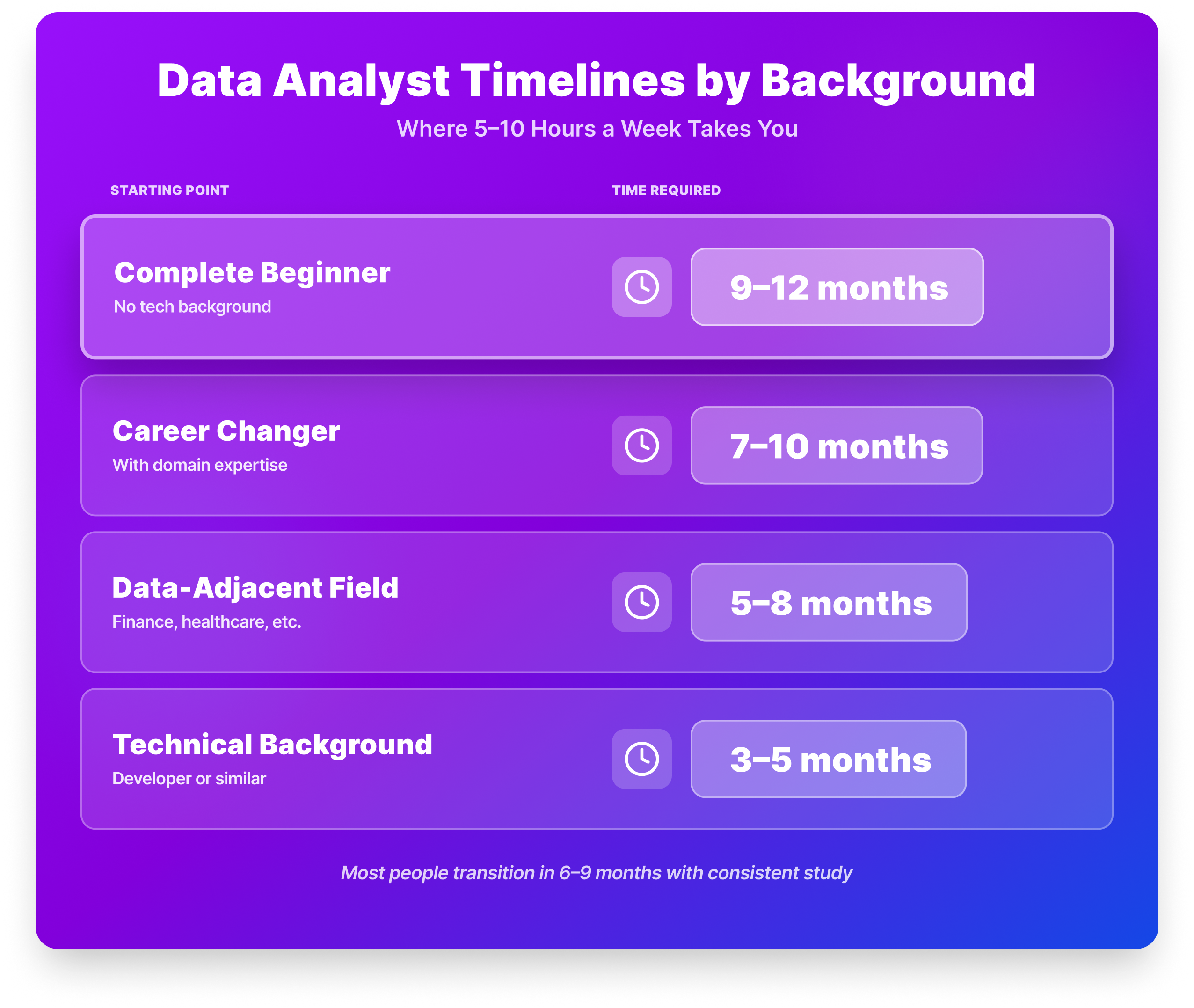
Dataquest's Data Analyst in Python path is designed to get you job-ready in roughly five months at 10 hours per week, that's less than 90 minutes a day with hands-on projects built throughout.
These ranges assume consistent practice, not binge-and-pause learning. An hour a day, five days a week, beats a six-hour Saturday session followed by two weeks off. Consistency compounds faster than intensity.
How to Become a Data Analyst: Step-by-Step
Step 1: Learn the Fundamentals
Start with SQL and Excel before you touch anything else. This is the part that feels slow and unsexy, and it's the part that matters most.
SQL is how you get data out of databases and almost every analyst role requires it. Start with SELECT, WHERE, GROUP BY, and JOIN. Then move to subqueries, CTEs, and window functions. At Dataquest, our SQL Fundamentals path covers this progression with hands-on exercises using real databases.
For free practice outside a structured course, SQL Murder Mystery is genuinely engaging where you solve a crime using queries, which turns a dry skill into something that actually holds your attention. SQLZoo and HackerRank SQL are good for drilling specific concepts.
Excel comes next. Learn pivot tables, VLOOKUP/XLOOKUP, conditional formatting, and basic charting. GCFGlobal has solid free tutorials, and ExcelJet is a reliable reference.
Once you have SQL and Excel down, move to Python. Focus specifically on pandas for data manipulation and matplotlib or seaborn for visualization. Don't try to learn all of Python. Instead, learn the parts analysts actually use. Kaggle Learn's Python and pandas courses are free and practical. Exercism's Python track is good for building fundamentals through deliberate practice.
For statistics, Dataquest’s Introduction to Statistics in Python course teaches you the fundamentals of statistics in data science and covers everything you need at the analyst level. StatQuest with Josh Starmer on YouTube explains statistical concepts visually, which makes them stick better than textbooks.
The Google Data Analytics Professional Certificate (~$50/month on Coursera) is a reasonable option if you want a structured credential alongside your learning. It covers SQL, R, and Tableau with case studies. It's worth having, but only alongside a portfolio. A certificate alone won't get you hired.
Step 2: Build Projects with Real Data
Projects are how you get hired when you have no experience. Not certifications, not course completions—projects that show you can find a question, find data, and produce an answer worth reading.
The biggest mistake learners make is waiting until they feel "ready" to build projects. You're ready when you know enough SQL to pull data and enough Python to manipulate it. That's much earlier than most people think.
Think of every project in your portfolio as a job application. It shows a hiring manager that you can find a dataset, clean it, explore it, and communicate what you found. That's most of what an entry-level analyst does.
Dataquest's Data Analyst in Python path includes more than 20 guided projects, each using real datasets. A few that make strong portfolio pieces:
- Lottery addiction analysis: Explores probability and expected value using lottery data. Accessible topic, surprising findings, and it demonstrates statistical thinking clearly.
- Spam filter: A naive Bayes classifier built from scratch using SMS data. Shows you can build something functional with code, not just run queries.
- Jeopardy question analysis: Uses natural language processing basics to find patterns in 200,000+ Jeopardy questions. A fun dataset that produces genuinely interesting results.
For finding your own datasets, Kaggle has thousands across every domain. Our free datasets guide is a curated list with project ideas attached. Data.gov, Our World in Data, and the FiveThirtyEight GitHub repo all have well-documented public data.
Pick a topic you actually care about. An analyst who's curious about the data produces a better project than one who picked a dataset at random. That curiosity shows in your projects.
Step 3: Create a Portfolio That Gets You Hired
Your portfolio is evidence. It exists to answer one question for a hiring manager: can this person actually do the work?
Three to five projects is the right number. Each one should live in its own GitHub repository with a clear README that explains what problem you investigated, what data you used, what you found, and why it matters. Write it for someone who wasn't in the weeds with you since that's the same skill you'll use when presenting to stakeholders.
As Miguel Couto, a data analyst who went through the Dataquest path, put it:
Your portfolio is the difference between saying you can do something and proving it.
Employers can't evaluate you from a course certificate. They can evaluate you from a GitHub profile with documented work.
If you're coming from a non-technical background, don't hide your previous career—use it! A former teacher who builds a project analyzing standardized test score trends is more interesting than a generic e-commerce sales analysis. Your domain expertise is a feature, not a gap to apologize for.
A few things that make a portfolio project stand out:
- A genuine question worth asking, not just "let's see what the data says"
- Clean, readable code with comments that explain decisions
- Visualizations that communicate, not just display
- A summary that a non-technical reader could follow
- Documented assumptions and limitations
Sign up for GitHub if you haven't already and push every project there. It's where recruiters look, and an empty profile is a missed opportunity.
Step 4: Network and Apply
The entry-level data analyst market in 2025–2026 is more competitive than it was a few years ago. More people are making this transition, which means more competition for the same jobs. That's not a reason to be discouraged, but it is a reason to be strategic.
The applications that get responses are usually the ones backed by a warm connection or a specific fit. Sending 100 cold applications to generic job postings is a low-return activity. Spending that same time building one genuine connection in the field is usually more effective.
Here's what actually works for career changers:
- LinkedIn is where most hiring happens in this space. A complete profile with a strong headline ("Aspiring Data Analyst | SQL, Python, Tableau | Former Healthcare Administrator") and portfolio links matters more than most people realize. Connect with analysts at companies you're interested in—not to ask for a job, but to ask how they made the transition.
- Communities are underused by most job seekers. r/dataanalysis, the Dataquest Community, and DataTalks.Club's Slack are all active. People in these communities share job postings, give portfolio feedback, and occasionally hire people they've seen contribute consistently. Lurking doesn't get you anywhere; participating does.
- Domain positioning gives you an edge that pure career changers don't have. If you spent five years in healthcare, you understand HIPAA, clinical workflows, and what questions matter to that industry. Target healthcare analytics roles where that knowledge is an asset, not a liability.
- Applying honestly. Don't wait until you feel perfectly ready. The job description that lists seven requirements is often written by someone who'd be thrilled to find a candidate who meets five of them well. Apply when you have your core skills and two solid portfolio projects. Rejection is data, not a verdict. When you're ready to interview, our guide to data analyst interview questions covers what to expect and how to prepare.
Free Resources to Accelerate Your Learning
You don't need to spend a lot to learn this. The best resources for each skill:
SQL: SQL Murder Mystery for engaging practice, SQLZoo for structured tutorials, HackerRank SQL for drilling specific concepts
Python: Dataquest's free lessons, Kaggle Learn, Exercism Python Track for deliberate practice with feedback
Excel: GCFGlobal Excel Tutorials, ExcelJet for quick reference
Visualization: Tableau Public for free software and a public portfolio, Microsoft's Power BI learning path for free BI training
Statistics: StatQuest with Josh Starmer on YouTube
Datasets: Kaggle Datasets, Dataquest's free datasets guide, Data.gov, Our World in Data, FiveThirtyEight GitHub
Communities: r/dataanalysis, Dataquest Community, DataTalks.Club
Conclusion
The pattern that works isn't waiting until you've finished every course or until the portfolio feels perfect. Not waiting until you've finished every course, not holding off until the portfolio is perfect—starting before you feel ready and building momentum from there.
Data analytics is a realistic career change for people coming from almost any background. The path is clear: SQL and Excel first, then Python, then projects, then a portfolio, then applying strategically. The timeline is real but not unreasonable. Most career changers are job-ready within 7–12 months of consistent effort.
Frequently Asked Questions
Will AI replace data analysts?
This question comes up constantly, and the honest answer is: not in the way most people fear.
AI is very good at automating repetitive tasks like cleaning data, running standard queries, and refreshing dashboards. It is not good at deciding which questions are worth asking, interpreting results in the context of a specific business, or communicating findings to stakeholders who do not care about methodology.
AI replaces the syntax part of the job, writing boilerplate code, not the semantics part, understanding what the data actually means.
Entry-level roles focused purely on routine reporting face more pressure than roles involving investigation, experimentation, or strategic decision support.
The practical takeaway is to learn to use AI tools as part of your workflow for drafting SQL, exploring datasets faster, and automating repetitive tasks. Analysts who work alongside AI are more valuable, not less.
Is data analytics a good career in 2026?
Yes, with nuance.
The overall job market remains strong, especially in healthcare, finance, tech, and e-commerce.
The caveat is that entry-level hiring is more selective than it was in 2020–2022. There are more candidates with certificates and course completions, which raises the baseline.
What gets you hired is not just knowing tools, but demonstrating that you can apply them to real problems. A focused portfolio and domain expertise matter more now than they did a few years ago.
How hard is data analytics to learn?
Harder than a weekend course, easier than most people assume.
The technical fundamentals, SQL, Excel, basic Python, are learnable without a technical background. The steeper curve is developing analytical thinking: asking meaningful questions, identifying signal versus noise, and communicating insights clearly.
SQL tends to click faster than expected. Python takes longer if you start from zero.
The biggest hurdle for most learners is moving from tutorials to independent projects. That transition is where real skill develops.
What's the difference between a data analyst and a data scientist?
Data analysts work with existing data to answer defined business questions like why something happened or how performance is trending. Their deliverables are typically dashboards, reports, and ad hoc analyses.
Data scientists build predictive models and machine learning systems, often answering questions about what is likely to happen next or which customers to target.
The roles can blur, especially at smaller companies. As a starting point, data analytics is generally more accessible. It requires less statistical depth and offers more entry-level openings. Many data scientists begin as analysts.
Do I need to know Python to get a data analyst job?
Not always, but increasingly yes.
Some industries still hire analysts focused on SQL and Excel. However, in tech, startups, and data-heavy organizations, Python is often required or strongly preferred.
SQL remains the top priority. It is used daily and is harder to substitute. But learning Python with pandas significantly expands the types of problems you can solve and the roles you qualify for.
How competitive is the entry-level data analyst job market right now?
More competitive than it was in 2020–2022, but not as bleak as online discussions sometimes suggest.
The number of candidates has increased because data analytics has been heavily marketed as an accessible career path.
What separates successful candidates is typically one of three things:
- A portfolio with real, documented projects
- Domain expertise aligned with a specific industry
- A warm introduction that bypasses automated filters
Applying broadly to generic postings is low yield. Building focused projects and targeting the right companies is far more effective.
Can I become a data analyst while working full-time?
Yes, this is how most career changers do it.
At 5–10 hours per week, expect roughly 3–12 months to become job-ready, depending on your background.
Consistency matters more than intensity. Short, regular study sessions outperform occasional marathon sessions.
The biggest challenge is carving out time for projects, which require deeper focus than watching lessons. Setting aside one longer weekly block specifically for project work helps maintain momentum.
What industries hire the most data analysts?
Finance and banking, healthcare, e-commerce and retail, tech, and marketing analytics hire data analysts in large numbers. Government and the public sector also hire steadily, often with greater stability and slightly lower salaries.
The easiest entry point for career changers is often within their existing industry. Domain knowledge is a genuine competitive advantage.
A former nurse targeting healthcare analytics or a marketer applying to marketing analytics roles brings contextual understanding that pure technical candidates may lack.