
Data Science vs Data Engineering: Which Career Is Right for You?
If you're weighing data science vs data engineering, you've probably noticed these roles get tangled together in job descriptions, Reddit threads, and career advice articles. Both work with data. Both pay well. Both show up on "best careers" lists. But they're fundamentally different jobs that attract different kinds of people.
Here's a concrete example: At a streaming company like Netflix, data scientists build recommendation algorithms that predict what you'll want to watch next. Data engineers build the pipelines that collect viewing data from millions of subscribers, transform it into usable formats, and deliver it to those algorithms in real-time. One role finds patterns. The other builds the infrastructure that makes pattern-finding possible.
If you're trying to decide between these paths, you're in the right place. Maybe you're a career changer exploring options, a student picking a major, or an analyst wondering what's next. The good news: both careers offer genuine paths from zero experience to job-ready, and people successfully break into each field every day.
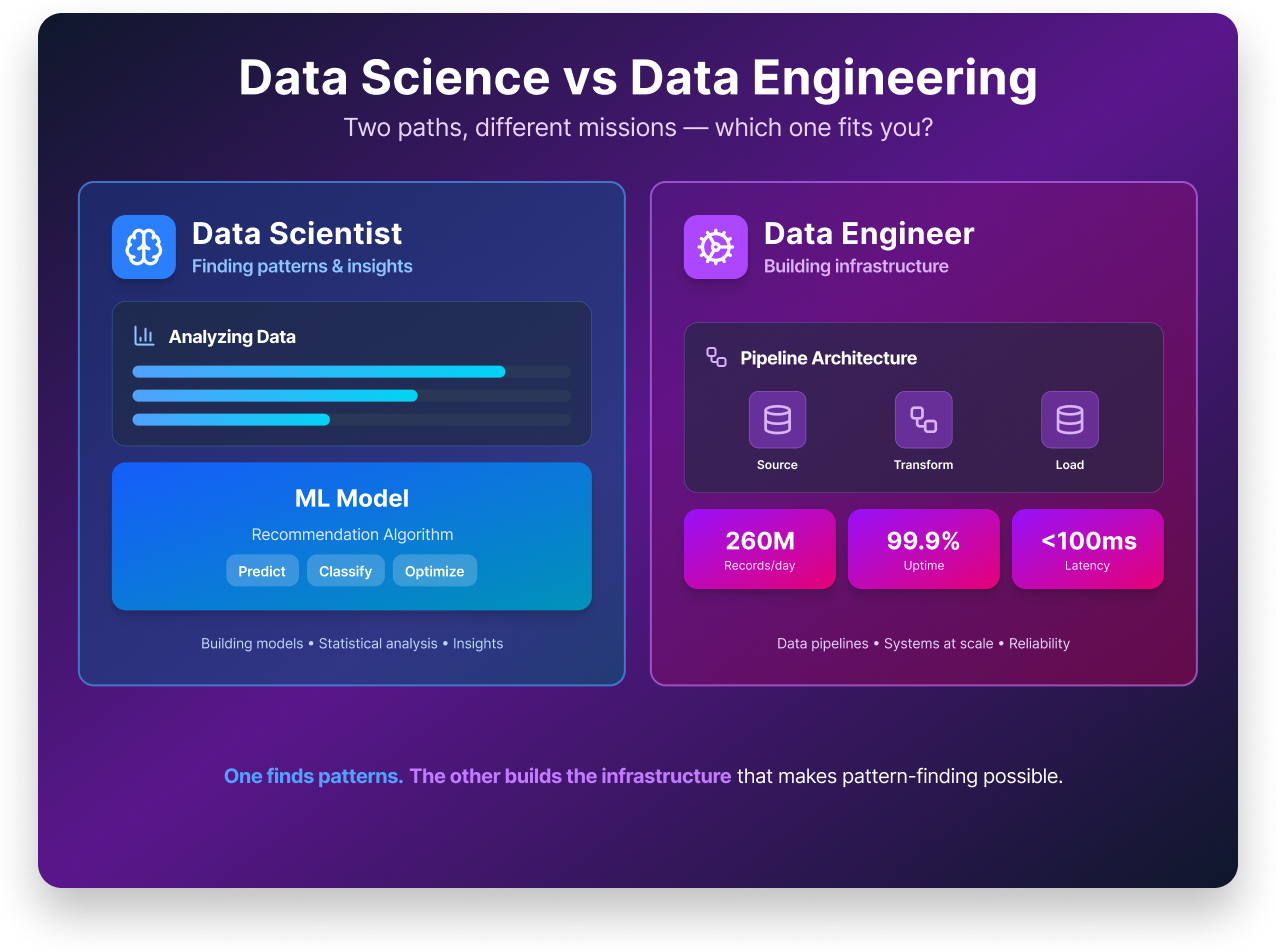
We'll break down the real differences: what each role actually does day-to-day, the skills you'll need, current salary data, job market outlook, and a framework to help you decide. At Dataquest, we offer dedicated paths for both data science and data engineering, so we've seen thousands of learners navigate this exact decision. Here's what we've learned.
What Is a Data Scientist?
A data scientist extracts insights from data to help organizations make better decisions. That's the textbook definition, but what does it actually look like?
On a typical day, a data scientist might:
- Analyze customer churn patterns to figure out why subscribers are canceling
- Build a machine learning model to predict which products will sell best next quarter
- Run A/B tests to determine whether a new app feature actually improves engagement
The work involves asking questions, finding patterns, building models, and translating technical findings into recommendations that non-technical stakeholders can act on.
Unlike what some job postings suggest, data scientists rarely spend their days building cutting-edge neural networks. Most of the work involves cleaning messy data, exploring datasets, running statistical analyses, and communicating results. The glamorous model-building part? Maybe 20% of the job, if you're lucky.
Data Scientist Skills
Python dominates data science, with R still relevant in specific industries like academia and pharmaceuticals. SQL is non-negotiable; you'll write it daily. Statistics knowledge separates data scientists from people who just know how to call sklearn functions.
Machine learning is an expected skill for data scientists, but the required depth varies by role. Some positions focus on traditional statistical modeling; others require deep learning expertise.
Communication matters more than most technical guides admit. You'll spend significant time explaining findings to people who don't know what a p-value is. If you can't translate technical results into business impact, your models won't matter.
Common Data Scientist Tools
The standard stack includes Python (pandas, scikit-learn, TensorFlow/PyTorch), SQL, Jupyter notebooks, and visualization libraries like Matplotlib or Plotly. Cloud ML platforms like AWS SageMaker, Google Cloud Vertex AI (formerly AI Platform), or Azure ML are increasingly common. Git for version control. Tableau or Power BI for business-facing dashboards.
What Is a Data Engineer?
If data scientists are the ones discovering patterns and making predictions, data engineers are the ones designing and running the data highways that make those discoveries possible.
A data engineer builds, maintains, and optimizes the systems that collect, store, and process data. When a data scientist complains that "the data is messy" or "I can't access the customer data I need," they're describing problems a data engineer solves.
On a typical day, a data engineer might:
- Build a pipeline to ingest real-time user activity from a mobile app
- Optimize a slow query that's causing reports to time out
- Set up monitoring and alerts for a data warehouse
- Debug why yesterday's batch job failed at 3 AM
Data Engineer Skills
SQL is fundamental, but you'll go deeper than a data scientist typically needs to. Understanding query optimization, indexing strategies, and database design matters when you're responsible for systems handling millions of records.
Python is standard for scripting and automation. Scala or Java appear in big data environments. Understanding distributed systems concepts (how data flows across multiple machines) separates junior from senior engineers.
Tools like dbt for data transformation, Apache Airflow for workflow orchestration, and cloud data warehouses like Snowflake and Databricks are widely used across the industry. Many competitors' articles miss this—they're still listing Hadoop as a primary tool when the industry has largely moved on.
You'll also need familiarity with cloud platforms (AWS, GCP, or Azure), containerization (Docker, Kubernetes), and CI/CD practices. Data engineers write code that ships to production, so version control, testing, and deployment pipelines matter.
Common Data Engineer Tools
The stack includes Python, SQL, Apache Spark for big data processing, Airflow for orchestration, dbt for transformation, and cloud services like AWS Redshift, Google BigQuery, or Snowflake. Kafka handles real-time streaming data. Infrastructure-as-code tools like Terraform are increasingly expected.
Data Science vs Data Engineering: Key Differences
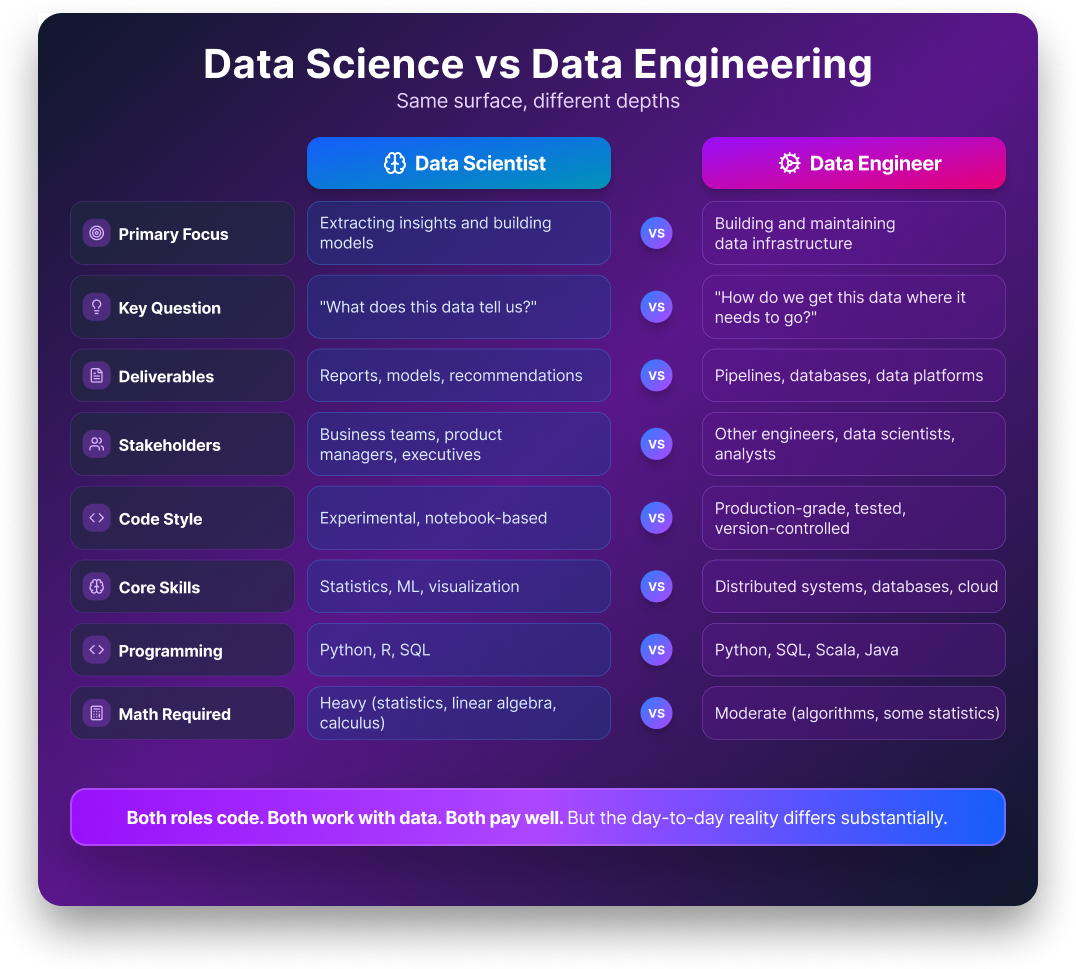
The roles share surface-level similarities (both require coding, both work with data, both pay well) but the day-to-day reality differs substantially.
How the Roles Work Together
In practice, data scientists depend on data engineers. A data scientist can't build a churn prediction model if customer data is scattered across five databases in inconsistent formats. A data engineer builds the pipeline that collects, cleans, and delivers that data.
This relationship creates a useful mental model: data engineers build the foundation, data scientists build on top of it.
At many companies, data scientists have historically been asked to do both roles. As one practitioner noted: "Companies focused on DS for a decade, but those individuals spent 90% of their time doing DE work." This recognition has driven the growth in dedicated data engineering positions, creating more opportunities for people who prefer building systems over analyzing data.
Salary Comparison: Data Scientist vs Data Engineer
Both careers pay well above the national average, and the salary gap between them is narrower than many people assume.
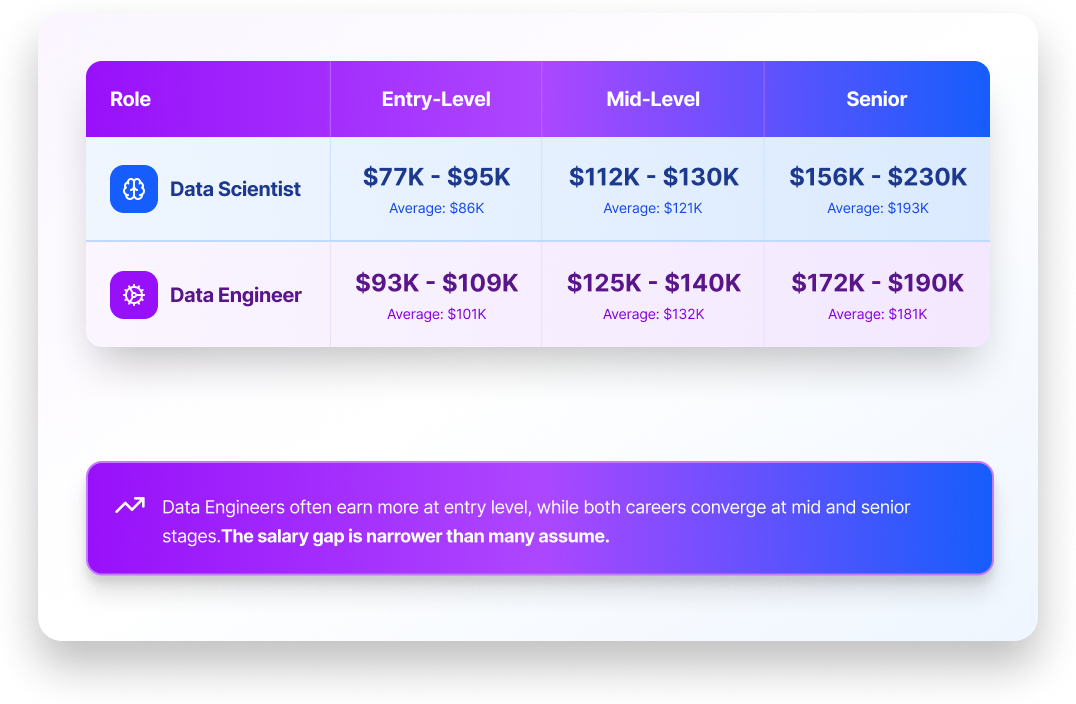
Sources: Glassdoor (2025), Indeed (2026), BLS (2024)
The Bureau of Labor Statistics reports a median data scientist salary of \$112,590 as of May 2024. Glassdoor estimates pay for both roles in the low six figures, with senior positions well above that.
Location significantly impacts these numbers. Tech hubs like San Francisco, Seattle, and New York pay 20-40% above national averages. Remote roles have somewhat compressed geographic premiums, but top-market salaries still skew higher.
The bottom line: salary shouldn't be the deciding factor. Both roles pay well, and your earning potential depends more on your skills, experience, and negotiation than on which title you hold.
Job Market and Career Outlook
Both data science and data engineering offer strong career prospects, with demand continuing to grow across industries.
The Bureau of Labor Statistics projects 34% growth for data scientists in the U.S. from 2024 to 2034, translating to roughly 23,400 new job openings annually. That's significantly faster than the 3% average for all occupations. The World Economic Forum's Future of Jobs Report 2025 ranked "big data specialists" as the #1 fastest-growing job category globally.
Data engineering demand has been particularly strong. Companies have realized that AI and machine learning projects require solid data infrastructure, and they're investing accordingly. This has created abundant opportunities for people entering the field.
What This Means for Career Changers
If you're considering a career switch into data, you're looking at a field with genuine demand. Companies across industries (not just tech) need people who can work with data. Healthcare, finance, retail, manufacturing, and government organizations are all hiring.
The key for career changers is building demonstrable skills. Employers care less about your previous career and more about whether you can do the job. A strong portfolio of projects, completion of a structured learning path, and practical experience (even from personal projects) can open doors.
Many successful data professionals started in completely unrelated fields. We've seen learners transition from teaching, marketing, operations, and countless other backgrounds into thriving data careers. The path exists. It takes work, but it's achievable.
Choosing Based on Market Demand
Both fields offer opportunity, so base your decision on fit rather than trying to predict which market will be "hotter." Data engineering may appeal if you prefer building systems and want skills that transfer easily to other software engineering roles. Data science may appeal if you love analysis and want to work closely with business strategy.
Which Career Is Right for You?
The honest answer: it depends on what kind of work energizes you. Here's a framework to help you decide.
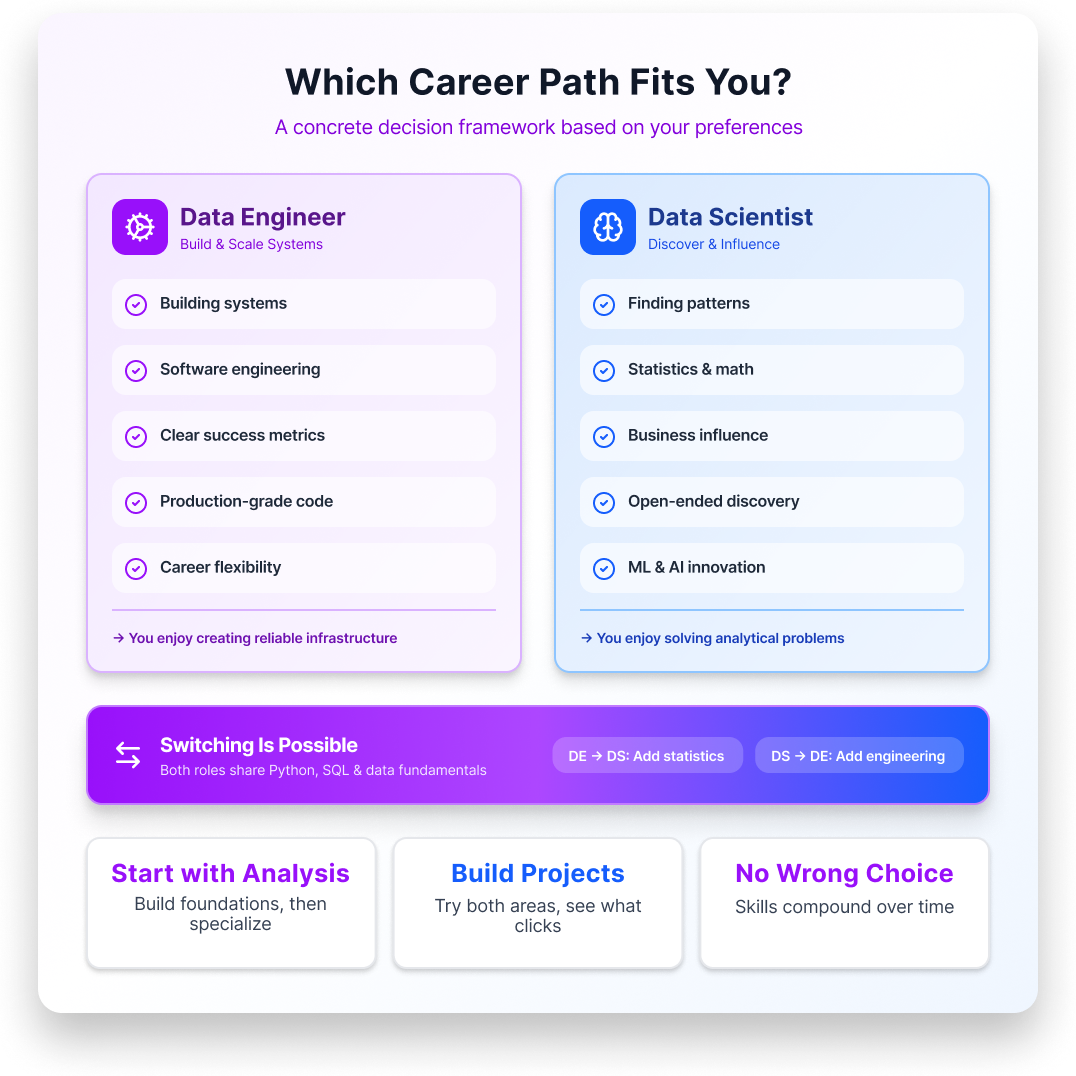
Choose Data Engineering If:
- You prefer building systems over analyzing data. If the idea of architecting a reliable, scalable data pipeline sounds more interesting than interpreting what the data means, DE is likely your path.
- You have (or want to develop) strong software engineering skills. Data engineering is fundamentally a software engineering discipline applied to data. If you enjoy writing clean, tested, production-grade code, you'll feel at home.
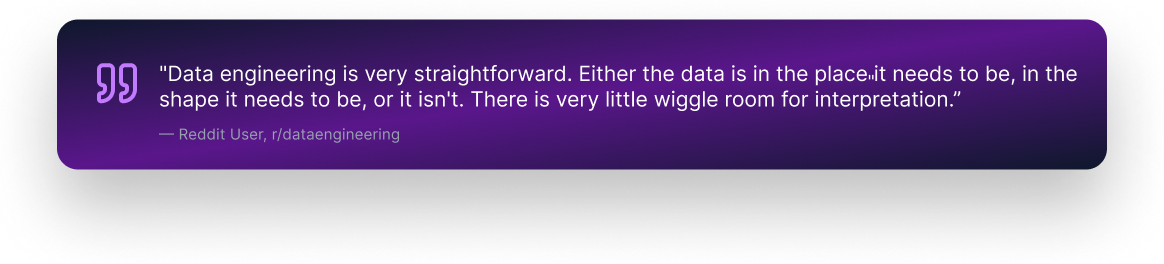
- You want clearer success metrics. In data engineering, success is concrete: the data arrives on time, in the right format, without errors. The systems either work or they don't.
- You're not excited by heavy statistics. One of the most common reasons people choose DE over DS is simply that they prefer building things to analyzing things. That's a valid reason.
- You want flexibility in your data career path. As one engineer noted: "Data engineering is closer to actual software engineering... so if any time I decided to be something else it would not be that difficult."
Choose Data Science If:
- You love finding patterns and telling stories with data. If the investigative aspect of data (asking questions, testing hypotheses, discovering insights) genuinely excites you, data science fits that curiosity.
- You have (or want to develop) strong statistics and math foundations. Probability, linear algebra, and calculus aren't just job requirements. They're the foundation of the work. If you enjoy this kind of thinking, you'll enjoy the role.
- You want to directly influence business decisions. Data scientists often have a seat at the table when strategic decisions get made. If you want your analysis to shape product direction or company strategy, DS offers that proximity.
- You're comfortable with open-ended problems. Data science projects often involve exploration and iteration. If you enjoy the process of discovery, even when the path isn't clear, you'll thrive.
- You're interested in machine learning and AI. If building predictive models and working with cutting-edge ML techniques excites you, data science is the more direct path.
What If You're Still Unsure?
Many successful data professionals started in one role and transitioned to the other. The skills overlap substantially, as both require Python, SQL, and data manipulation abilities. If you choose "wrong," you haven't wasted your time.
One common path: start with data analysis to build foundational skills, then specialize based on what you enjoy. Dataquest also offers a Junior Data Analyst path specifically designed for people starting from zero.
Another option: build projects in both areas and see which work feels more engaging. You'll learn something valuable either way.
Can You Switch Between Data Science and Data Engineering?
Yes, and it happens frequently. The skills overlap enough that transitioning is realistic with focused upskilling.
Moving from DS to DE typically means deepening your software engineering skills: learning to write production-grade code, understanding distributed systems, and getting comfortable with infrastructure and deployment.
Moving from DE to DS means building statistical foundations and machine learning knowledge. You'll already have the programming skills; the gap is usually in statistics, experimentation design, and ML theory.
Many practitioners end up somewhere in between. "ML Engineer" and "Analytics Engineer" roles blend elements of both. Understanding how data flows from source systems through transformations to analytics-ready formats is the core competency.

Our data engineering courses catalog offers more targeted options if you already have some background.
Pick Your Path
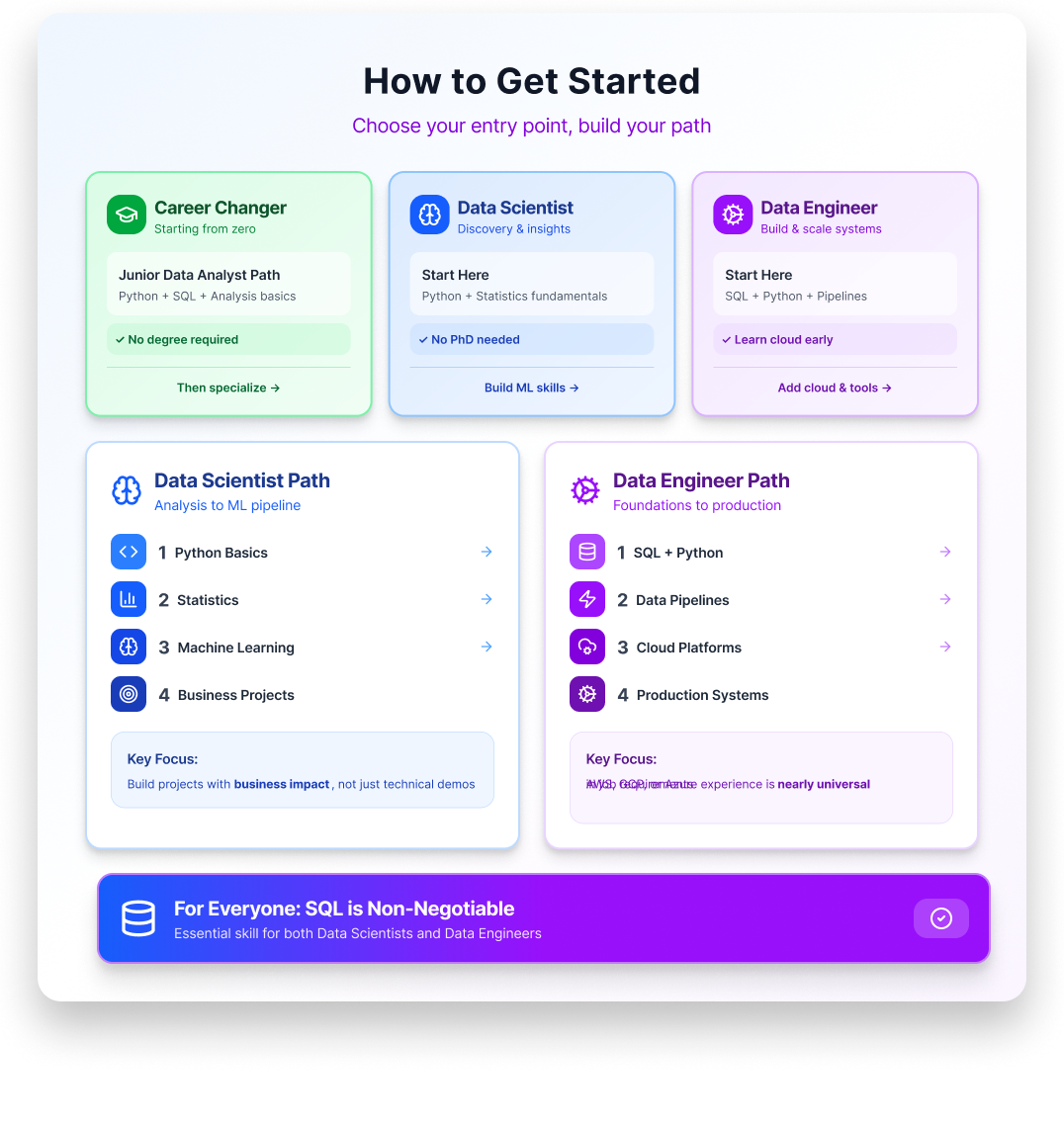
Regardless of which path you choose, certain fundamentals apply to both. The visual below shows how different starting points lead to specialized paths.
For Aspiring Data Scientists
Start with Python and statistics fundamentals. You don't need a PhD to get started, but you do need solid foundations in probability, hypothesis testing, and regression before moving to machine learning.
Dataquest's Data Scientist in Python path covers the progression from Python basics through machine learning and portfolio projects. If you prefer to explore individual topics first, our data science courses catalog lets you pick specific skills to develop. For a complete roadmap, our guide on how to become a data scientist breaks down the full journey.
Build projects that demonstrate business impact, not just technical skill. A churn prediction model is more impressive when you can explain how it would save a company money than when you can only describe the algorithm.
For Aspiring Data Engineers
Start with SQL and Python, then move into data pipeline fundamentals. Understanding how data flows from source systems through transformations to analytics-ready formats is the core competency. If you're wondering whether this path is right for you, our article on why learn data engineering covers the career benefits in detail.
Get comfortable with cloud platforms early. Nearly every data engineering job requires AWS, GCP, or Azure experience. Free tiers let you experiment without cost.
For Career Changers Starting from Zero
If you're new to data and programming, don't feel overwhelmed. Thousands of people make this transition successfully every year.
Start with foundational skills. Our Junior Data Analyst path is designed specifically for beginners and teaches the core skills (Python, SQL, data analysis) that both data scientists and data engineers build upon.
The path from zero to job-ready is real. It requires consistent effort, but you don't need a computer science degree or years of experience to get started. What matters is building skills and demonstrating them through projects.
For Everyone
Regardless of which path you choose, SQL fluency is non-negotiable. Our SQL Skills path provides comprehensive coverage for both roles.
If you want to understand how these roles fit into the broader data landscape (including data analyst positions), our comparison guide on data analyst vs data scientist vs data engineer provides additional context.
Conclusion
Both data science and data engineering offer rewarding careers with strong salaries, interesting problems, and long-term demand. The right choice depends on whether you're drawn to analyzing data or building the systems that make analysis possible.
If you're still uncertain, that's okay. Start learning the foundational skills both roles share (Python, SQL, working with data) and pay attention to which aspects of the work energize you. The data field rewards people who keep learning, and the skills you build now will serve you regardless of which direction you ultimately choose.
Ready to start? Explore Dataquest's data science or data engineering paths, or begin with our Junior Data Analyst path if you're starting from zero.
FAQs
Is data engineering harder than data science?
“Harder” depends largely on your strengths.
Data engineering requires stronger software engineering skills and comfort with distributed systems. Data science requires deeper knowledge of statistics and machine learning.
Many engineers find data engineering more straightforward because success criteria are concrete—pipelines either work or they don’t. Data science often involves more open-ended exploration and experimentation.
The best choice comes down to what type of challenge you enjoy more.
Which pays more, data science or data engineering?
Salaries are generally comparable.
Mid-level roles in both fields often land in the low six figures, with senior positions exceeding $170,000–$200,000.
Your earning potential depends more on your skills, company, and location than on the job title itself.
Can I get into data science or data engineering without a degree?
Yes. While some positions require degrees, many employers prioritize demonstrated skills over credentials.
A strong portfolio of projects, completion of a structured learning path, and the ability to perform well in technical interviews can open doors.
Career changers from non-technical backgrounds successfully enter both fields every year.
Which field is better for career changers?
Both fields are accessible to career changers.
Data engineering may feel more approachable if you already have some programming or technical experience. Data science may feel more natural if you come from an analysis, research, or statistics-heavy background.
In either case, expect to invest 6–12 months of focused learning to become job-ready.
Can I transition from data analyst to either role?
Absolutely.
Data analysts already have foundational skills that transfer well to both paths, including SQL, data manipulation, and business context.
Moving to data science requires adding depth in statistics and machine learning. Moving to data engineering requires adding software engineering fundamentals and infrastructure skills.
Many professionals successfully use data analyst roles as a launchpad into either career.