
10 Best Data Science Certifications in 2026
You're probably researching data science certifications because you know one could help your career. But choosing the right one is genuinely difficult. Dozens of options promise recognition, but few explain which one matters for your specific situation, or whether it's even still possible to earn.
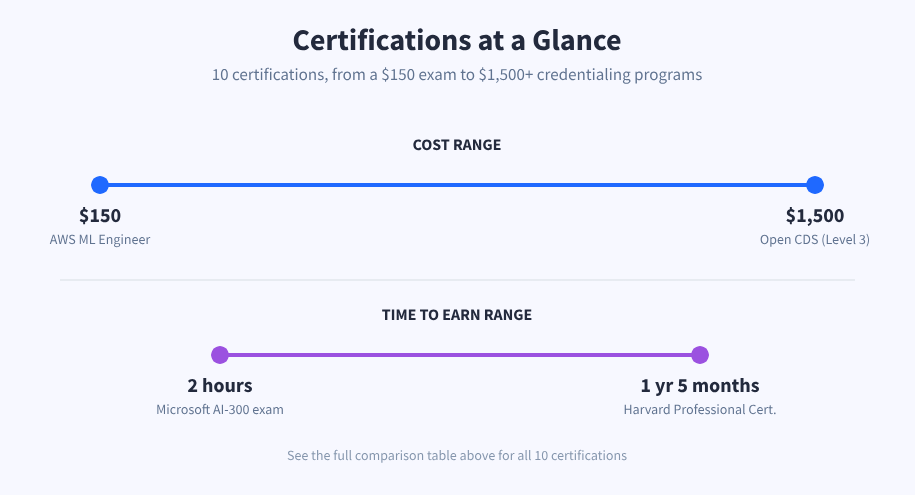
Certification costs range from around $150 for a single exam to over $1,000 for some advanced credentialing programs. Two certifications that showed up on nearly every best-of list through 2025, AWS Machine Learning – Specialty and Microsoft's Azure Data Scientist Associate (DP-100), have both been retired in 2026. If you're studying from an older guide, you could be preparing for an exam you can no longer take.
This guide cuts through that. We compared the best data science certifications for 2026 based on where you are in your career and what you're trying to prove, including what replaced the two that retired this year.
Table of Contents
- All 10 Certifications at a Glance
- Best Certifications for Breaking Into Data Science
- Best Certifications for Cloud and Platform-Specific ML Roles
- Best Certifications for Advanced and Specialized Roles
- How to Choose the Right Data Science Certification
- Starting Your Certification Journey
- Frequently Asked Questions
All 10 Certifications at a Glance
Costs, timelines, and expiration terms below were checked against official provider pages; jump to any row's full review further down for the details.
| Certification | Cost | Time | Level | Validity | Best For |
|---|---|---|---|---|---|
| Dataquest Data Scientist in Python | $49/mo or $588/yr list (often discounted) | ~9 months at 5 hrs/week | Entry | No expiration | Hands-on learners, portfolio builders |
| IBM Data Science Professional Certificate | Coursera subscription (~$49/mo) | 4 months at 10 hrs/week | Entry | No expiration | Beginners who want a recognizable name |
| Harvard Data Science Professional Certificate | $1,481 total | ~1 yr 5 months | Entry–Intermediate | No expiration | Deep stats/R foundation seekers |
| AWS ML Engineer – Associate | $150 per attempt | 130-min exam; prep varies | Intermediate | 3 years | Cloud ML engineering roles |
| Microsoft AI-300 | Varies by region | 120-min exam | Intermediate | 1 year (free renewal) | Azure MLOps and GenAIOps roles |
| Databricks ML Associate | $200 per attempt | Exam only; 6+ months practice recommended | Intermediate | 2 years | Databricks-based teams |
| DASCA SDS | $950 all-inclusive | 100-min exam, 85 questions | Expert | 5 years | Experienced professionals (3–5+ years) |
| SAS AI & ML Professional | Varies by region; $75 for students | Variable (3 prerequisite exams) | Expert | 5 years | SAS-heavy industries (finance, health, gov) |
| Open CDS | $1,100–$1,500 | Variable | Expert | 3 years | Senior practitioners with a project history |
| CAP | $195–$695 depending on level and membership | Variable | Entry–Expert | 3–5 years | Analytics generalists, all career stages |
Best Certifications for Breaking Into Data Science
The certifications below help you build foundational skills and credibility while pursuing your first data science role.
1. Dataquest Data Scientist in Python
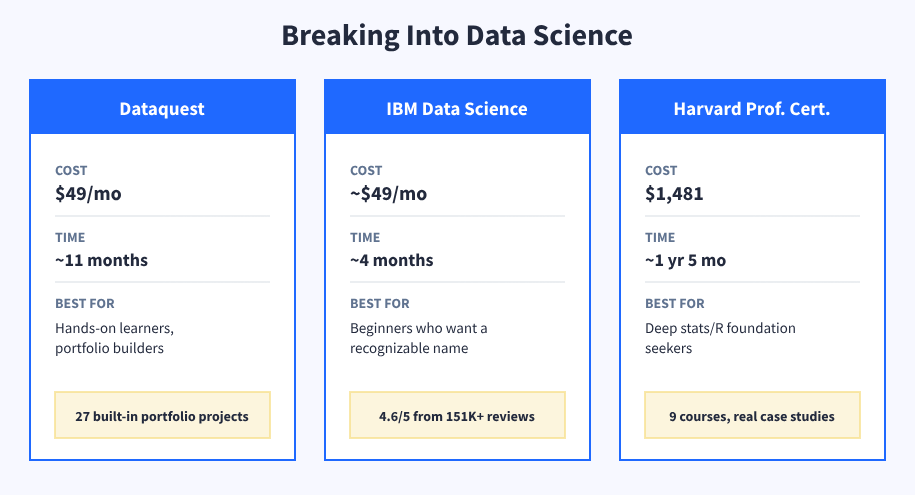
Dataquest's career path teaches data science by having you build real projects with real datasets, in your browser, from the first lesson.
- Cost: $49/month, or $588/year at list price; promotional pricing is often available
- Time: ~9 months at 5 hours per week
- Prerequisites: None. Starts from absolute zero.
- What you'll learn: Python, SQL, pandas and NumPy, data cleaning and visualization, statistics, and machine learning fundamentals
- What this gets you: 27 finished projects you can walk an interviewer through in detail, not just a line that says you took a course
- Validity: No expiration
- Industry recognition: 450,000+ learners enrolled
- Best for: Self-motivated learners who want hands-on practice and a portfolio built in as they learn.
Dataquest's project-based approach means you're building portfolio pieces as you learn, not after you finish. Many learners complete a Dataquest path first, then add a vendor certification like AWS or Microsoft's for platform-specific recognition.
Worth knowing: This is a completion certificate, not a proctored exam. Some employers specifically ask for a named vendor certification, so your portfolio is what does the heavier lifting here.
2. IBM Data Science Professional Certificate
IBM's certificate puts you straight into real tools and guided labs rather than heavy theory.
- Cost: Included with a Coursera subscription (~$49/month)
- Time: About 4 months at 10 hours/week, 12 courses
- Prerequisites: None
- What you'll learn: Python, pandas, NumPy, SQL, Jupyter notebooks, data cleaning, visualization, machine learning fundamentals, and a generative AI module
- Validity: No expiration
- Industry recognition: 4.6/5 on Coursera from over 151,000 reviews
- Best for: Beginners who want a fast, credible starting point with a widely recognized brand.
IBM covers Python, SQL, and basic modeling through short, hands-on tasks. Like Dataquest, it's self-paced, but the individual modules are shorter, so it moves faster if you're putting in consistent hours.
Worth knowing: Several learners report explanations thin out in the later modules, and the certificate alone won't demonstrate the project work employers want to see. Treat it as a starting point, not a finish line.
3. Harvard Data Science Professional Certificate
HarvardX's certificate is a long, structured program built around real case studies rather than toy examples.
- Cost: About $1,481 on Harvard's site (edX sometimes lists it lower, around $1,333)
- Time: Roughly 1 year 5 months across 9 courses
- Prerequisites: None, but comfort learning R is expected
- What you'll learn: R programming, data wrangling, visualization, and core statistics: probability, inference, and linear regression
- Validity: No expiration
- Industry recognition: Strong Harvard brand recognition, though it's course-completion based rather than a proctored exam
- Best for: Learners who want a genuine statistics foundation and don't mind a long runway.
This is closer to a compact academic program than a short certification, building toward modeling through real case studies rather than toy examples.
Worth knowing: Nine courses in R is a serious time commitment, and if your target roles are Python-first, that investment won't transfer as directly.
Best Certifications for Cloud and Platform-Specific ML Roles
Once you have the fundamentals, employers in cloud and ML engineering roles often want proof you can work in the specific platform their team uses.
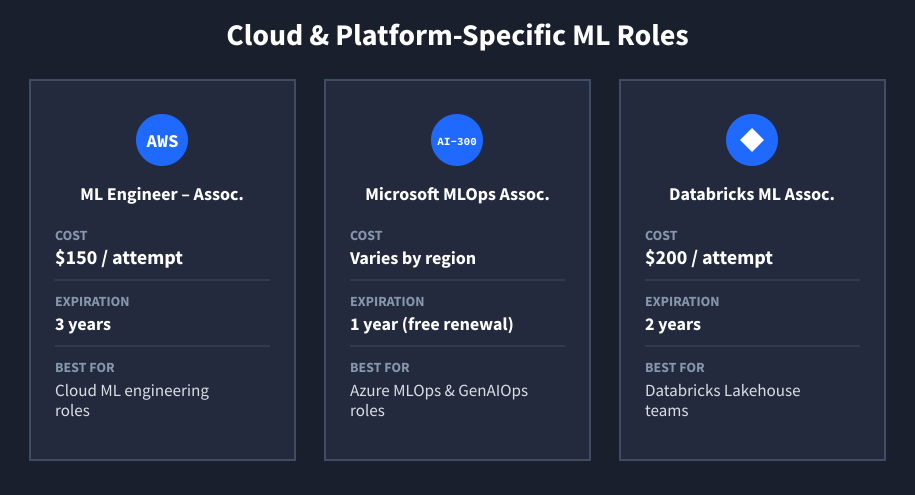
4. AWS Certified Machine Learning Engineer – Associate

This is the current associate-level AWS credential for machine learning work, and the main successor to the retired ML – Specialty (last exam March 31, 2026). AWS frames the Specialty as succeeded by several credentials, including this one, AI Practitioner, and Generative AI Developer – Professional; this Associate targets about 1 year of experience versus the Specialty's 2+.
- Cost: $150 per attempt
- Time: 130-minute exam, 65 questions
- Prerequisites: About 1 year of hands-on experience with Amazon SageMaker recommended
- What it covers: The full ML lifecycle on AWS: data prep, model training and tuning, deployment, and monitoring
- Exam format: Pearson VUE test center or online proctored; passing score of 720/1,000
- Validity: 3 years
- Best for: Cloud engineers and ML practitioners who need to prove they can build and operate production ML systems on AWS.
The Machine Learning Engineer – Associate (MLA-C01) covers similar ground to the old Specialty exam, with a heavier focus on production deployment and MLOps rather than pure algorithm theory.
Worth knowing: MLA-C01 is itself being updated. Registration for MLA-C02 opens September 1, 2026, and the current English-language MLA-C01 retires September 28, 2026. If you're starting prep now, decide quickly whether to sit MLA-C01 before it retires or prepare for the new C02 instead, since you don't have much runway either way.
5. Microsoft Certified: Machine Learning Operations Engineer Associate (AI-300)
This is Microsoft's current Azure machine learning credential, replacing the Azure Data Scientist Associate certification (DP-100), retired June 1, 2026.
- Cost: Priced by the country or region where you sit the exam
- Time: 120-minute exam
- Prerequisites: A data science background with Python experience, entry-level DevOps familiarity, and hands-on knowledge of Azure Machine Learning and Microsoft Foundry
- What it covers: Designing and implementing MLOps and GenAIOps infrastructure, managing the ML model lifecycle, and generative AI quality assurance and optimization on Azure
- Exam format: Pearson VUE test center or online proctored
- Validity: 1 year, with a free online renewal assessment
- Best for: Azure-based ML teams who need a credential focused on operating models and generative AI systems reliably at scale.
AI-300 is now generally available and covers more ground than DP-100 did, adding generative AI operations alongside traditional MLOps.
Worth knowing: If your role is narrowly focused on classic ML, expect some exam content on Foundry and generative AI you may not use day to day.
6. Databricks Certified Machine Learning Associate

This certification proves you can run a basic ML workflow inside Databricks specifically, not machine learning in general.
- Cost: $200 per attempt
- Time: 90-minute exam
- Prerequisites: None required; 6+ months of hands-on Databricks practice recommended
- What it covers: Data prep, feature engineering, model training, and deployment inside Databricks, including AutoML and core MLflow capabilities
- Exam format: Online or test center; ML code in Python, some SQL
- Validity: 2 years
- Best for: Teams already working in the Databricks Lakehouse.
A Professional-level version also exists for more advanced, production-scale ML work, aimed at practitioners with a year or more of Databricks experience.
Worth knowing: This is much less useful as a general-purpose credential if your target employer doesn't run Databricks. Check their stack first.
AWS vs. Microsoft vs. Databricks: Which Should You Choose?
Check your target company's tech stack first. AWS has the largest overall public-cloud footprint, which makes it a common baseline across many industries. Microsoft's certifications matter most in enterprises already running Microsoft 365 and Azure infrastructure. Databricks matters where a company has standardized on the Databricks Lakehouse.
If you're not sure which to start with, AWS is a reasonable general-purpose choice, and the underlying ML engineering skills transfer reasonably well if you later need Azure or Databricks-specific knowledge.
Best Certifications for Advanced and Specialized Roles
If this section is for you, you're not learning data science basics anymore. These certifications serve senior, leadership, and specialized purposes.
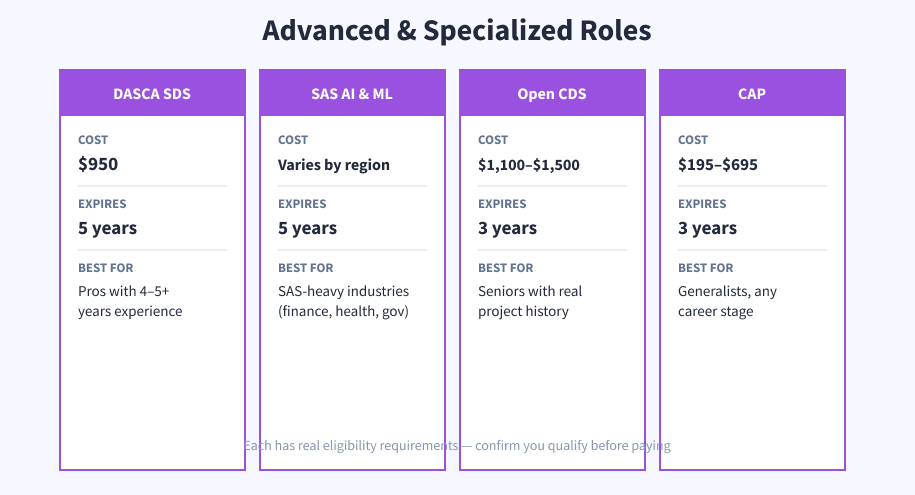
7. DASCA Senior Data Scientist (SDS)
DASCA's SDS is aimed at practitioners who are past entry-level work and want a vendor-neutral credential that reflects that.
- Cost: $950, all-inclusive
- Time: 100-minute exam, 85 questions; DASCA recommends up to 6 months of prep at 8–10 hours/week
- Prerequisites: 3–5 years of applied experience depending on your degree and track, plus a relevant degree
- What it covers: Statistics, exploratory analysis, ML concepts, cloud and big data tools, applied MLOps, generative AI, and recommendation systems
- Exam format: Online, remote-proctored, with a structured study kit and mock exam included
- Validity: 5 years
- Best for: Experienced practitioners who want a credential recognized in enterprise and leadership tracks.
It leans toward business impact and leadership readiness rather than tool-specific syntax.
Worth knowing: The eligibility requirement is real. Standard routes need 3 years (Master's) to 4-5 years (Bachelor's) of applied experience, and DASCA's ExpressTrack can lower that further for grads of recognized institutions. There are also few independent public reviews to weigh against DASCA's own materials.
8. SAS AI & Machine Learning Professional
This is the most traditional analytics path on this list, built for industries where SAS is still part of the core stack.
- Cost: Varies by region; students and educators can register through SAS Skill Builder for Students for $75 per exam
- Time: Variable; requires passing three prerequisite exams first
- Prerequisites: Three separate SAS Certified Specialist credentials: Machine Learning; Forecasting and Optimization; and Natural Language Processing and Computer Vision
- What it covers: Machine learning, forecasting, optimization, NLP, and computer vision using SAS Viya
- Exam format: Online proctored or in-person test center
- Validity: 5 years
- Best for: Practitioners in finance, healthcare, and government, where SAS remains part of the production stack.
If your target employer runs SAS in production, this recognition is specific in a way a general Python credential isn't.
Worth knowing: Getting there takes three separate exams first, so budget time and money accordingly. In a Python-first shop, this credential may carry less weight.
9. Open CDS (Certified Data Scientist)
Open CDS inverts the usual certification model: there's no exam. Instead, you assemble evidence of real project work and defend it to a review board.
- Cost: $1,100 for Level 1; $1,500 for Levels 2 and 3
- Time: Varies by candidate; based on Milestones and a board review, not a timed exam
- Prerequisites: Documented evidence of real data science project work
- What it evaluates: Skills such as business problem framing, methodology selection, model building and testing, and communicating results, assessed against The Open Group's Body of Knowledge rather than a fixed checklist
- Format: Submit five Milestones with project evidence, then present to a peer-review board across three levels: Certified, Master, and Distinguished
- Validity: 3 years
- Best for: Senior practitioners who already have real project history to submit.
That structure is a meaningful part of why it carries weight in enterprise settings, though it also means it isn't accessible without project history behind you.
Worth knowing: This isn't a starting point. It's a way to formalize experience you already have.
10. CAP (Certified Analytics Professional)
CAP tests something most technical certifications skip: whether you can frame a vague business question as an analytics problem and communicate results clearly. INFORMS restructured it in 2025 into three tiers.
- Cost: CAP-Essentials $195 (member)/$275 (non-member), no prerequisites. CAP-Pro $325/$460, no formal prerequisites. CAP-Expert: $55 application fee plus $440/$640 exam fee, requires 2–8 years of experience depending on degree level.
- Time: 3 hours of exam time for any level
- Prerequisites: None for Essentials or Pro; application and experience requirements for Expert only
- What it covers: The INFORMS Analytics Framework's seven domains across all three levels: business problem framing, analytics problem framing, data, methodology selection, model building, deployment, and lifecycle management
- Exam format: Online-proctored or test center, 100 scored multiple-choice questions, vendor-neutral
- Validity: Essentials and Pro: 5 years, recertify by retesting. Expert: 3 years, recertify via Professional Development Units.
- Best for: Analytics generalists from early-career (Essentials) through senior leadership (Expert).
The older aCAP credential stopped accepting new applicants in June 2025. Existing aCAP holders keep their credential and can apply for CAP-Expert if they meet its requirements; there's no automatic upgrade.
Worth knowing: These are exam fees, not the separate prep-course fees INFORMS also sells, confirm the current one at registration. CAP is also less of a signal in software-engineering-flavored data science roles, where a cloud ML credential or a strong portfolio carries more weight.
How to Choose the Right Data Science Certification
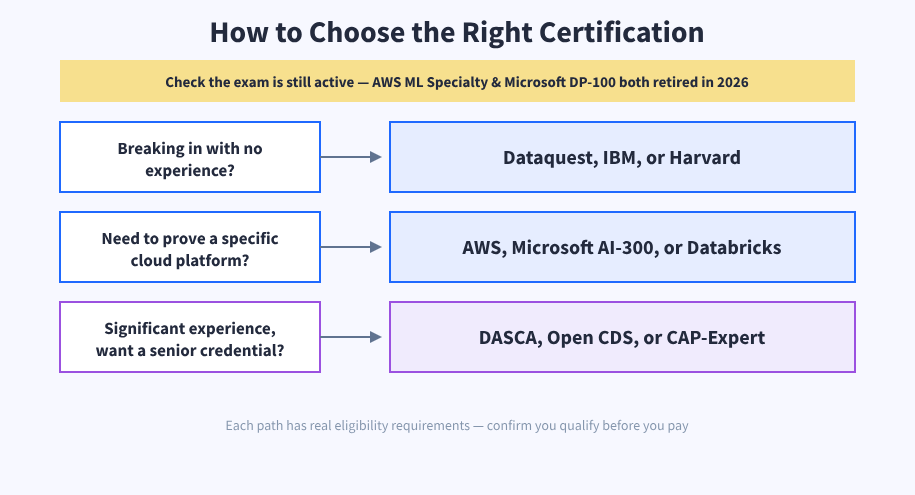
I want to break into data science and land my first role. Look for programs that build both concepts and practical skills, like Dataquest, IBM, or Harvard, but weigh the time commitment carefully: IBM and Dataquest run 4 and 9 months respectively, while Harvard's is closer to a year and a half.
I'm already working with data and need to prove I know a specific cloud platform. AWS, Microsoft's AI-300, or Databricks' ML Associate work better here. Check your current employer's infrastructure first, since that's often the fastest way to know which platform is worth certifying in, then check job postings for target employers too.
I have significant experience and want a credential for senior or leadership roles. DASCA, Open CDS, and CAP-Expert are built for this. Each has meaningful eligibility requirements, so confirm you qualify before paying.
Before you commit, check whether the exam is still active. AWS ML Specialty and Microsoft's DP-100 were both retired in 2026.
Starting Your Certification Journey
Once you've matched a certification to your situation using the guidance above, don't rush the actual work; the learning matters more than the credential itself. Build 2-3 portfolio projects alongside it that demonstrate what you learned, since a certification validates knowledge but a project proves you can apply it. If you want a self-paced way to build that portfolio alongside a certificate, Dataquest's Data Scientist in Python path has one built in from the first lesson.
Frequently Asked Questions
Are data science certifications worth it?
They're worth it for structure and skill validation, less so as a hiring guarantee on their own. In our conversations with hiring managers, demonstrated project work mattered more than certifications. A certification that includes real projects is worth more than one that's exam-only.
What happened to the AWS Machine Learning – Specialty certification?
It was retired on March 31, 2026. Anyone who earned it before that date keeps it active for its normal 3-year validity, but it can no longer be newly earned. The main successor is the AWS Certified Machine Learning Engineer – Associate (MLA-C01), which targets about a year of hands-on experience rather than the Specialty's 2+ years, and shifts the focus toward production deployment and MLOps over pure algorithm theory. AWS also frames AI Practitioner and Generative AI Developer – Professional as related successor paths, depending on which skills you're proving.
What happened to Microsoft's DP-100 certification?
Microsoft retired DP-100 and the Azure Data Scientist Associate certification on June 1, 2026. The replacement is AI-300, leading to the Machine Learning Operations Engineer Associate certification, now generally available.
Do I need a certification to become a data scientist?
No. A certification can accelerate structured learning, but employers hire based on demonstrated skills and project work, not credential count. Many working data scientists have no formal certification and got hired on a strong portfolio instead.
Do I need a degree to become a data scientist?
Not always. Several certifications on this list (Dataquest, IBM, Databricks, AWS, Microsoft) have no degree requirement at all. Where degrees matter is at the higher-eligibility tiers: DASCA's SDS and CAP-Expert both factor your degree level into how much work experience you need, and Harvard's certificate assumes college-level academic pacing even though it has no formal prerequisite.
Which data science certification is best for beginners?
Dataquest and IBM's certificate are both built for zero prior experience, and both are self-paced. Dataquest leans on hands-on projects throughout; IBM leans on name recognition and shorter individual modules.
Which certification is best if I already work with data?
AWS's Machine Learning Engineer – Associate, Microsoft's AI-300, and Databricks' ML Associate all assume some hands-on platform experience. DASCA's SDS goes further, requiring 3-5 years of applied experience depending on your degree and track.
How long do data science certifications stay valid?
Dataquest, IBM, and Harvard's certificates don't expire. Vendor cloud certifications (AWS, Microsoft, Databricks) typically run 1-3 years. DASCA and Open CDS run 3-5 years, and CAP splits by tier: 5 years for Essentials and Pro, 3 years for Expert. Check renewal terms before you commit, since some require a paid re-exam and others offer a free renewal assessment.
