
11 Best Data Science Bootcamps in 2026
If you're searching for the best data science bootcamps, you're probably trying to answer one question: will this actually get you hired, or is it a waste of money?
Bootcamp landing pages are good at telling you about real projects, mentors from top companies, and career support. They're less forthcoming about how current the curriculum is, what that support actually involves, and what a job guarantee's fine print asks of you. That gap is usually what separates a bootcamp that pays for itself from one that doesn't.
The U.S. Bureau of Labor Statistics projects 34% job growth for data scientists between 2024 and 2034, with a median annual wage of $112,590 as of May 2024, the most recent figures BLS has published. The question is whether a given program gets you there faster than doing it yourself.
To make this easier, we reviewed and compared 11 of the best data science bootcamps and career programs of 2026. Use the comparison table below to scan them at a glance, then read the full reviews for the ones that match your goals.
Table of Contents
- At-a-Glance Comparison
- Top Data Science Bootcamps
- University Data Science Programs vs. Bootcamps
- Before You Enroll in a Data Science Bootcamp
- Frequently Asked Questions
At-a-Glance Comparison
These programs range from a subscription costing a few hundred dollars a year to instructor-led bootcamps costing well over $10,000. Scan the table to narrow your shortlist, then jump to the full reviews using the links in the first column.
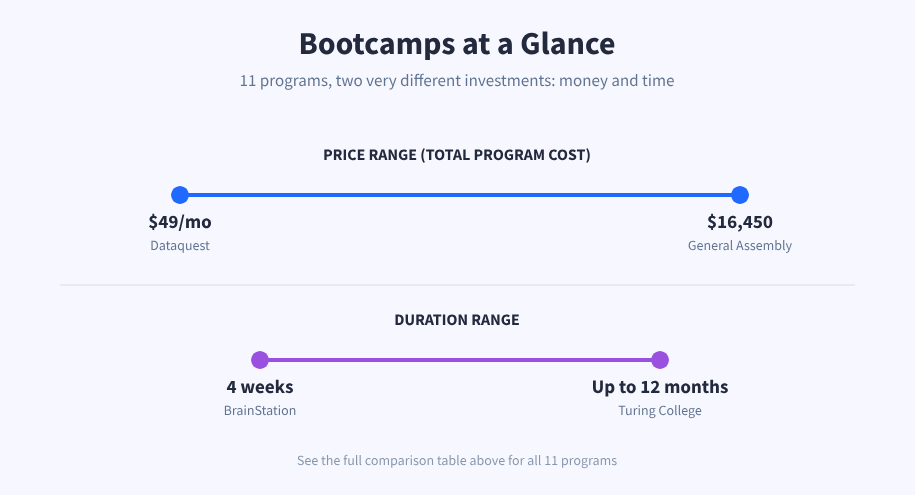
| Bootcamp | Best for | Type | Price | Duration | Format |
|---|---|---|---|---|---|
| Dataquest | Best value | Self-paced platform | Free to start; $49/mo or $399/yr | ~9 months at recommended pace | Online, self-paced |
| BrainStation | A quick, live credential | Live short course | ~$3,750 | 4–8 weeks, part-time | Live online or in-person |
| Le Wagon | In-person learning | Live bootcamp | From €7,900 | 9 wks FT or 24 wks PT | Online or in-person (dozens of locations) |
| Springboard | Mentorship | Self-paced + mentor | $9,900 upfront | ~6 months part-time | Online, self-paced + 1:1 mentor |
| Data Science Dojo | A lower-cost option, once it returns | Discontinued; relaunching self-paced | ~$2,799 (last listed) | 16 weeks | Online |
| General Assembly | Live, career-focused instruction | Live bootcamp | ~$16,450 list price (varies by market) | 12 weeks full-time | Online live or in-person |
| 4Geeks Academy | A job guarantee | Live bootcamp | ~$13,499 (varies by market) | ~18 weeks | Online or in-person, live |
| Turing College | Peer-driven, self-paced study | Self-paced + mentor | €5,400 upfront, or €540/mo × 12 | 8–12 months, flexible | Online, mentor + peer reviews |
| TripleTen | Career changers | Self-paced + tutor | $9,800 (per Course Report) | 8 months part-time | Online, structured platform |
| allWomen | Women exploring data analytics | Self-paced course | €299 | 10 weeks (~30 hours) | Primarily self-paced, with live sessions |
| Imperial College London x HyperionDev | A university-quality-assured credential | Live mentorship program | $6,900–$10,235 (U.S. rate; confirm with admissions) | 12 wks FT or 39 wks PT | Online, live feedback |
Top Data Science Bootcamps
Each entry below covers price, duration, format, and what the curriculum actually includes, along with who the program suits and where it falls short.
1. Dataquest
- Price: Free to start; full access from $49/mo or $399/yr
- Rating: 4.8/5
- Duration: ~9 months at the recommended pace (5 hrs/week)
- Format: Fully online, self-paced, browser-based with instant feedback
- Pros: Considerably less expensive than most live, instructor-led bootcamps; project-first learning; fits around a full-time job
- Cons: No live classes; limited career coaching; progress depends on your own consistency
Key Features:
- Python, SQL, and machine learning fundamentals, taught step by step
- 38 courses and 27 guided projects featuring hands-on coding directly in your browser
- Beginner-friendly, no prior coding experience required
Dataquest's Data Scientist in Python path runs entirely in your browser: you write Python code, get instant feedback, and work through hands-on projects using tools like pandas, Matplotlib, and scikit-learn.
Dataquest is a self-paced platform rather than a cohort bootcamp, which is the point for a lot of people. It covers the same foundational technical skills as the programs below at a fraction of the price, on your own schedule, with no application or start date to wait for.
2. BrainStation Data Science Certification
- Price: Approximately $3,750 (confirm current tuition directly with BrainStation)
- Rating: 4.7/5
- Duration: 4–8 weeks, part-time (8 evening sessions or 4 weekend-day sessions)
- Format: Live online, with New York, Toronto, and London cohorts (check current start dates)
- Pros: Short, live, and taught by working practitioners; flexible scheduling
- Cons: Not a full career-change bootcamp on its own; less depth than longer programs on this list
Key Features:
- Python for data science, hands-on projects, and core data tools
- Live instruction from industry professionals, online or at a BrainStation campus
- Data Scientist Certification (DSC™) upon completion
BrainStation's Data Science Certification is a short, live, part-time course rather than a full multi-month bootcamp. Sessions run over 4 to 8 weeks, either as evening classes or weekend days, and cover Python and core data science tools through applied, project-based sessions taught by working practitioners.
This is a strong fit if you want a fast, credentialed introduction taught live. It's also a low-risk way to test whether data work suits you before committing to a program that costs three or four times as much.
3. Le Wagon

- Price: From €7,900, varies by campus and format (Le Wagon does not publish tuition; confirm with your campus)
- Rating: 4.9/5
- Duration: 9 weeks full-time or 24 weeks part-time
- Format: Online or in-person across dozens of global locations
- Pros: Strong international alumni community; curriculum updated for GenAI
- Cons: Not for complete beginners, since Le Wagon points those learners to its Data Analytics bootcamp instead; expects full-time hours for nine straight weeks
Key Features:
- Data analysis, machine learning, and deep learning with TensorFlow and Keras
- Modules on LLMs, RAG, and reinforcement learning, added in the 2025 curriculum update
- Prep work in Python, SQL, and math is recommended or required before class starts
Le Wagon runs like a real classroom. Sessions are live, days follow a clear schedule, and pair work is part of daily life, which keeps you out of the isolation that often derails self-paced study. It's offered both online and in person across dozens of campuses, which is the main reason it earns the in-person distinction here.
The pace is fast and assumes basic coding comfort going in; this isn't the best fit for a true first-time coder. If you learn better alongside other people and want a global alumni network behind you afterward, the intensity works in your favor rather than against it.
4. Springboard
- Price: $9,900 upfront (monthly and deferred options available)
- Rating: 4.6/5
- Duration: ~6 months part-time (20–25 hrs/week)
- Format: Online, self-paced with weekly 1:1 mentor calls
- Pros: Personal mentor with weekly calls; published outcomes; flexible pace
- Cons: Expensive relative to similar self-paced programs; refund requires a weekly application quota and US or Canada work authorization
Key Features:
- Multiple hands-on projects and capstone work that produce a portfolio you can bring to job applications
- Weekly 1:1 calls with a mentor working in the field
- Tuition-back guarantee for graduates who meet program and job-search requirements
Springboard pairs a self-paced curriculum with accountability built in: a dedicated mentor who checks in weekly. Springboard's own outcomes report shows 93.2% of graduates it classifies as job-qualified received an offer within 12 months. Two caveats matter: the figure is self-reported rather than independently audited, and "job-qualified" counts only graduates who met every guarantee condition, so it describes a filtered group rather than everyone who enrolled. Springboard's most recent published outcomes cover through 2024.
The guarantee sounds simple on the landing page but comes with conditions, read the actual terms rather than assuming it's a no-questions-asked refund. Refund eligibility requires on-time completion of every course requirement, core project, and career development task, plus a minimum number of qualifying job applications per week during the search, plus US or Canada work authorization for two years after graduating.
5. Data Science Dojo
Note: Data Science Dojo has discontinued this bootcamp. Its site says: "Currently, this bootcamp is discontinued. We plan to relaunch it this year in a self-paced format." Check for the relaunch date before planning around it.
- Price: Approximately $2,799 for the 16-week remote program when it was last listed on Course Report; relaunch pricing hasn't been announced
- Rating: 4.9/5
- Duration: 16 weeks in its last remote format
- Format: Online; the relaunch is planned as self-paced rather than instructor-led
- Pros: Lower price than most bootcamps here; broad curriculum spanning analysis through big data
- Cons: Not currently enrollable; limited job placement support; not ideal for complete beginners
Key Features:
- Data wrangling, visualization, predictive modeling, and deployment in Python
- Text analytics, recommender systems, and A/B testing
- Big data engineering with Hadoop and Spark
Data Science Dojo sat at the budget end of this list, covering exploratory analysis, feature engineering, tree-based models, and clustering through to big data tooling. It's worth watching if price is your binding constraint, but you can't enroll today.
The tradeoff for the lower price was always thinner career support than the bigger-name bootcamps, and a self-paced relaunch is unlikely to change that. This suits you better if you already have some technical footing and mainly want structured content, not job-search hand-holding.
6. General Assembly
- Price: List tuition has been around $16,450, though pricing varies by market and cohort; confirm current tuition directly
- Rating: 4.3/5
- Duration: 12 weeks full-time
- Format: Online live or in-person at select campuses
- Pros: Hands-on projects with company data; long-established global alumni network
- Cons: Fast-paced; positioned as intermediate, not zero-experience
Key Features:
- Python, statistics, and machine learning with NumPy, pandas, scikit-learn, and TensorFlow
- Modules on neural networks, NLP, and generative AI
- Full-workflow capstone from problem definition to final presentation
General Assembly leans into live instruction and a large, well-established alumni network, the kind of program where the community and career connections are as much a part of the value as the curriculum itself. Applicants are expected to have some foundational data or programming experience; this isn't positioned as a zero-experience course.
Twelve weeks full-time is a compressed timeline, so expect some topics to move quickly. It works best for learners who already have some technical footing and want momentum toward a career change.
7. 4Geeks Academy

- Price: Around $13,499 (Course Report lists this for 4Geeks' AI and Machine Learning Engineering track; 4Geeks doesn't publish pricing for the Data Science and ML program, so confirm directly)
- Rating: 4.8/5
- Duration: ~18 weeks
- Format: Live online or in-person (multiple campuses across the Americas and Europe)
- Pros: Unlimited 1:1 mentorship; structured job guarantee program
- Cons: Support quality varies by campus and mentor; the job guarantee is an add-on rather than standard, and the refund requires passing the admissions test and completing every career development step
Key Features:
- Python, data collection, cleaning, and modeling with pandas and scikit-learn
- Machine learning and AI: decision trees, KNN, and neural networks in TensorFlow
- Final project: build and deploy your own ML/AI model
4Geeks offers a job guarantee you add to an eligible program, promising a full tuition refund if you aren't hired within nine months of graduation. Eligibility rests on four conditions: work authorization in your own country, completing all program requirements, passing the admissions logic test, and following the full career development process. Unlike most guarantees here, it isn't restricted to the US, but read the actual terms before counting on it as a safety net.
Mentorship is positioned as unlimited rather than scheduled, with a 1:7 instructor-to-student ratio advertised on its current program page. It's also the thing students single out most often in Course Report reviews, where the mentors' availability comes up repeatedly.
8. Turing College

- Price: €5,400 upfront, or €540/month for 12 months
- Rating: 4.9/5
- Duration: 8–12 months, flexible (15+ hours/week recommended)
- Format: Online, self-paced with mentor and peer review
- Pros: Adaptive learning platform; business-problem capstones; mentors from the field
- Cons: Demands strong self-management; no fixed daily classroom cohort
Key Features:
- Python, data wrangling, and statistical inference, starting from the ground up
- Supervised and unsupervised machine learning, with a computer vision or NLP specialization track
- Up to 15 hands-on projects plus a capstone modeled on a business problem
Turing College replaces daily live classes with structured deadlines, mentor check-ins, and peer review: you submit work and get feedback from people, not just an automated grader, without being tied to a fixed schedule. Turing College reports a 97% employment rate among job-qualified graduates within six months, per its own site (self-reported). As with Springboard's figure above, "job-qualified" counts only graduates who met every program requirement, so it describes a filtered group rather than everyone who enrolled.
It expects you to manage your own pace without much hand-holding. For learners who want flexibility around work or family and are comfortable driving their own progress, that tradeoff can be worth it.
9. TripleTen

- Price: $9,800 upfront per Course Report (TripleTen doesn't publish tuition; installment plans available)
- Rating: 4.8/5
- Duration: 8 months, part-time
- Format: Online, structured platform with tutor support
- Pros: Regular 1-on-1 tutoring; structured portfolio projects; open to non-STEM backgrounds
- Cons: Fast pace for those with little prior experience; refund requires US residency and completion of the full career program
Key Features:
- Python, statistics, and ML basics, moving into neural networks, NLP, and computer vision
- Structured portfolio projects plus a final capstone
- Optional externships with partner companies
TripleTen is built specifically for people switching careers with no STEM background: the program starts with the fundamentals and relies on frequent tutor check-ins rather than assuming prior technical comfort. Its guarantee offers a relevant job within 300 days, or a full tuition refund, provided you complete the program including Career Prep and Career Acceleration, actively apply to relevant roles, stay in contact with your career coach, and are a US resident.
The externship option sets TripleTen apart: it's one of the few ways on this list to get something closer to on-the-job experience before you've actually been hired anywhere.
10. allWomen Data Analytics Foundations

- Price: €299
- Rating: 4.9/5
- Duration: 10 weeks, approximately 30 hours of content
- Format: Primarily self-paced, with live expert sessions and mentor feedback
- Pros: Supportive, women-focused instruction; low weekly time commitment; practical final project
- Cons: Lighter career support than a full live bootcamp; covers data analytics fundamentals only, not the full data science stack
Key Features:
- Python, data analysis, and data visualization fundamentals across five self-paced modules
- Live expert sessions and mentor feedback alongside the self-paced material
- Practical assignments and an optional final project
allWomen's Data Analytics Foundations is a 10-week, roughly 30-hour course: primarily self-paced, with live expert sessions and mentor feedback layered on top. It's built for women starting from zero in coding who want an exploratory, lower-time-commitment way into data analytics, taught by instructors who work in data and AI themselves.
11. Imperial College London x HyperionDev
- Price: $6,900 upfront (U.S. rate, may be a limited-time discount), or $10,235 in installments; the site currently advertises "from £290 per month," so confirm US pricing with admissions
- Rating: 4.5/5 (reflects HyperionDev's programs broadly on Course Report, not this Imperial-specific bootcamp)
- Duration: 12 weeks full-time (35–40 hrs/week) or 39 weeks part-time (10–20 hrs/week)
- Format: Online, live feedback and mentorship
- Pros: Quality-assured by Imperial College London; daily code review; suitable for true beginners
- Cons: Non-credit certificate, not an Imperial degree; smaller peer community than larger bootcamps
Key Features:
- Python, probability, statistics, and machine learning with NumPy, pandas, and scikit-learn
- Daily code reviews and mentor feedback
- Continued career support and alumni resources after your course
The certificate is issued by HyperionDev and quality assured by Imperial College London, which reviews the curriculum. It isn't an Imperial degree or a formally accredited qualification, and it doesn't carry academic credit.
For true beginners, the combination of a short timeline (as little as 12 weeks if you go full-time) and daily feedback is a meaningfully different experience than the mostly self-directed pace of longer programs on this list. The part-time route is the longer commitment it appears to be: 39 weeks works out to roughly nine months.
University Data Science Programs vs. Bootcamps
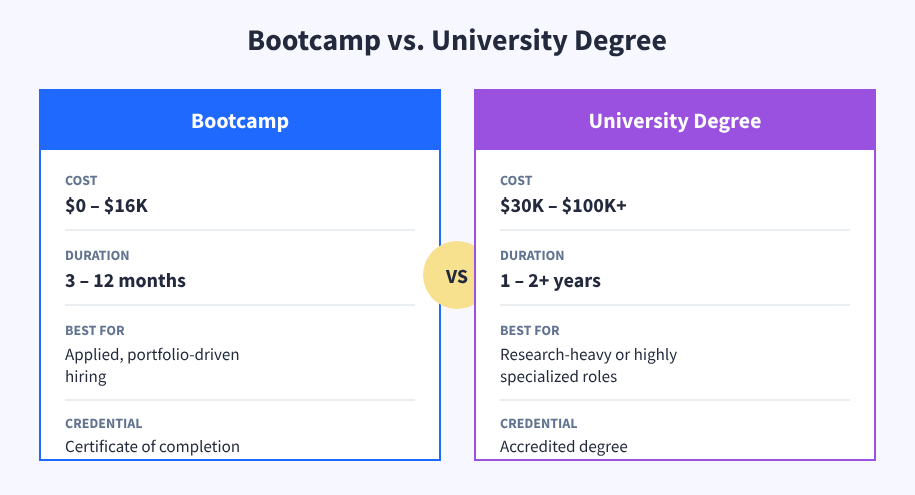
You'll find data science programs connected to well-known universities. How closely the university is actually involved varies by program, so it's worth checking who designs the curriculum, who delivers it, who issues the certificate, and whether it carries academic credit before assuming the university name means the university runs things day to day.
Whether a graduate degree is better than a bootcamp depends on the job you want. Research and highly specialized data science roles, especially at large tech companies and research labs, often prefer candidates with a master's or PhD. Many applied data, analytics, and entry-level technical roles focus more on your skills, projects, and experience than on having a graduate degree, but every employer is different.
If you're not sure which path you need, look at job postings for the roles you want. They'll tell you far more than assuming a degree or bootcamp is always the right choice.
Before You Enroll in a Data Science Bootcamp
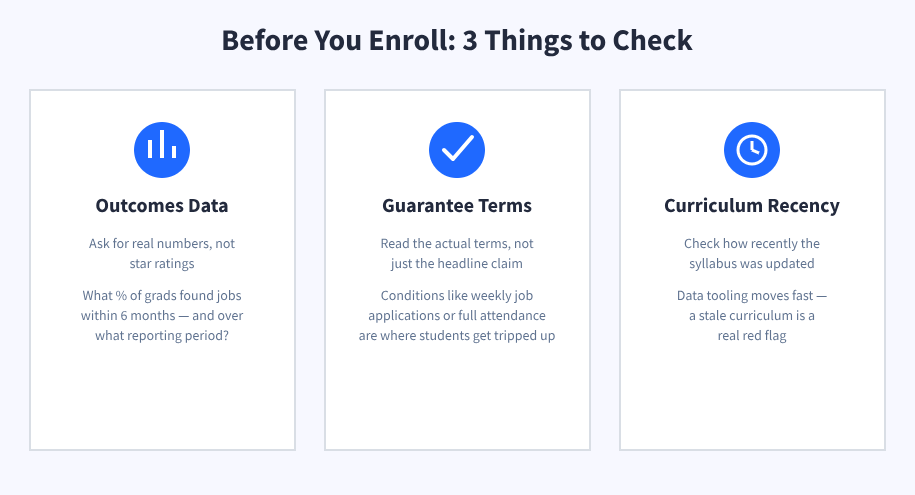
Before spending real money and months of your life on any program, do a reality check. Ask for outcomes data more specific than star ratings: what percentage of recent graduates found relevant jobs within six months, and over what reporting period?
Read the actual terms of any job guarantee or refund policy, not just the headline claim, since the conditions (weekly job applications, full attendance, every assignment on time) are usually where students get tripped up. It's easy to miss that job guarantees are often restricted by location. Springboard and TripleTen both require US work authorization or residency, so if you're outside the US the guarantee may not apply to you even though the program does. 4Geeks is the exception here: it asks for work authorization in your own country rather than the US specifically.
Check how recently the curriculum was updated, since data science tooling moves fast enough that a syllabus from a few years ago is a red flag.
If you want to find out whether self-paced learning works for you before spending bootcamp money, that's what we built Dataquest for. Start with our free projects, try the Data Analyst path if you want to start smaller, or go straight to the Data Scientist in Python path. And if you're still weighing self-paced courses against a bootcamp more generally, our best data science courses roundup is a useful next stop.
Frequently Asked Questions
Is a data science bootcamp worth it?
For many career changers, yes. A good bootcamp compresses months of self-study into a structured program with feedback, deadlines, and career support, and typically costs a fraction of a graduate degree.
The trade-off is that outcomes vary a lot by program and by how much effort you put in. If you're self-motivated and budget-conscious, a cheaper self-paced path can get you most of the way there before you commit to a full bootcamp price tag.
How much does a data science bootcamp cost?
Programs on this list run from around €299 for a short introductory course like allWomen's, up to roughly $16,450 for a full live bootcamp like General Assembly. Self-paced platforms sit near the bottom of that range, and most full bootcamps fall between $3,750 and $13,500. Many providers offer installment plans, income-based financing, or a job guarantee that ties part of the cost to your outcome. Check the at-a-glance table above for exact figures by program.
How long do data science bootcamps take?
Most run 3 to 9 months depending on pace.
- Full-time programs typically finish in 3 to 4 months
- Part-time or self-paced programs often take 6 months to a year
- How much project work you do outside class also affects how job-ready you actually feel at the end
Which data science bootcamps offer job guarantees?
Three programs on this list currently offer one: Springboard, 4Geeks Academy, and TripleTen. Each has different conditions and windows. Springboard requires US work authorization and a weekly job-application quota, 4Geeks sells the guarantee as an add-on and requires work authorization in your own country plus passing its admissions test, and TripleTen requires US residency and gives you 300 days. Read the specific terms before treating any guarantee as a given.
Do I need a math or statistics background to start?
Not always, but not never, either. Several programs on this list, including General Assembly and some Le Wagon cohorts, expect prior technical knowledge and are positioned as intermediate. Turing College can accept learners without coding experience, but applicants may need to complete preparatory Python coursework and should be comfortable with high school-level math. If you're a true beginner, look specifically for programs that say so.
Is a master's degree better than a bootcamp for data science?
It depends on the role. Research-heavy or highly specialized data science roles, especially at large tech companies or labs, often still favor a master's or PhD. Some applied analyst and product-facing data roles accept bootcamp graduates or self-taught candidates who can demonstrate skills through a strong portfolio, but this varies by employer.
Check job postings for your specific target roles rather than assuming either path is required across the board.
What do data science bootcamp graduates earn?
Numbers vary by program, but at least one is citable: TripleTen's 2024 Outcomes Report puts the median salary for its data science graduates at $89,300, against a $76,600 median across all its bootcamps. For broader context, the U.S. median annual wage for data scientists overall, covering all experience levels rather than just new graduates, was $112,590 as of May 2024, according to the Bureau of Labor Statistics. Most bootcamp graduates start below that figure and grow into it over the following years, and your actual outcome depends on location, prior background, and the specific role you land.
What jobs can you get after a data science bootcamp?
Common target roles include data analyst, junior data scientist, business intelligence analyst, and analytics associate, with some graduates moving into junior machine learning or data engineering roles, depending on their curriculum and prior technical background.
A strong portfolio and the ability to explain your work in interviews can matter at least as much as the program's name, especially for entry-level roles.
