

Best Data Science Programs in 2026
Searching for the best data science programs means sorting through university degrees, bootcamps, online platforms, and professional certificates, each claiming to be the fastest path to a data science career. The options range from free YouTube tutorials to \$100,000+ master's degrees, and most comparison articles flatten them into one list without explaining which type actually fits your situation.
This guide breaks down every major category side by side, with honest trade-offs, real costs, and a decision framework that matches programs to where you are right now. Whether you're exploring from scratch or choosing between a bootcamp and a degree, you'll know which direction to go by the end.
Table of Contents
- Top Picks by Goal
- Types of Data Science Programs
- Top University Degree Programs
- Top Data Science Bootcamps
- Top Online Learning Platforms
- Top Professional Certificates
- What Makes the Best Data Science Programs Stand Out
- How to Choose the Best Data Science Program for You
- When You Don't Need a Data Science Program
- Frequently Asked Questions
Top Picks by Goal
Want the short version? Here are the strongest picks for the most common goals:
- Best hands-on platform for beginners: Dataquest Data Scientist in Python
- Best affordable online master's degree: Georgia Tech OMS Analytics
- Best beginner analytics certificate: Google Data Analytics Certificate
- Best bootcamp for career switchers: See our guide to the best data science bootcamps for 18 options ranked
Types of Data Science Programs
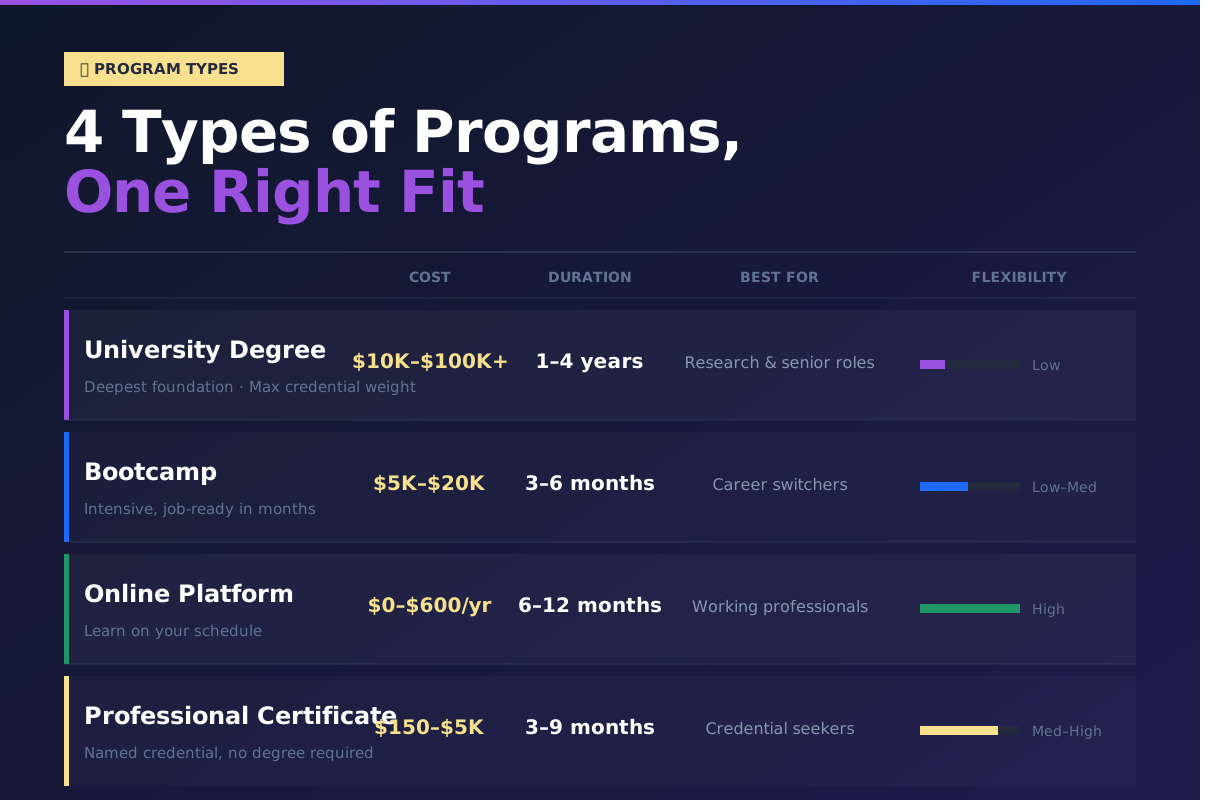
Not all data science programs are built the same way. The four major categories differ in cost, time commitment, depth, and flexibility.
University degrees offer the deepest theoretical foundation, typically costing \$10,000–\$100,000+ and taking one to four years. They carry the most credential weight, especially for research and senior roles.
Bootcamps are intensive programs designed to get you job-ready in three to six months, usually for \$5,000–\$20,000. They work best for career switchers who can commit full-time.
Online learning platforms let you learn on your own schedule for \$0–\$600/year. The trade-off is self-discipline, but for working professionals, the flexibility is hard to match.
Professional certificates sit between a short course and a degree, typically \$150–\$5,000 over three to nine months. They add a recognized name to your resume without requiring a full degree commitment.
Each section below covers three strong picks within each category.
Top University Degree Programs
University programs make the most sense if you're targeting research, academia, senior roles, or industries that require formal credentials. These three online master's programs offer strong data science training with more flexibility than traditional on-campus programs.
1. Georgia Tech OMS Analytics
- Cost: Under \$12,000 total
- Time: 2–3 years (flexible pacing)
- Format: Fully online, same curriculum as on-campus
- Prerequisites: Bachelor's degree; quantitative and programming background recommended
Why it works: Georgia Tech describes OMS Analytics as a top-5 nationally ranked data science and analytics program. It draws from three of Georgia Tech's top-ranked colleges (Computing, Engineering, and Scheller Business), covering machine learning, statistical modeling, optimization, and business analytics. At under \$12,000 total, it's one of the most affordable top-tier master's options available.
Worth knowing: This is an analytics-focused program, not a pure computer science degree. It leans toward modeling, statistical analysis, and decision science rather than software engineering or data infrastructure. Admissions are competitive, and the coursework is rigorous.
2. UT Austin MS in Data Science
- Cost: Around \$10,000 total
- Time: 1.5–3 years (flexible pacing)
- Format: Fully online via edX
- Prerequisites: Bachelor's degree; demonstrated knowledge of math and programming; MSDS Quest Assessment
Why it works: UT Austin's program is jointly sponsored by the Department of Statistics and Data Sciences and the Department of Computer Science, giving it a dual technical foundation. Students can tailor coursework across areas like reinforcement learning, health-focused data science, and machine learning. At roughly \$10,000 total, it's among the most affordable accredited online data science master's programs.
Worth knowing: The program is delivered through edX but created and supervised by UT Austin faculty. The Quest Assessment is a unique admissions requirement; it tests quantitative and programming readiness in lieu of standardized test scores.
3. UC Berkeley Master of Information and Data Science (MIDS)
- Cost: Approximately \$82,096 total
- Time: 1–2.5 years (accelerated, standard, or decelerated paths)
- Format: Fully online with live sessions
- Prerequisites: Bachelor's degree; programming experience; statistics background
Why it works: Berkeley's MIDS program combines data engineering, machine learning, and data ethics with a required capstone project. The Berkeley brand carries significant weight in hiring, particularly at West Coast tech companies. The program offers accelerated, standard, and decelerated pacing, so working professionals can adjust the timeline.
Worth knowing: At approximately \$70,000, this is significantly more expensive than Georgia Tech or UT Austin. The investment makes the most sense if the Berkeley network and brand value are strategically important for your career targets. If affordability is the priority, the other two programs deliver strong outcomes at a fraction of the cost.
Top Data Science Bootcamps
Bootcamps work best for career switchers who need job-ready skills fast. These three represent different strengths. For a deeper comparison, our guide to the best data science bootcamps covers 18 programs in detail.
1. Le Wagon Data Science & AI Bootcamp
- Cost: Varies by location
- Time: 9 weeks full-time or 24 weeks part-time
- Format: Online or on 28+ campuses worldwide
- Industry recognition: 4.98/5 on Course Report from 3,778+ reviews
Why it works: Le Wagon combines live instruction, peer collaboration, and a global alumni network of 32,000+ graduates. Recent curriculum updates added modules on LLMs, RAG systems, and reinforcement learning. The in-person format across 27 cities gives it a community advantage that purely online programs can't match.
Worth knowing: The intensity is real, full-time students should expect long hours. Some students felt post-bootcamp job support was inconsistent across campuses.
2. Springboard Data Science Bootcamp
- Cost: Confirm current tuition with Springboard
- Time: ~6 months
- Format: Online, self-paced with weekly 1:1 mentorship
- Industry recognition: 4.6/5 on Course Report from 1,767 reviews
Why it works: Springboard's 1:1 mentorship model pairs you with an industry professional for weekly calls. The capstone project takes a problem from prototype to deployment, which is stronger portfolio evidence than most bootcamp projects. A job guarantee is available (terms apply).
Worth knowing: Self-paced format requires discipline. Mentor quality can vary. The job guarantee has strict eligibility requirements, read the terms before factoring it in.
3. TripleTen Data Science Bootcamp
- Cost: Varies by payment option; recent listings around \$9,800
- Time: 8 months
- Format: Online, part-time, flexible schedule
- Industry recognition: 4.84/5 on Course Report from 529 reviews
Why it works: TripleTen is designed for absolute beginners, including learners without STEM backgrounds. The program includes 20 projects and a money-back job guarantee. Instructor support and code reviews provide more structure than fully self-paced options.
Worth knowing: At 8 months, the pace can feel slow for learners who already have programming experience. The job guarantee has strict requirements. ML is taught as part of a broader data science workflow rather than as a deep specialization.
Top Online Learning Platforms
Online platforms are the most flexible and affordable option. These three offer structured paths rather than random course collections.
1. Dataquest Data Scientist in Python
- Cost: Free to start; full access from \$49/month or \$588/year
- Time: ~11 months at 5 hours per week. 38 courses, 27 projects
- Format: Interactive browser-based, self-paced
- Industry recognition: 4.8/5 from 359 reviews. 446,000+ learners enrolled
Why it works: Dataquest's career path starts from zero coding experience and builds through Python, SQL, statistics, data visualization, and machine learning with 27 guided projects woven throughout. You write code from the first lesson, no passive video lectures. The ML coverage comes after foundational work in Python, SQL, and statistics, which gives learners the context they need before modeling.
Worth knowing: This is a learning platform, not a vendor certification. You'll earn a certificate when you finish, but it's not a proctored exam like AWS or Google Cloud. Think of it as building job-ready skills and a portfolio, while vendor credentials prove knowledge through formal testing. Many learners do both.
2. DataCamp
- Cost: Free tier available; Premium from \$25/month
- Time: Self-paced; career tracks take 3–6 months
- Format: Browser-based, video lessons + coding exercises
- Industry recognition: Widely used in enterprise training; 14M+ learners
Why it works: DataCamp offers a large library of courses across Python, R, SQL, and machine learning, with career tracks that provide a structured sequence. The platform is popular for enterprise teams, so if your company already has a DataCamp subscription, it's a convenient starting point.
Worth knowing: DataCamp's format leans more on short video lessons followed by guided exercises, which can feel more passive than a fully code-first approach. Some learners report that the exercises are too scaffolded and don't build enough independent problem-solving confidence.
3. Coursera Data Science Specializations
- Cost: Free to audit; \$59/month for Coursera Plus (includes certificates)
- Time: Varies by specialization; typically 3–9 months
- Format: Video lectures, quizzes, peer-reviewed assignments
- Industry recognition: University-branded certificates (Johns Hopkins, IBM, Google)
Why it works: Coursera aggregates specializations from universities and companies, so you can choose based on your preferred institution or tool focus. The Johns Hopkins Data Science Specialization and IBM Data Science Professional Certificate are among the most enrolled data science programs online. Free auditing lets you preview content before paying.
Worth knowing: Quality varies across specializations since they're created by different institutions. The video-heavy format can lead to passive watching. Peer-reviewed assignments sometimes have inconsistent feedback quality.
Top Professional Certificates
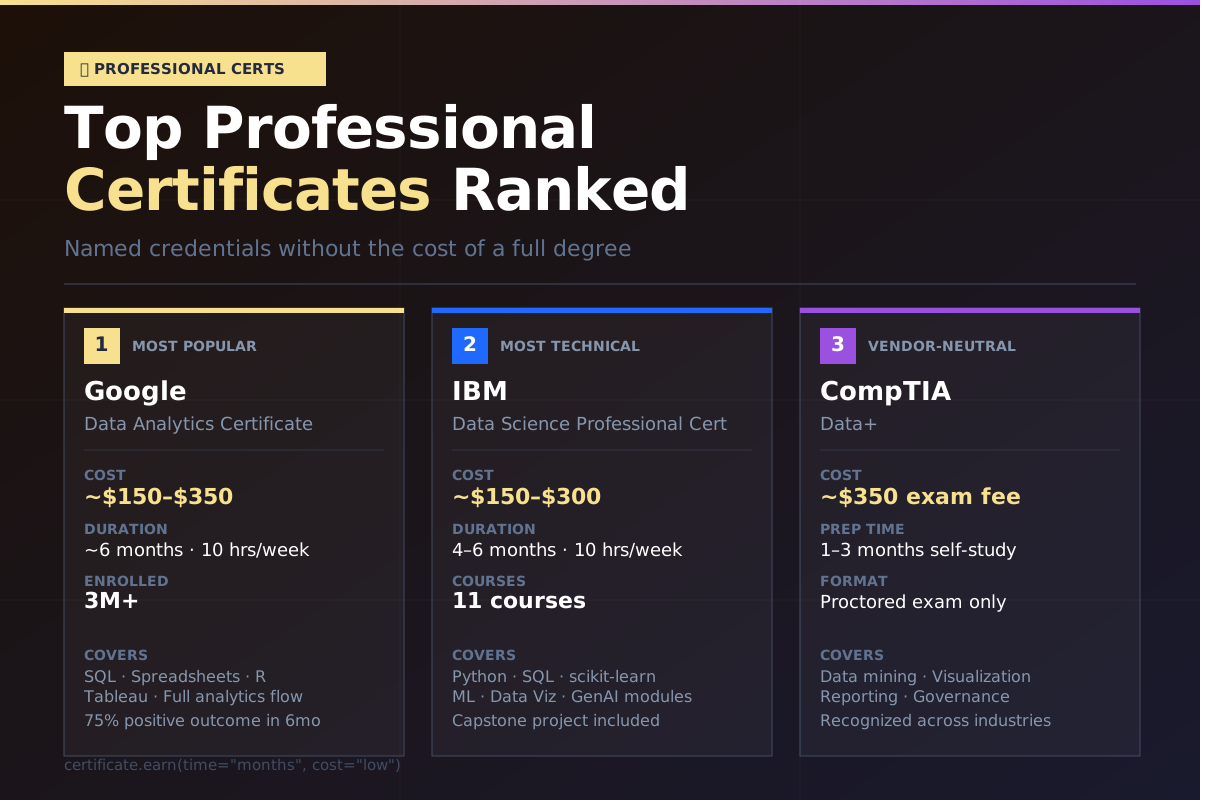
Certificates add a recognized name to your resume without the time or cost of a full degree. These three cover different audiences and skill levels.
1. Google Data Analytics Professional Certificate
- Cost: \$49/month via Coursera in the U.S. and Canada after a 7-day free trial; most learners can complete it for under \$300
- Time: ~6 months at 10 hours per week
- Format: Video + hands-on projects on Coursera
- Prerequisites: None
Why it works: The Google certificate is the most popular entry point into analytics, with over 3 million enrollments. It covers the complete analytics workflow: data collection, cleaning, analysis, and visualization using spreadsheets, SQL, R, and Tableau. Google reports that 75% of graduates report a positive career outcome within 6 months.
Worth knowing: This is an entry-level data analytics certificate, not a full data science program. It covers tools like spreadsheets, SQL, Python, Tableau, and R, but learners aiming for data scientist roles will still need deeper training in statistics, machine learning, and portfolio projects.
2. IBM Data Science Professional Certificate
- Cost: \$49–\$59/month via Coursera (total ~\$150–\$300 depending on pace)
- Time: ~4–6 months at 10 hours per week
- Format: 12 courses on Coursera with hands-on labs
- Prerequisites: None
Why it works: IBM's certificate covers more technical ground than Google's, including Python (pandas, NumPy, Matplotlib), SQL, machine learning with scikit-learn, and data visualization. The 11-course sequence builds toward a capstone project. Recent updates added generative AI modules.
Worth knowing: The learning curve is steeper than Google's certificate. Some courses feel less polished than others. The IBM Cognos Analytics tool taught in the program is less widely used than Tableau or Power BI in most job markets.
3. CompTIA Data+
- Cost: Exam fee ~\$405 (plus optional prep materials)
- Time: Self-study; most candidates prepare in 1–3 months
- Format: Proctored exam (no required coursework)
- Prerequisites: None formally; 18–24 months of data analytics experience recommended
Why it works: Unlike the Google and IBM certificates (which are course completion credentials), CompTIA Data+ is a proctored, vendor-neutral exam that tests your knowledge independently. It covers data concepts, data mining, visualization, reporting, and data governance. The vendor-neutral approach means it's recognized across industries, not tied to one platform.
Worth knowing: This is an exam, not a learning path. If you don't already have a foundation in data analytics, you'll need to study separately before attempting the exam. The certification carries more weight for roles that specifically list CompTIA credentials.
What Makes the Best Data Science Programs Stand Out
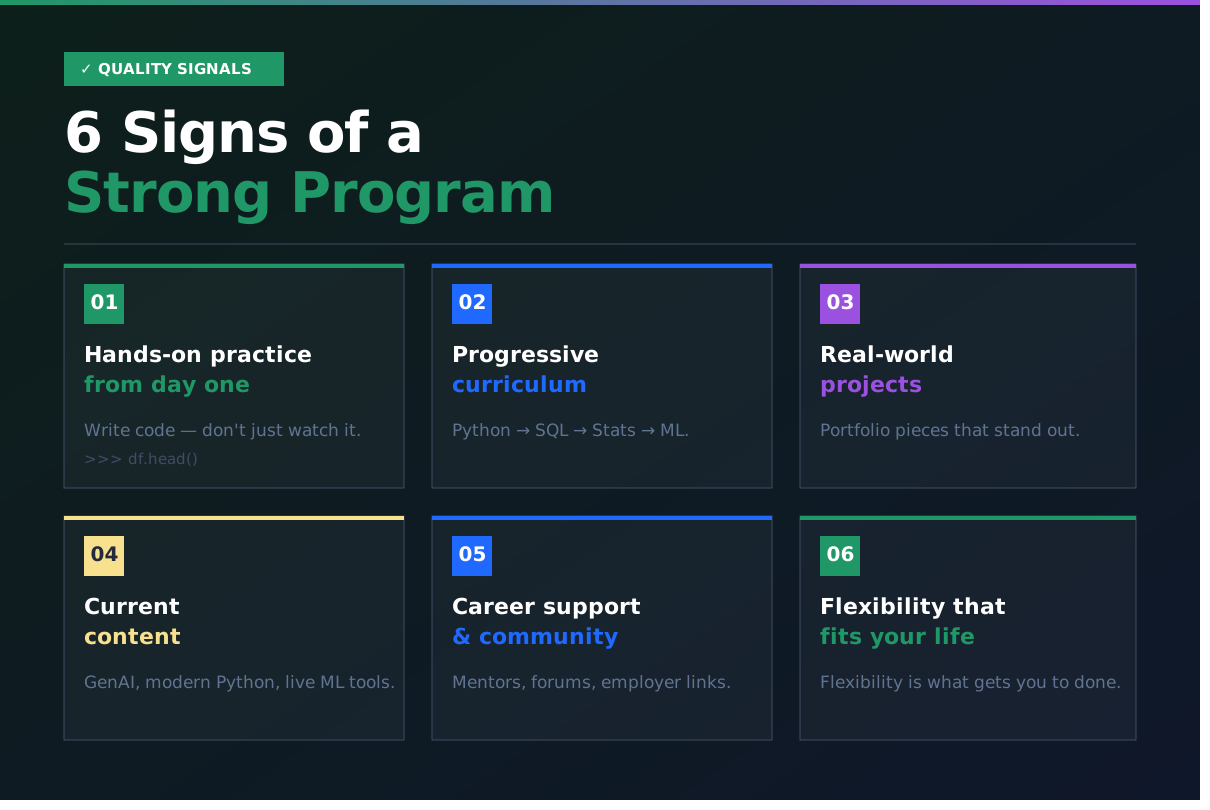
With hundreds of programs available, these are the signals that separate strong programs from mediocre ones.
Hands-on practice from day one. You should be writing code, not watching someone else write it. Look for programs where coding exercises are integrated into every lesson.
A structured, progressive curriculum. Jumping between random tutorials creates gaps. The best programs follow a deliberate sequence: programming fundamentals, data manipulation, statistics, visualization, machine learning, and projects.
Real-world projects. Your portfolio is one of the clearest ways hiring managers can evaluate your practical skills. Programs that use realistic datasets and job-relevant problems give you portfolio pieces that stand out.
Current content. A program built around outdated tools, unsupported libraries, or obsolete workflows may not prepare you well for current job expectations. Check whether the curriculum addresses current tools, including GenAI fundamentals, modern Python workflows, and machine learning frameworks that are still widely used.
Career support and community. Mentorship, peer communities, and active forums make a real difference when you hit rough patches. Some programs include job placement support, career coaching, or employer partnerships.
Flexibility that fits your life. A program requiring 60 hours a week isn't useful if you have a full-time job. Flexibility determines whether you'll actually finish.
How to Choose the Best Data Science Program for You
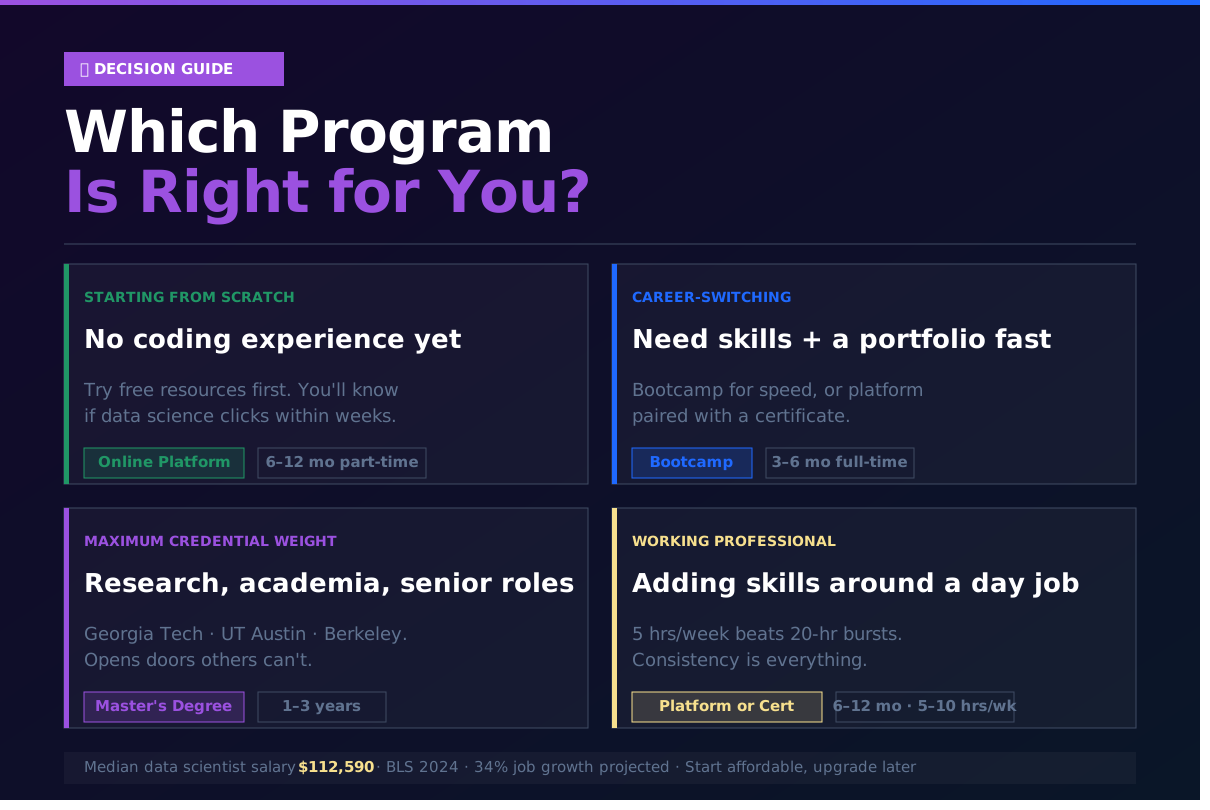
Your ideal program depends on where you are right now and where you're trying to go.
If you're starting from scratch: You don't have coding experience and you're exploring whether data science is right for you. Free resources like Dataquest's introductory content, Kaggle Learn, or SQLBolt let you try writing real code with zero commitment. You'll know within a few weeks whether data science clicks. Timeline: 6–12 months part-time to build strong foundations.
If you're career-switching: You've decided data science is where you want to go, and you need practical skills and a portfolio. A bootcamp (for speed) or an online platform paired with a certificate both work. Focus on building projects that showcase your ability to work with real data. Timeline: 3–6 months full-time or 6–12 months part-time.
If you want maximum credential weight: Some industries, including research, academia, pharmaceuticals, and large financial institutions, place significant value on formal degrees. Consider online options like Georgia Tech (~\$12,000 total), UT Austin (~\$10,000 total), or UC Berkeley (~\$70,000 total) for more flexibility at very different price points. A degree can open doors that other credentials don't, especially for senior, research-focused, or highly specialized roles. Timeline: 1–3 years.
If you're a working professional adding skills: Flexibility isn't a nice-to-have, it's a requirement. Self-paced career paths or professional certificates with asynchronous content fit around a full-time job. Consistency matters more than intensity, five hours a week sustained over six months beats a burst of 20-hour weeks followed by months of nothing. Timeline: 6–12 months at 5–10 hours per week.
A note on cost: For many entry-level roles, cheaper programs can get you to the same outcome as expensive ones, hiring managers often focus on your portfolio, practical skills, and ability to explain your work. That said, a master's from a well-regarded program can open doors to senior and research roles where credentials carry real weight. The BLS reports a median data scientist salary of \$112,590 as of May 2024, and projects 34% employment growth for data scientists from 2024 to 2034. Starting affordable and upgrading later is a perfectly valid strategy.
When You Don't Need a Data Science Program
A program isn't always the right move. You can probably skip one if:
You already work with data daily. If you write SQL at work and want to add Python, the official Python documentation, Kaggle tutorials, and targeted practice may move faster than a structured course.
You have a narrow, specific goal. Need to build one dashboard for your team? Need to automate one report? A targeted tutorial or AI-assisted pairing session may be better than a 6-month program.
You've started multiple programs and finished none. The fifth program won't fix the pattern. Pick one project, build it, learn from what broke, and iterate.
You're exploring casually. Free resources like Kaggle Learn and YouTube channels like StatQuest cover a lot of ground at zero cost. Use them to test your interest before committing money.
Your Next Step
There's no single "best" data science program. The right choice depends on your budget, timeline, career goals, and how you learn best. What successful learners have in common is that they started somewhere and stayed consistent.
If you're still weighing options, try something low-risk. Dataquest offers free introductory content across its career paths, so you can start writing Python code and working with real data today, with no commitment.
Frequently Asked Questions
What is the best program to become a data scientist?
It depends on your background, budget, and timeline. If you're starting from scratch on a limited budget, a self-paced online platform with a structured career path is a strong starting point. If you need a credential for a specific industry, a master's degree may be worth the investment. The How to Choose section breaks this down by situation.
Can I learn data science without a degree?
Yes. Some employers still list a degree as a requirement, especially for senior or research-focused roles. But many entry-level and mid-level data science positions are filled by candidates without graduate degrees, self-taught learners, bootcamp graduates, and online learners who built their skills through structured courses and projects. What matters most is demonstrated ability: a strong portfolio, practical skills, and the ability to explain your work clearly.
How long does it take to learn data science?
Full-time bootcamps typically run three to six months. Self-paced online platforms take six to twelve months at five to ten hours per week. A master's degree requires one to three years. No matter the format, consistency matters more than speed.
Is a data science bootcamp worth it?
A good bootcamp can be worth the investment, especially if you thrive in structured, high-intensity environments and want to career-switch quickly. Quality varies significantly — check student reviews, job placement rates, and curriculum depth before committing. For a detailed comparison, see our guide to the best data science bootcamps.
What skills do I need before starting a data science program?
Most beginner-friendly programs assume no prior coding experience. Basic comfort with math (algebra-level concepts) helps, but it's not strictly required. If you can think logically and practice consistently, you have what you need to start.
How much do data scientists earn?
The BLS reports a median annual salary of \$112,590 (May 2024). Glassdoor reports a U.S. average of \$155,638 when bonuses and equity are included. Senior data scientists at major tech companies regularly see total packages above \$200,000. The BLS projects 34% job growth for data scientists between 2024 and 2034.
Do I need a master's degree for data science?
Not always. Many entry-level and mid-level data science positions are filled by candidates without graduate degrees. A master's matters most for research-focused roles, positions at companies with strict credential requirements, and senior roles where theoretical depth is expected. For applied data science work, a strong portfolio and demonstrated skills often carry more weight.
